Of UELs, 1812 Vets, and Willeys

Of UELs, 1812 Vets, and Willeys

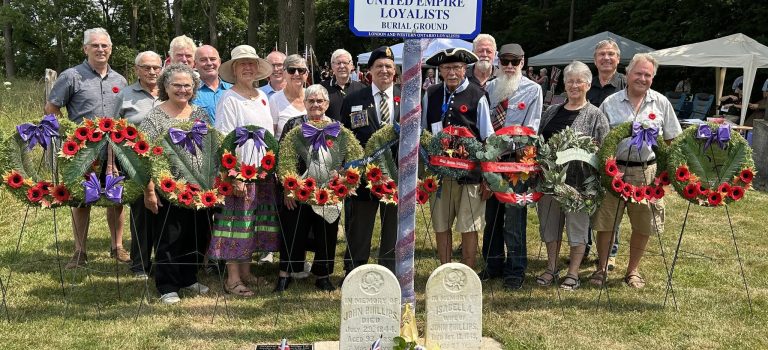
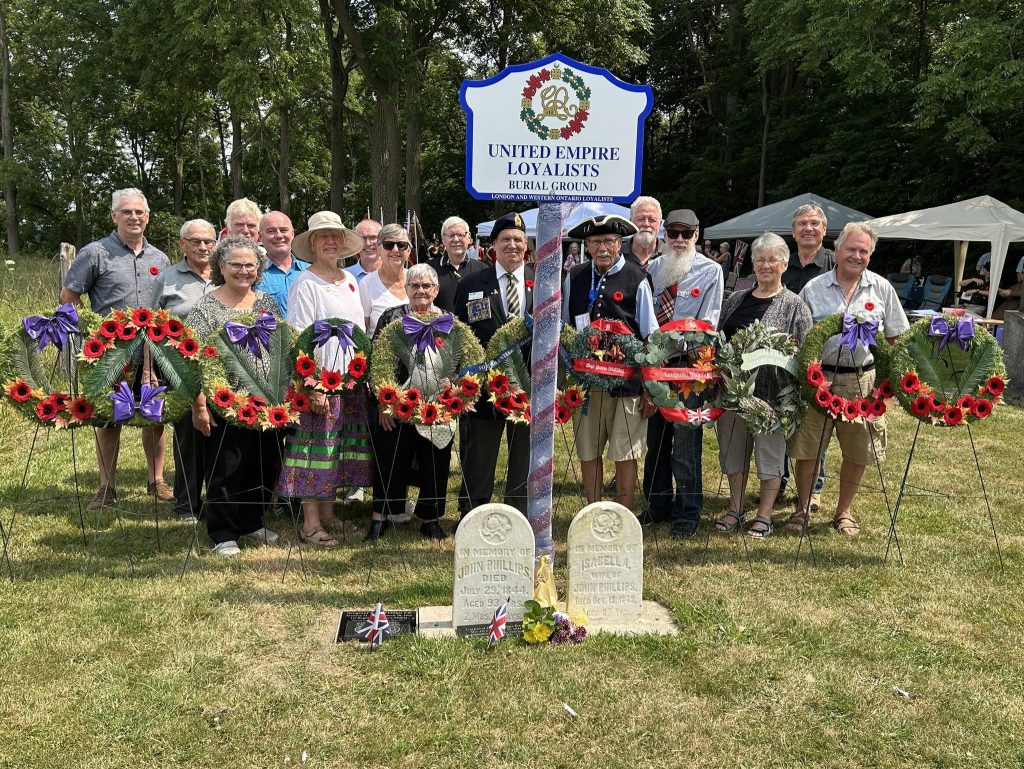
By Jennifer Grainger – On July 26, I attended the Willey Cemetery memorial service. This quiet graveyard at 5267 Gentleman Drive, just off Thames Road in the former Ekfrid Township, was busier that day than it had been in years, as it was officially dedicated as a United Empire Loyalist (UEL) Burial Ground. A War of 1812 veteran buried here was honoured at the same time. The event, sponsored by UELAC Western Ontario Branch and Glencoe & District Historical Society, reminds “Old Stock” Canadians who we are and why we’re here. 

Continue reading Jennifer’s post at her blog site: https://jennifergrainger.blogspot.com/2026/08/of-uels-1812-vets-and-willeys.html

G&DHS Members at Willey Cemetery July 2026

Mapping Our Disappearing Heritage — A Session with Evan Abma

Mapping Our Disappearing Heritage — A Session with Evan Abma

June 20, 2026 at The Archives, Glencoe: The Glencoe & District Historical Society welcomed twenty attendees for a wonderful Saturday morning session featuring guest presenter Evan Abma. The workshop was organized by Denise Corneil, Secretary of the G&DHS, who is a passionate advocate for documenting our region’s historical structures before they’re lost.

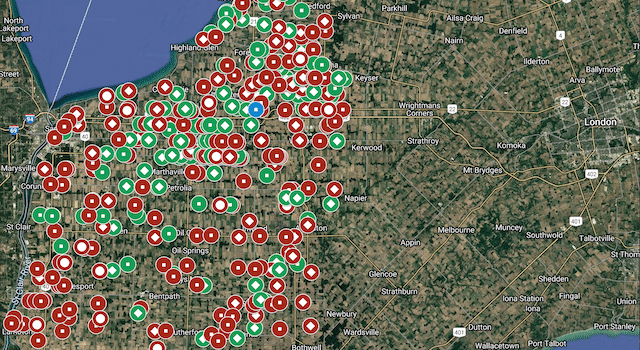
Evan, Chair of the Sarnia Heritage Committee and a leading voice in documenting Ontario’s disappearing rural heritage, shared the remarkable project he has built mapping historic farmhouses across Lambton County. Working from the observation that many homes featured in an old article on Warwick Township had since vanished, Evan’s small tracking project grew into a county-wide documentation effort. He has now catalogued 2500 historic farmhouses built in 1921 or earlier, recording their architectural styles and histories.

Read more
Stories and Song in the African Methodist Episcopal Church

Stories and Song in the African Methodist Episcopal Church

By Mary Simpson

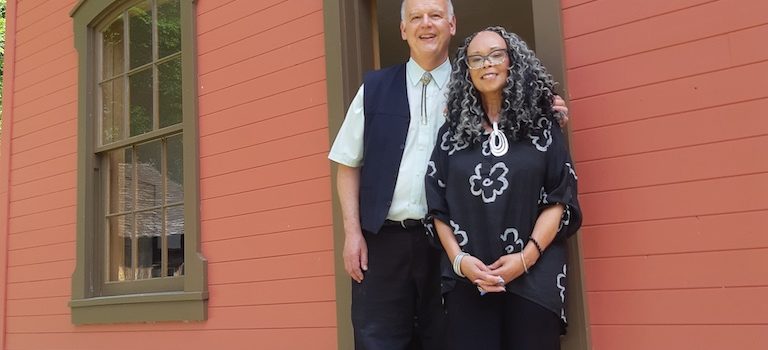
I was privileged to be in the historic African Methodist Episcopal Church at Fanshawe Pioneer Village recently, listening to two accomplished artists bring two remarkable Black Canadian lives into the light. Denise Pelley, accompanied by Stephen Holowitz, held the fifth event in the Fanshawe Village series—and what an extraordinary homecoming it was.

Not long ago, the AME Church stood on Thames Street in London, largely forgotten. Built around 1848, it had served London’s Black community as a place of worship, gathering, and resistance—a sanctuary for people who had escaped slavery and found freedom in Canada West. The plaque that marks its history tells of John Brown’s rumored visit in 1858, when the church became a space where conversations about abolition and freedom took form. For over a century after the congregation moved to a larger brick church on Grey Street, the building was someone’s home. Its original purpose faded from public memory, buried under layers of wallpaper and time.

Read more
The Ghostliest “Ghost Town” in Middlesex

The Ghostliest “Ghost Town” in Middlesex

By Jenny Grainger, Jenny’s London & Southwestern Ontario

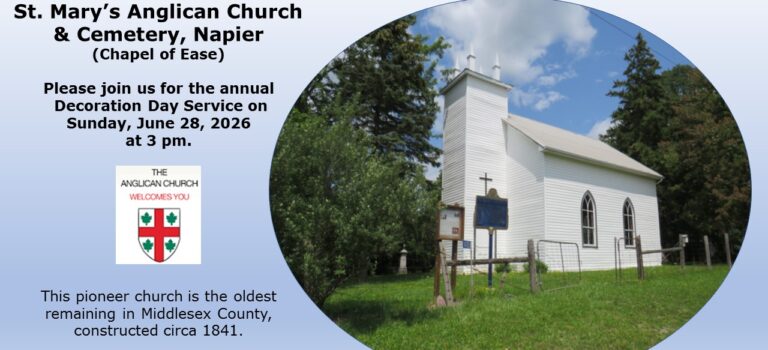
Napier: One of the first public buildings constructed in Napier was St. Mary’s Anglican Church. The land for the church, on a hill north of the village, was donated by Charles Preston. The exact construction date varies with the source, but the church was completed around 1843.

The oldest remaining church in Middlesex County, St. Mary’s Chapel of Ease holds an annual Decoration Day Service in June. It’s a day I try not to miss, since it’s an opportunity to enter a primitive pioneer building that’s usually closed. 

Read more
Vanished Villages in Western Middlesex

Vanished Villages in Western Middlesex

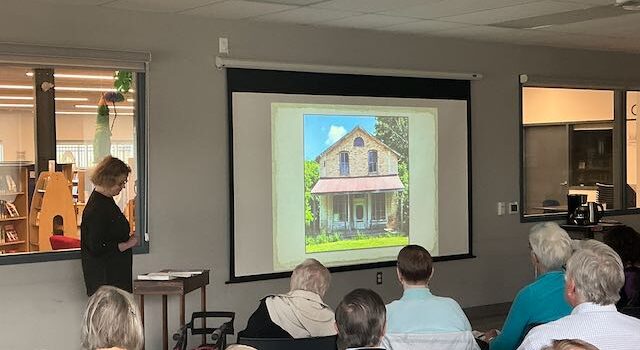
On June 18, 2026, the Glencoe Public Library was filled to capacity as 45 community members gathered to hear local historian Jennifer Grainger explore the rise and fall of Middlesex County’s vanished villages. The event was presented in partnership between the Glencoe & District Historical Society and the Glencoe Public Library.

Drawing on maps, photographs, land records, and archaeological clues, Grainger traced where these once-thriving communities were located, how historians and genealogists research them today, and what—if anything—remains visible on the landscape now. 

The G&DHS thanks the Glencoe Public Library and Courtney Joris for their partnership in bringing this event to the community, and extends its appreciation to Jennifer Grainger for sharing her research.  Here is the piece Jenny wrote for the Middlesex Banner featuring Cashmere, Napier, and Kilmartin. 

Read more
Glencoe Masons Lodge Goes Dark After 152 Years

Glencoe Masons Lodge Goes Dark After 152 Years

Written by Harold Carruthers, No. 282 Lorne Lodge Mason historian, July 2024.

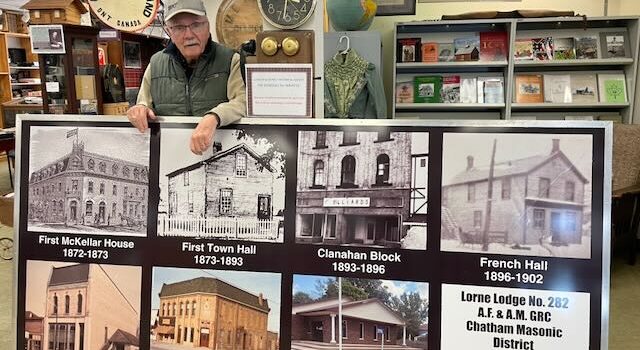
If one were to trace the history of any one Lodge, it might be compared with that of trying to determine the very origin of humanity.  I am talking about the meeting places of the members of the organization called Free Masonry. The history of our local chapter, Lorne Lodge No. 282 Glencoe, can be traced back to 1872  and ended this year 2024 when our Lodge went dark after 152 years.

Last meeting of #282 Lorne Lodge: back row L-R: Keith Dickie, Alex McLean, Ron Livingston, Harold Carruthers, Doug Reycraft. Front L-R: Bob Munroe, John Mitchell, Ryan Brubacher, Bev Whitlock, Jim May, Terry Plant. Missing: Allan Mayhew, Brad Walker, Chris Yates.

Meetings were held in some of the most historical buildings in the village of Glencoe, Middlesex County. 

Read more
The Treasured Family Archive Arrives

The Treasured Family Archive Arrives

May 12, 2026 – The Treasure Arrives

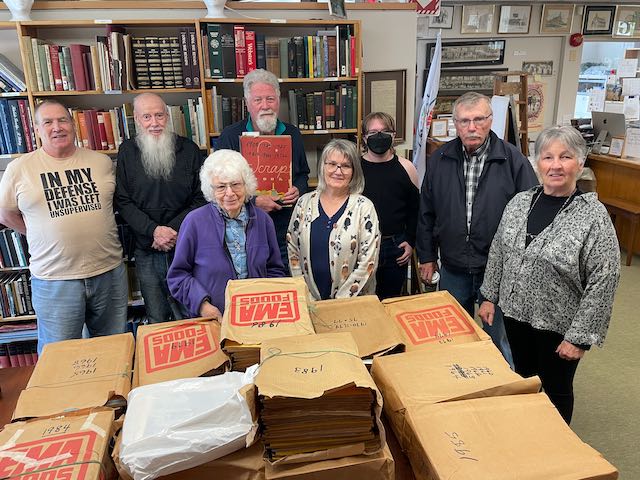
Glencoe Archives – Amy, great great granddaughter of Mrs. John “Alberta” McFarlane of R.R. #4, Appin, arrived Tuesday with her great grandmother, Caroline Gough, and grandmother, Betty Ann Gough, to deliver the Bertie Fonds. Here is Amy, a fourth year Western student headed into Library and Archive Science, descibing the significance of these scrapbooks.

This generous donation reminds us how essential it is to care for our family archives. These homegrown collections deserve professional preservation, cataloguing, and digitization so that families, genealogists, and historians alike can continue to piece together the stories that define who we are.

L-R Back – Gerry Cross, Norm McGll, Ken Beecroft, Amy, Harold Carruthers, Marilyn McCallum. L-R Front: Caroline Gough, Betty Ann Carr.

Read more
Our Local Mastodons

Our Local Mastodons

The Mayfair Mastodon

Glencoe Transcript, October 30, 1890: The bones of another Mastodon have been found on the farm of T. Jones, at. While plowing on Wednesday, the head, upper jaw, three teeth and one rib of a mastodon were ounearthed. The rib is 4 ft in length and the teeth are 3 in wide and 6 in long.. The parties are still digging, and additional discoveries are expected. 


A Bit of History about the Mosa Mastodon

… by Glennda (WATSON) Dupuis, 2024

Mr. and Mrs. Andrew Watson, along with their two sons, Edward and James, came from Ompah, Ontario (in Frontenac County in eastern Ontario) in 1919. Andrew purchased a farm on the C.P.R. Road in Mosa Township (northerly half of Lot #8, Third Concession, Mosa Township) from Mr. George Innes.

Andrew and Elizabeth resided on this farm until Andrew’s death in 1947. James purchased the farm from his mother and resided there with his wife, Dora, until 1956, when they sold and moved into the town of Glencoe. Their children were Clara, Morley, and Glenn. I am Glenn’s daughter and James’ granddaughter.

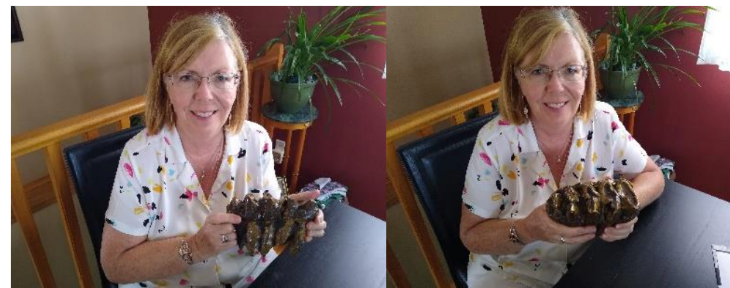
In 1939, while plowing a drained bog on his farm, James unearthed two giant teeth which were later confirmed to be those of a mastodon. Each tooth weighed approximately 4.5 lbs (just over 2 kg) and measured approximately 7.5 inches by 4 inches.

Other bones were found on the site and were described by James as being “as far round as a football.” These were believed to be leg bones. Unfortunately, not being well versed in the preservation of fossils and not truly understanding what he had discovered, the process used to unearth these other bones resulted in them falling into pieces.

Read more
Ina’s Penny Bank: A Small Object, A Larger Story

Ina’s Penny Bank: A Small Object, A Larger Story

By Mary Simpson

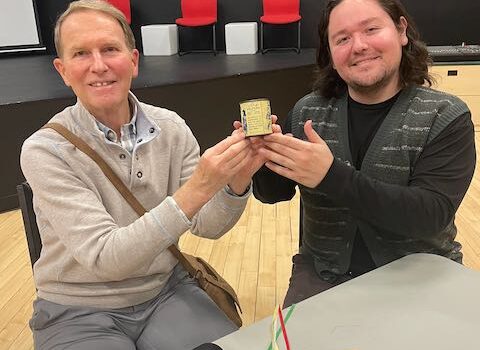
Brantford; On April 13, 2026, David Nelms and Mary Simpson travelled to Brantford, Ontario, to visit the Woodland Cultural Centre, located on the grounds of the former Mohawk Institute Residential School.

In their care was a small metal penny bank—simple in form, worn with age, and carrying with it the memory of a life.

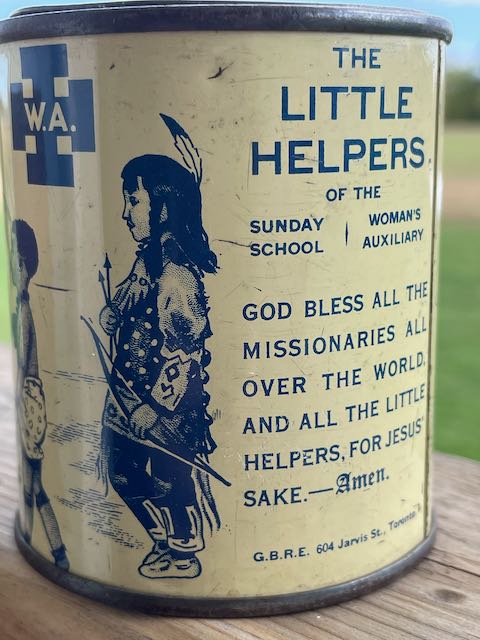
The bank belonged to Jemima “Ina” Simpson Nelms, who passed away in the summer of 2025 at just over 100 years old. As a child growing up in rural Southwestern Ontario, Ina attended St. John’s Anglican Church in Glencoe.  She received the penny tin through her Sunday School program known as “The Little Helpers.”  She would save her pennies and drop them into the slot, believing—as she had been taught—that the money would help “the little Indian children.”

Printed on the surface are images of children from around the world, as they were depicted at the time, along with a short prayer:  “God bless all the missionaries all over the world, and all the little helpers, for Jesus’ sake. Amen.”  Strangely, the handsome North American Indigenous boy is standing aloof from the group.  Jesus has his back to him and the child is not part of the group – he’s just watching.  

The Little Helpers of the Sunday School. Penny bank sponsored by the Woman’s Auxiliary of the Anglican Church of Canada. The Indian child stands apart from the group of children talking to Jesus.
Read more
My Treaty Responsibilities –

My Treaty Responsibilities –

by Mary Simpson, Old River Farm, Mosa Township, Treaty 21.

Attending Mark French’s presentation at the Glencoe and District Historical Society (18 March 2026) felt like waking up to a responsibility I had never fully acknowledged. Mark, an Elder from Deshkan Ziibiing (Chippewas of the Thames First Nation) and husband of our G&DHS treasurer Diana Jedig, spoke about treaties not as dry legal relics but as living relationships. 

As a farmer and settler whose family names – Simpson, Moorehouse, Pearce, McEachran, Stalker – are written into this land, his words left me moved. We begin meetings with a land acknowledgement, yet what follows? Learning about the treaties themselves, understanding how they were made in good faith, and recognizing the complex histories and losses Indigenous peoples have endured are our next steps. This piece is my attempt to articulate what I learned.

Mark French explains the significance of this wampum belt. March 18, 2026.
Read more

Mar 18, 2026 – Treaty 21 and the Longwoods Treaty:

A 200-Year-Old Agreement in Southwestern Ontario

Date & Time: Wednesday, March 18, 2026 – 7:00 p.m.
Location: The Archives, Glencoe
Guest Speaker: Mark French
Hosted by: Glencoe & District Historical Society

On March 9, 1819, representatives of the Chippewas of the Thames First Nation and the British Crown signed what became known as Treaty 21—the first of three written versions of the agreement now commonly called the Longwoods Treaty. This treaty set in motion a process that still shapes southwestern Ontario today.

The Longwoods Treaty covered land north of the Thames River, stretching from Strathroy and Komoka in the east to Oil Springs in the west, Bothwell in the south, and Watford in the north. While the second version (1820) repeated the same boundaries, the third version (1822) listed the land as 580,000 acres—a “rounding up” that continues to raise questions about accuracy and fairness.

Unlike earlier treaties, such as one that exchanged two million acres south of the Thames for a one-time payment of goods worth less than $5,000, Treaty 21 introduced the concept of an annuity. For the Longwoods Treaty, the Crown promised $2,400 annually, in perpetuity. While the payment is still made today, it goes into Canada’s consolidated revenue fund rather than directly to the First Nation.

Historical records also show that Indigenous leaders came to negotiations with their own vision for the future, including land for additional reserves, a blacksmith, and support for animal husbandry. Yet none of these provisions were written into the treaty.

Language and worldview also played a role in shaping outcomes. The treaty text, rooted in British legal nomenclature, could not be translated directly into Anishinaabemowin. The very concept of drawing lines on the ground to buy and sell land was foreign to the First Nations worldview, which saw the people as stewards of the land rather than owners.

As Mark French explained, Treaty 21 is more than a historical document—it is a window into the complex relationships, misunderstandings, and negotiations between Indigenous peoples and the Crown. It also raises questions about what was truly agreed to, and how responsibilities to the land continue to this day.

Mary Simpson’s piece on her Treaty Responsibilities.

For more context, you can view the official map of Ontario treaties here:
👉 Map of Ontario Treaties and Reserves.

The Royal Proclamation

The Royal Proclamation

It’s been called the Indigenous Magna Carta and the Indigenous Bill of Rights. But what exactly does that mean? In this episode Falen and Leah dive into the history of the Royal Proclamation, a document that is often spoken about when discussing the history of Canada and Indigenous land rights. But what do we really know about it? link to podcast

Incudes detail from Rick Hill about wampum belts and the canoe analogy.

Source: The Secret Life of Canada

Archibald William (A.W.) Campbell, b. May 14, 1863 in Wardsville

Archibald William (A.W.) Campbell, b. May 14, 1863 in Wardsville

By Marie Williams, for the G&DHS Facebook Page, January 9, 2026:

Among the many artifacts at the Glencoe and District Historical Society Archives are some personal items of Archibald William (A.W.) Campbell, who was born on May 14, 1863 in Wardsville.

His father had immigrated to western Upper Canada from Caithness, Scotland and his mother had been brought up on the family farm in Ekfrid Twp. The Campbells moved to the farm from Wardsville in 1864. Archibald received his early education in local schools and graduated from St. Thomas High School. He apprenticed in engineering and surveying for three years to the county engineer of Middlesex and Elgin before being commissioned as a provincial land surveyor in April 1885.

In 1888, he joined the Canadian Society of Civil Engineers and formed a private partnership, specializing in waterworks, drainage systems and bridges. In 1891 Campbell became city engineer and was a founding editor of the monthly “Municipal World” (St. Thomas). He compiled its “Engineering Section.”

Campbell was particularly interested in improved roadways and soon became recognized as a progressive advocate. “A good road-bed pays,” he wrote in May 1892. “It saves power, shortens distance and time, increases speed, insures comfort and safety, and is, in whatever way you state it, a good investment.” Public attention to roads had been eclipsed by enthusiasm for railways but, in the 1890s, the bicycle craze and the formation of the Ontario Good Roads Association spurred renewed interest. Campbell’s concern was practical: the construction and maintenance of good roads, from the farm gate to the markets and the grain elevators, meant that horses could easily pull heavier loads and that transportation costs could be lightened and consumers’ prices lowered. He was also interested in improving the professional status of engineering.

Norm McGill models Campbell’s uniform at The Archives in Glencoe.

Roadwork was the responsibility of municipalities, which in earlier deys often farmed the tasks out to influential citizens who then employed statute labour, at times resulting in shoddy standards. Campbell used the publication “Municipal World” to champion the use of trained engineers. Campbell’s advocacy led to his appointment in April of 1896 as provincial instructor in roadmaking, under the Minister of Agriculture. In 1900, he became Deputy Minister.

Read more
Journey of the Highgate Mastodon

Journey of the Highgate Mastodon

Written by Merry Helm. Reposted from the Dakota Datebook Archive. July 23, 2004. Details of the Highgate Mastodon museum tour Feb 18, 2026.

In the spring of 1890, William Regcraft found some bones while digging a ditch on his uncle’s farm, one mile from Highgate, Ontario. A hardware merchant named William Hillhouse bought the bones, and he and his uncle, John Jelly, also bought the right to continue excavating. What they found was almost an entire skeleton of an Ice-Age mastodon, relative of the modern elephant.

Read more
And then there are the Elders

And then there are the Elders

Allen Deleary of Bkejwanong (Walpole Island First Nation) speaking recently at a special Indigenous Lifeways Workshop locally. Allen shared teachings and insights from Anishinaabe traditions, exploring how Indigenous lifeways continue to guide relationships with the land, water, and one another. The evening included a community discussion, offering space for reflection, dialogue, and shared understanding:

Allen Deleary of Bkejwanong


And then there are the Elders:

Simon Winchester:

They keep a steady hand upon the tiller. That, in essence, seems to be the greatest and most enduring strength of aboriginal peoples around the world. The frantic pace of modern life, the endless bursts of technological advance, the alarums and excursions, and our various political and military adventures all come and go, but all the while and in the background, keeping their wary and watchful eyes upon us, are the wise ones…

Read more
A Canoe for His Grandfather

A Canoe for His Grandfather

By Mary Simpson with Ron McRae.

When Ron McRae first began researching how to build a cedar strip canoe, it was during the COVID outbreak and at the urging of his son, Steven. Ron had recently retired and he and his wife, Linda had purchased two plastic kayaks. They enjoyed getting out on the water, but Ron found the seating position painful on his lower back. So he began researching canoes. 

“I found Bear Mountain Boats in Peterborough,“ Ron recalls. “They sell cedar-strip canoe kits and have all these resources for amateur builders. I contacted them, hoping to register for a workshop with Ted Moores, the founder of the company and the man who wrote Canoecraft, the definitive how-to book for canoe builders. But his wife told me Ted was now in his seventies and had given up his in-person courses. She then said something that stuck with me: ‘Why don’t you buy the book, read it, and call me back if you still think you can do it?’”

So he did.

And he could.

And he did.

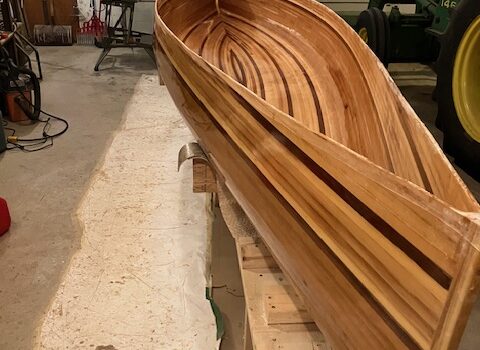
Ron ordered his first kit, which came with all the essential parts: carefully milled cedar strips in a range of colours from dark brown to nearly white, ash gunnels, deck pieces and seats and hardware. The key to a sound, straight tracking hull is the molds which shape it. Ron decided to purchase laser cut molds which were perfect, rather than risk cutting them by hand with a jigsaw. He chose a design that balanced form and function= something stable, not too long and suitable for beginners.

“I picked the Freedom 15 design,” he says. “It’s easy to paddle, good for two people or as a solo. I thought it would be a relatively easy build and perfect for novice paddlers like Linda and me.”

“I built that first canoe in about six months and really enjoyed the process. Linda and I have been exploring Southern Ontario paddling opportunities in it for the past three years and we seldom go out on the water without a comment on the beauty of our cedar strip canoe.”

Cedar strip kit – centre line hull
Read more
The Alexanders: A Migrant Story 

The Alexanders: A Migrant Story 

By Kellie Davenport 

As the agent of his excellency the Right Honourable Lord Howden, Her Majesty’s Ambassador at Madrid, I hereby certify that Mr. James Alexander has been employed as a farm manager on his Lordship’s Grimston Estate for six years.

By his own desire, he will leave this country to try his fortune in America. I have great pleasure in testifying that his conduct has always been most trustworthy, steady and exemplary in the extensive farm works carried on here. 

Also, from his good education and experience in farming, I consider him well qualified to conduct and manage any agricultural operation in all its branches.

—M. Harington, Grimston Park, Tadcaster, Yorkshire. 

Penned in 1853, this letter of reference launched the Alexander family legacy in Canada—and a long line of dedicated Ontario farmers. More than 170 years later, the Alexanders’ original crown settlement south of Melbourne, Ont. is still a working cattle farm, now into its sixth generation of the family. 

These deep agricultural roots sprouted in rural Forfarshire, Scotland, before blossoming on a Yorkshire estate owned by a British lord and later blooming across the ocean in Southwest Middlesex. The Alexander story is a true migrant tale, showcasing the upheaval, ambition, dedication and success of newcomers to Canada.  

Read more
From Yorkshire to Ekfrid and Back Again

From Yorkshire to Ekfrid and Back Again

By Kellie Davenport 

As our Uber approached the stately manor house at Grimston Park, a historic North Yorkshire estate about 25 minutes west of York, the size of the property immediately struck us. The sprawling 2,500-acre estate was a far cry from our quaint 200-acre family farm in Ekfrid Township near Melbourne, Ont. 

But surprisingly, we felt right at home. 

Along with my parents, Debbie and Alexander, we had travelled to this far-flung county to visit this rather impressive place because our ancestor James Alexander (1824-1895), my three-times great-grandfather, once lived, worked and worshipped here. (Though he likely arrived here via Scotland by horsedrawn coach, not electric car.) 

Read more
McAlpine–Smith Family Fonds

McAlpine–Smith Family Fonds

Dec 6, 2025. The Archives, Glencoe – Donation and provenance provided by Kathleen Scott, great grand daughter, St. Thomas, Ontario. Received by Mary Simpson and Norm McGill. 

This collection of items belonged to the McAlpine and Smith families of 3528 Oil Field Road, near Glencoe, Ontario. At the center of the family story is the marriage of Rebecca Smith and Alexander McAlpine, who were married on April 12, 1899. Their illustrated marriage certificate, preserved inside Alexander’s family Bible, is one of the key artifacts in this collection.

Rebecca and Alexander lived on the family farm on Oil Field Road. After Alexander’s death, the property was eventually purchased by Jim Schieman, and the McAlpine family maintained a warm friendship with the Schieman family for many years afterward. Several items in the collection reflect this long community connection.

Also included are photographs and records connected with the Zavitz, Schieman, and Peters families, who were neighbours and later stewards of the original McAlpine farm. A wedding photo of Peter Schieman’s son is part of this grouping.

Rebecca and Alexander lived on the family farm on Oil Field Road. After Alexander’s death, the property was eventually purchased by Jim Schieman, and the McAlpine family maintained a warm friendship with the Schieman family for many years afterward. Several items in the collection reflect this long community connection.

These artifacts—Bibles, hymnals, books, and photographs—together illuminate more than a century of rural family life in Southwest Middlesex, documenting marriages, migration, faith, work, and community connections passed down through generations. Thank you Heather for entrusting these treasures to the Glencoe & District Historical Society. 

Read more