The Mayfair Mastodon
Glencoe Transcript, October 30, 1890: The bones of another Mastodon have been found on the farm of T. Jones, at. While plowing on Wednesday, the head, upper jaw, three teeth and one rib of a mastodon were ounearthed. The rib is 4 ft in length and the teeth are 3 in wide and 6 in long.. The parties are still digging, and additional discoveries are expected.
A Bit of History about the Mosa Mastodon
… by Glennda (WATSON) Dupuis, 2024
Mr. and Mrs. Andrew Watson, along with their two sons, Edward and James, came from Ompah, Ontario (in Frontenac County in eastern Ontario) in 1919. Andrew purchased a farm on the C.P.R. Road in Mosa Township (northerly half of Lot #8, Third Concession, Mosa Township) from Mr. George Innes.
Andrew and Elizabeth resided on this farm until Andrew’s death in 1947. James purchased the farm from his mother and resided there with his wife, Dora, until 1956, when they sold and moved into the town of Glencoe. Their children were Clara, Morley, and Glenn. I am Glenn’s daughter and James’ granddaughter.
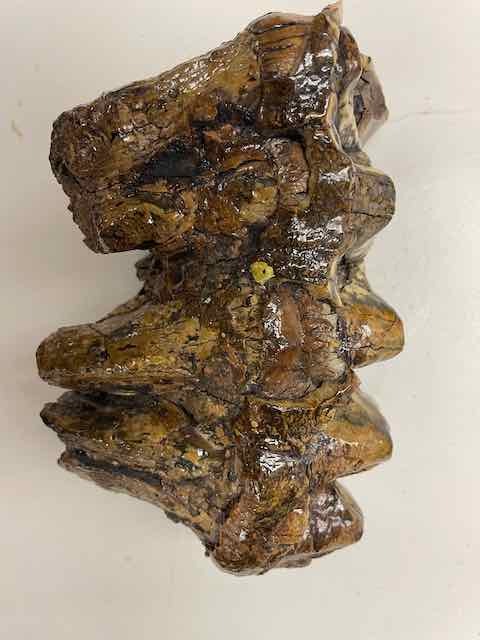
In 1939, while plowing a drained bog on his farm, James unearthed two giant teeth which were later confirmed to be those of a mastodon. Each tooth weighed approximately 4.5 lbs (just over 2 kg) and measured approximately 7.5 inches by 4 inches.
Other bones were found on the site and were described by James as being “as far round as a football.” These were believed to be leg bones. Unfortunately, not being well versed in the preservation of fossils and not truly understanding what he had discovered, the process used to unearth these other bones resulted in them falling into pieces.
Some 30 years prior, Mr. Innes (former owner of the farm) reportedly had also made some valuable discoveries in the general area, although I have no knowledge of exactly what was discovered.
Scientists from the University of Western Ontario in London came to the site, and it was reported that the two teeth were turned over to UWO to be placed in their museum. Somehow, someone decided that James would be permitted to keep one of the teeth in his possession.
Although I am not sure, I would like to assume that the young boy in the photo of the excavation site is my father. He would have been nine years old at the time.
Over the years, at least three of James’ grandchildren took the tooth to school for “show and tell.” I was one of those grandchildren. When one of my cousins asked to take the tooth to his school, of course it was turned over to him. Although I have no specific memory of the occasion, I do recall being told that he thought the tooth looked a bit “dull,” so he varnished it.
I have no idea how our branch of the family tree became the “keepers” of this treasure, but it remained in my parents’ possession and then came to me.
I consulted several experts about how we could possibly remove the varnish. I was told there were two ways: one was to dip the entire tooth into a solution that would dissolve the varnish; however, it could possibly also dissolve the tooth. The other possible solution was to use a dental pick to chip away the old varnish. I was afraid of doing more damage to the tooth, so I did nothing, and the varnish remains to this day.
After my own children had their turn to show the tooth to their classmates, I, being an Educational Assistant in Edmonton, Alberta, also had a turn to share it with my own students, after which the tooth went back into its box on a storage shelf in my basement.
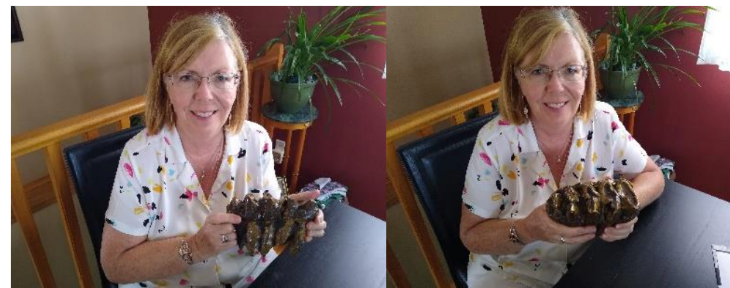
Not wanting this treasure to somehow be discarded in error when I am no longer here, I consulted with my sons, and they agreed with me that the Glencoe & District Historical Society would be the best “keeper” of this tooth.
With this decision made, in 2022 we transported the tooth, along with documentation of its finding,
The London Free Press, August 14, 1939.
FIND TEETH OF MASSIVE ANIMAL – Relics of Pre-Historic Monster Unearthed Near Glencoe
PROBABLY A MASTODON
Western University Geologists Plan To Visit Scene
GLENCOE — Interest has been aroused in the scientific implications of two giant teeth, weighing four and a half pounds each, discovered by James Watson, Glencoe district farmer, who turned them up as he was plowing a drained bog. The teeth are thought to be those of a mastodon and have been taken to the University of Western Ontario.
A “mastodon” was a mammal of the elephant family, closely allied to the “mammoth,” and existed millions of years ago from the Miocene Age to the Pleistocene Age, in company with the “stegosaurus,” the giant lizard with two brains; the “pterodactyl,” a giant flying reptile; the “brontosaurus,” a lizard whose feet alone were as big as a table; the “iguanodon,” another giant lizard with feet like a bird; the “triceras,” a great six-horned monster; the “plesiosaurus,” the “glyptodon,” and many other nightmarish monsters that roamed the earth long before the old Stone Age period before the dawn of history in the evolution of man.
Mr. Watson, a Mosa Township farmer, lives four miles northwest of Glencoe.
Each tooth weighs four and a half pounds; the grinding surface measures seven and a half inches by four inches; the depth of each crown (exclusive of the fangs) is four inches. C. G. Storer, principal of Glencoe High School, expressed the belief that the teeth were the back teeth of a mastodon.
OTHER FINDS
This is not an isolated discovery at this spot, as on several similar occasions finds have been made in this old bog, and a mastodon tusk was turned up close to the spot where these teeth were found, giving grounds for the belief that both finds may have belonged to the same creature.
Mr. Watson examined the immediate area more closely, finding traces extending some 15 or 20 feet to where he partially uncovered a huge bone, which he stated was “as far round as a football.” Unfortunately, Mr. Watson failed to remove the soil from around it before attempting to lift it, and the bone fell into pieces.
This old bog has a quicksand bottom, and there is much local speculation concerning the many types of prehistoric treasures which it may contain.
According to historians, it is believed that mastodons and other monsters of that age were finally wiped out of existence by the coming of what is spoken of as the Ice Age.
Thirty-two years ago, Mr. William Innes, a former owner of the Watson farm, also made some valuable discoveries of prehistoric relics close to the spot from which the present ones were taken from.
The two teeth unearthed last Friday have been turned over to the University of Western Ontario, London, for placing in their museum.
From further inquiries it was learned that on the slightly higher ground bordering the bog from which these relics were taken there stands the site of an early Indian encampment from which owners of the land have from time to time discovered stone hunting and skinning knives and many other early Indian relics.
Captions below photos:
Across the top are two teeth, each weighing four and a half pounds and measuring seven and a half inches across, believed to have belonged to a mastodon, dead these many centuries. They were found on a farm belonging to James Watson, Glencoe district farmer, who turned them up while plowing a drained bog. Lower left is a party making investigation of the ara where the teeth were found.
On the right is Mr. Watson, while on the centre, with the shovel, is Dr. L. W. M. Freele, former M.L.A. for South Middlesex. Others are members of Dr. Freele and Mr. Watson. Lower left is Mr. Watson holding the teeth. Western U. zoologists plan to visit the scene.
What the journalist got wrong
By Mary Simpson, April 9, 2026.
The article blends together creatures from vastly different time periods, creating a misleading picture:
- Mastodons and mammoths lived during the Cenozoic Era, specifically the Pleistocene Epoch (about 2.6 million to ~10,000 years ago).
- Dinosaurs like stegosaurus, brontosaurus, and pterodactyls lived during the Mesozoic Era — tens to hundreds of millions of years earlier.
The gap between them is enormous:
- Stegosaurus: ~150 million years ago
- Mastodon: as recent as ~10,000 years ago
That’s like saying humans lived alongside dinosaurs. By 1939, scientists understood this separation, so the journalist was either simplifying for effect or repeating outdated popular ideas.
What the article got right
- C. G. Storer (Glencoe High School principal) correctly identified the teeth as mastodon molars — excellent observation.
- Later, the article correctly places mastodons in the Ice Age context, which aligns with modern understanding.
The local educator was more scientifically accurate than the writer. Here are actual photos of the Mosa mastodon’s molar dug up in 1939.
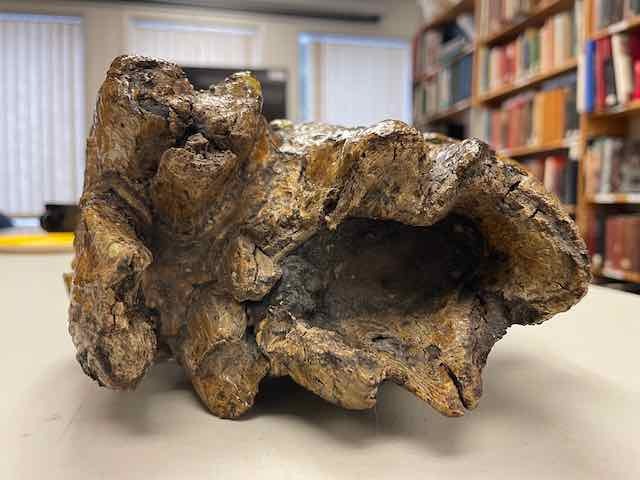
The Mosa molar held at The Archives, Glencoe, Ontario.
What mastodons actually were
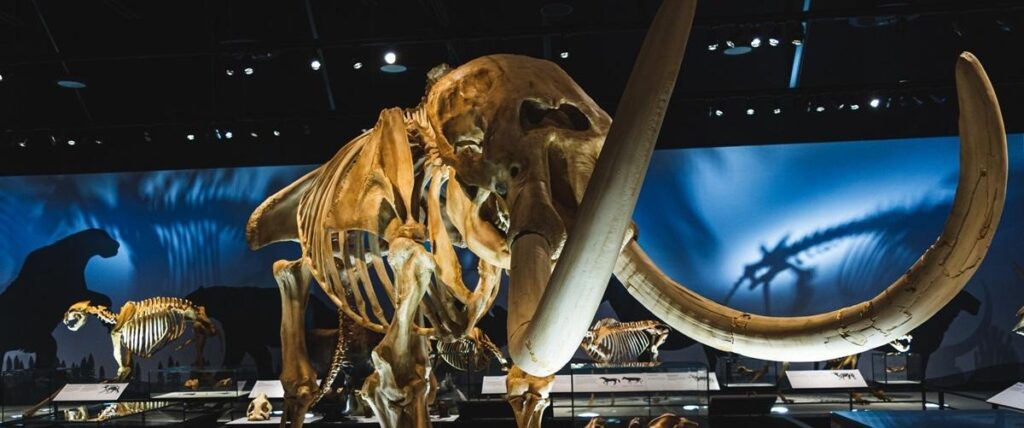
- Mastodons (genus Mammut) were relatives of elephants, but distinct from mammoths
- Lived in North America, including Ontario
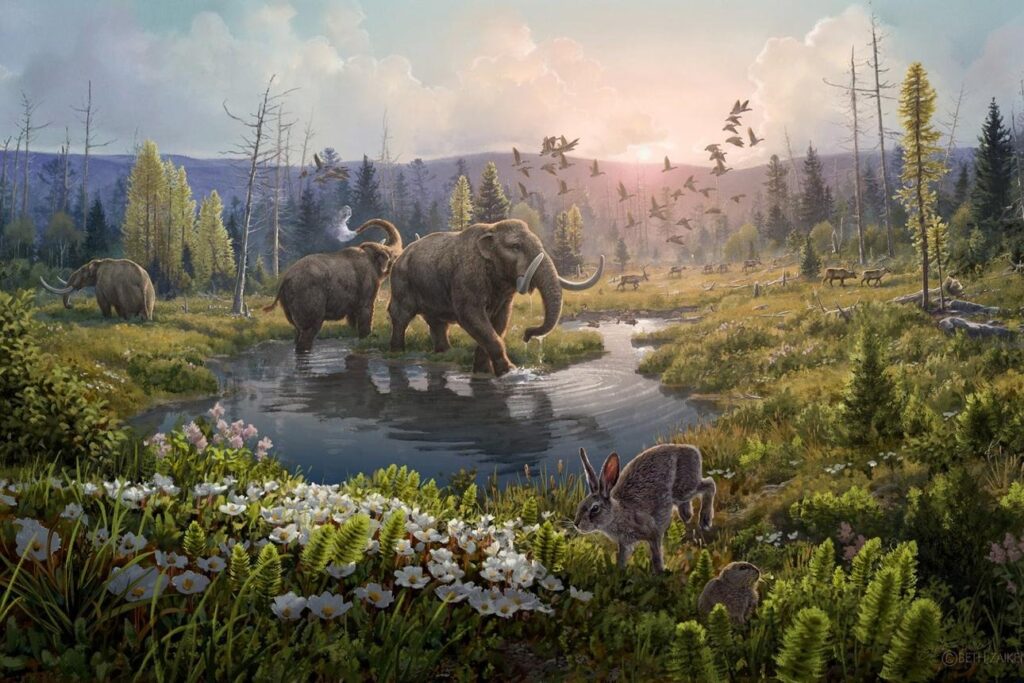
- Thrived in forested environments, not open tundra
- Their teeth were cusped (bumpy) — ideal for browsing
Diet
Unlike mammoths (grass eaters), mastodons mainly ate:
- Spruce and fir twigs
- Leaves and shrubs
- Wetland vegetation
They were essentially forest browsers, which becomes important when thinking about their extinction.
When they lived
- Appeared: ~5 million years ago
- Most common: during the Pleistocene (Ice Age)
- Disappeared: about 10,000–11,000 years ago
As you noted — this is very recent in geological time. Humans were already present.
Why mastodons disappeared
There’s no single agreed cause, but most scientists point to a combination of factors:
1. Climate change (major factor)
- The end of the Ice Age brought rapid warming
- Forest ecosystems shifted
- Spruce-dominated habitats (their preferred food source) declined in many areas
2. Human hunting (likely contributing)
- Early humans (Paleo-Indigenous peoples) were present in North America
- Evidence suggests some hunting of mastodons
- Even low levels of hunting can destabilize slow-reproducing large animals
3. Ecological stress
- Changing wetlands, vegetation, and competition
- Possible disease or cascading ecosystem effects
👉 The current thinking is “climate + humans” together, not one or the other.