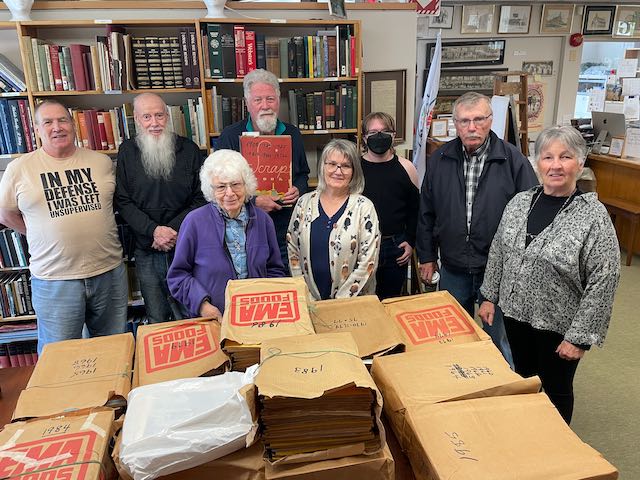
Glencoe Archives – Amy, great great granddaughter of Mrs. John “Alberta” McFarlane of R.R. #4, Appin, arrived Tuesday with her great grandmother, Caroline Gough, and grandmother, Betty Ann Gough, to deliver the Bertie Fonds. Here is Amy, a fourth year Western student headed into Library and Archive Science, descibing the significance of these scrapbooks.
This generous donation reminds us how essential it is to care for our family archives. These homegrown collections deserve professional preservation, cataloguing, and digitization so that families, genealogists, and historians alike can continue to piece together the stories that define who we are.
L-R Back – Gerry Cross, Norm McGll, Ken Beecroft, Amy, Harold Carruthers, Marilyn McCallum. L-R Front: Caroline Gough, Betty Ann Carr. Read more →
Glencoe & District Historical Society– Annual General Meeting for 2025 – 2026
President’s Report, Mary Simpson
Prepared for the AGM April 15, 2026– 7:00 p.m. Nineteen in attendance. The ARCHIVES, 178 McKellar St., Glencoe
Founded in 1978, the Glencoe & District Historical Society (G&DHS) was established to preserve and share the rich history of Southwestern Ontario, with a particular focus on the Glencoe area.
We are supported by a dedicated group of officers, directors, and managers—those remarkable volunteers who have taken on defined roles. Their commitment is the foundation of our work. General Manager Harold Carruthers and Vice President Norm McGill keep it all going, providing steady operational oversight, community presence, and mentorship to volunteers.
Mary Simpson’s report, Outgoing President
As I complete my two-year term as President, I do so with deep appreciation for the strength of this organization and the people who sustain it. I am pleased to be moving into the role of Past President, and to welcome Norm McGill as incoming President.
When I stepped into this role, I had a few simple hopes. I wanted the Historical Society to feel like a safe and welcoming place—where people could show up as themselves, and where we support each other in the work we care about. I wanted us to be inclusive, to open the door wider, and to recognize that everyone here has something valuable to contribute.
I also saw this Society as part of something bigger. Not just one organization, but part of a whole network of heritage work happening across our district—our museums, our libraries, our local historians, our community groups. Over the past couple of years, I think we’ve taken real steps toward connecting those dots, building relationships, and working more collaboratively.
At the heart of it, my goal has been to help us grow as a community-based organization—one that is rooted in the principles of community development. That means sharing leadership, supporting volunteers, encouraging initiative, and trusting people to step forward and take on meaningful roles. And we’ve seen that happen. Thank you, everyone—for your time, your energy, and your commitment to this community and its history.
This work doesn’t belong to any one person—it belongs to all of you. I’m very grateful for the chance to serve as President, and I’m looking forward to continuing in a supporting role as Past President. Norm, I know you’ll do a wonderful job, and I’m here to support you and the team however I can. – Mary Simpson
by Mary Simpson, Old River Farm, Mosa Township, Treaty 21.
Attending Mark French’s presentation at the Glencoe and District Historical Society (18 March 2026) felt like waking up to a responsibility I had never fully acknowledged. Mark, an Elder from Deshkan Ziibiing (Chippewas of the Thames First Nation) and husband of our G&DHS treasurer Diana Jedig, spoke about treaties not as dry legal relics but as living relationships.
As a farmer and settler whose family names – Simpson, Moorehouse, Pearce, McEachran, Stalker – are written into this land, his words left me moved. We begin meetings with a land acknowledgement, yet what follows? Learning about the treaties themselves, understanding how they were made in good faith, and recognizing the complex histories and losses Indigenous peoples have endured are our next steps. This piece is my attempt to articulate what I learned.
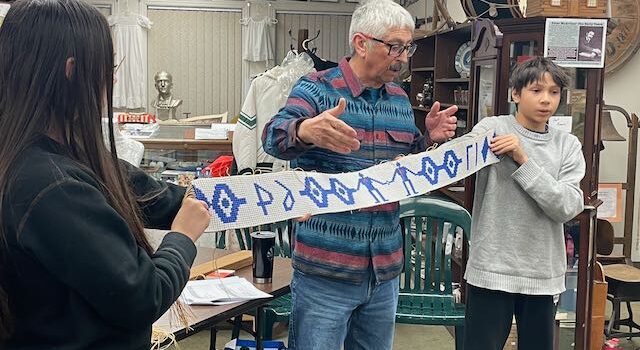
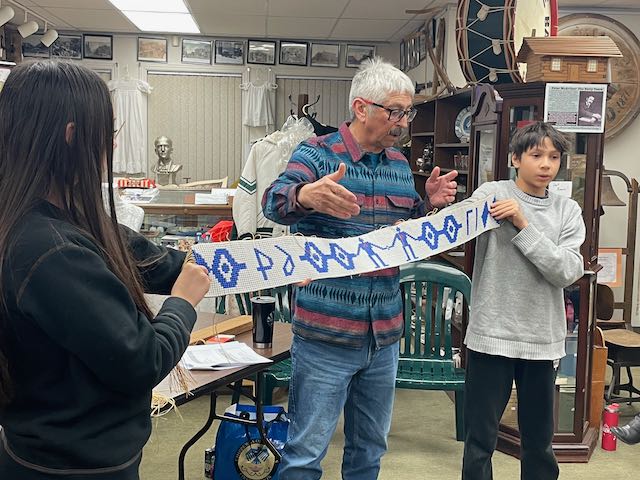
Mark French and his two grandchildren explain the significance of this wampum belt. March 19, 2026.
Treaties as Living Relationships
In Mark’s talk I learned that treaties are far more than legal documents. Indigenous peoples from this region have long understood treaties as formal agreements that create a framework for a relationship and an ongoing process for maintaining it. In Anishinaabe world views, all life is interconnected – plants, animals and other beings have spirit and agency, and humans carry reciprocal duties of care. A treaty establishes ongoing responsibilities to one another, to other beings and to the land.
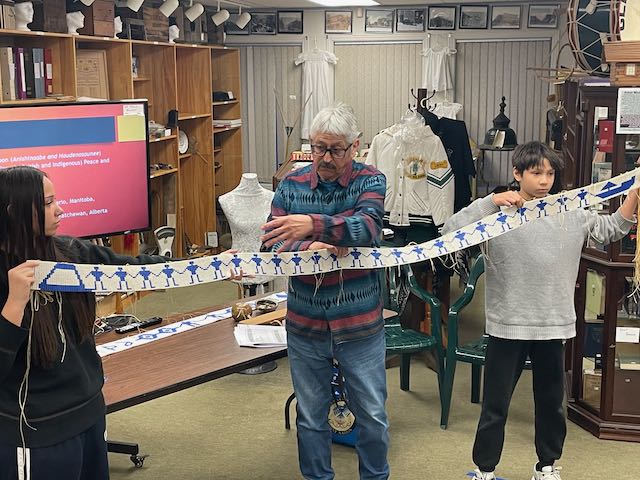
Mark showed how Wampum belts (the ones shown here were crafted by his brother) are a powerful visual record of these agreements. Wampum belts are made of purple and white shell beads woven into symbolic designs that hold the words and pledges spoken in their presence. Each belt is a living presence that connects present treaty partners with generations past. When a belt is brought out, its story and obligations are renewed. These designs were not just art – they are instructions for relationship.
The originals back in the day were painstakingly crafted from small beads laboriously carved out of quahog shells. No wonder wampum, a currency, was so highly prized. No wonder the beads manufactured in Europe were welcomed along with other technological breakthroughs – iron pots, kettles, knives, and axes.
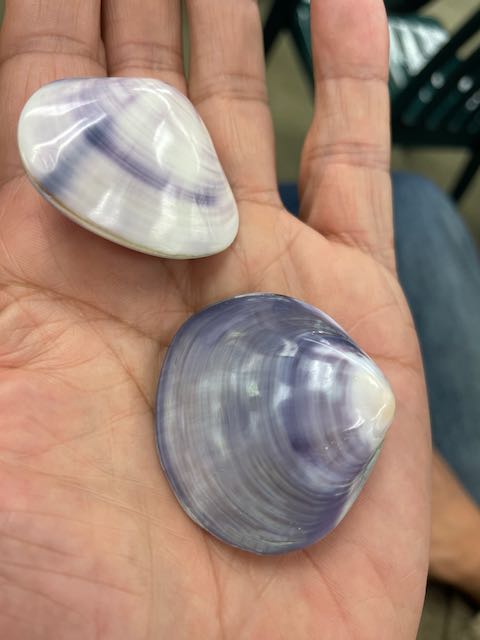
Wampum beads were crafted from purple and white quahog clam shells (Mercenaria mercenaria). They signify a sacred, living record of history, diplomacy, and spiritual beliefs for Northeast Indigenous nations. Far beyond currency, these shells symbolize peace, authority, and the interconnectedness of life, used to bind treaties, honor leaders, and preserve ancestral wisdom.
Local Treaties in Southwestern Ontario
Middlesex County rests on multiple treaties. Locally, we acknowledge that we are on the traditional lands of the Anishinaabek, Haudenosaunee, Lūnaapéewak and Attawandaron and that the area is covered by several treaties: the Two Row Wampum/Silver Covenant Chain, the Beaver Hunting Grounds (Nanfan) Treaty of 1701, the McKee Treaty of 1790, the London Township Treaty of 1796, the Huron Tract Treaty of 1827, and the Dish with One Spoon Covenant.
Responsibilities of Settlers
Settlers are treaty people. I had always thought treaty rights were something only Indigenous peoples had, but treaties are agreements that bestow rights and obligations upon both parties. Historic treaties established an ongoing relationship between settlers and First Nations where each group asserted rights and responsibilities in relation to the other. These agreements were meant to last “as long as the sun shines, the grass grows, and the river flows”, a phrase that emphasises permanence.
Being a settler treaty person means recognising both the rights granted to us and the responsibilities that accompany them.
Settler rights under treaties included freedom of religion, the right to share the land, the right to pursue agriculture and economic activities, the right to political self‑determination and the right to peace and goodwill.
These rights came with obligations: to respect Indigenous spiritual traditions, to recognise Indigenous control over reserves and resources, to honour Indigenous sovereignty and to maintain peace and goodwill.
Non‑Indigenous Canadians have a responsibility to know the treaties they are part of and the rights and responsibilities they have through them. The Indigenous Foundation notes that to honour treaty responsibilities, we must hold the Canadian government accountable when it violates treaty obligations. This means educating ourselves, insisting that governments respect treaties, and supporting Indigenous communities when they assert their rights.
Mark also spoke about how Indigenous peoples have endured broken promises, land theft, residential schools and other systemic violations despite upholding their treaty responsibilities. Settlers often colluded in these injustices by refusing to understand their own history. Recognising our own ancestors’ complicity does not condemn them but calls us to do better.
Mark explains the design and significance of the wampum – a sacred, living record of history, and diplomacy.
Being a Treaty Person: Learning and Action
KAIROS Canada summarises what it means to be a treaty person: everyone living in North America – Turtle Island – is a treaty person, and treaties are living relationships meant to guide how we live together based on mutual respect, peace and sharing. Being a treaty person brings responsibilities:
Learn the truth about the land we live on. Start by discovering whose traditional and treaty territory we reside on. Tools like Native-Land.ca can help.
Uphold the spirit and intent of the treaties. Treaties were agreements to share the land, not to surrender it. We must honour sharing and reciprocity.
Listen to and follow the leadership of First Nations. Indigenous peoples continue to uphold their side of treaty responsibilities despite systemic injustices. Our role is to support and not override their leadership.
Reject erasure, stereotypes and colonial myths. This includes challenging narratives that depict treaties as mere land sales or Indigenous peoples as obstacles to progress.
Take action towards justice and reconciliation. This might include supporting Indigenous land claims, participating in treaty education and engaging in land stewardship initiatives.
As farmers, we can also take concrete steps. In Saskatchewan, there is an interesting program called the Treaty Land Sharing Network which encourages non‑Indigenous landholders to voluntarily open their privately owned land to Indigenous peoples for cultural practices, ceremony, harvesting and gathering. This grassroots initiative recognises that treaties were meant to share land, not to exclude. By building relationships through land-sharing, the network renews treaty responsibilities and helps Indigenous land users reconnect with their traditional territories.
Reflection from a Settler Farmer
I know that the land is not something owned outright but loaned to us by previous generations and entrusted to us for future ones. I love the matriarchal reverence for ancestors, respect for elders and for the earth that nurtures us.
Coming from a long line of settlers, the McEachrans, the Pearces, Stalkers… I take pride in the hard work of my ancestors – particularly my many great grandmothers and their daughters. The grinding labour to clear fields, plant, harvest, grind grain, feed and cloth their families. But the truth is: my clans’ prosperity would not have been possible without treaties that opened land to settlement and the dispossession of Indigenous peoples. -Mary
Mark spoke about how Indigenous communities view ancestors not as distant memories but as active participants in community life, guiding decisions and reminding us of responsibilities.
I also learned that acknowledging the land is only the beginning. Many land acknowledgements emphasise gratitude and respect for the natural world, but they conclude by stressing that awareness means nothing without action and encouraging everyone to take steps toward decolonising practices. Mark challenged us to move beyond reciting acknowledgements and to engage with treaty education. Treaties involve complex histories; some include fair negotiations, while others involved coercion or misunderstanding. Many treaties were not honoured, leading to the erosion of culture, language and land.
The injustices that plagued Indigenous communities – broken treaties, residential schools, dispossession – are mirrored in today’s world where economic deals often harm those without power. As settlers’ descendants, we must see the patterns: the same disregard for human dignity continues when corporations put profit over people. When we understand that the exploitation of Indigenous peoples is part of a larger pattern of injustice, we can better align ourselves with those fighting for justice today.
Moving Forward: Commitments from the Heart
Writing this piece has prompted me to articulate personal commitments that flow from my treaty responsibilities:
Educate myself and others. I will learn about the treaties that cover the land where I live and farm. I will seek out Indigenous perspectives on these treaties, recognising that official documents often omit Indigenous voices.
Support Indigenous leadership and initiatives. When Indigenous communities call for action – whether it is opposing harmful development projects, asserting land rights or protecting water – I will listen, amplify and support them. This includes holding governments accountable for treaty obligations.
Participate in land sharing. Maybe we can create a Treaty Land Sharing Network in Ontario and open parts of our farm for Indigenous cultural practices and harvesting. Sharing the land honours the spirit of treaties and builds relationships based on reciprocity, and sounds like fun.
Challenge colonial narratives. When conversations around me diminish Indigenous rights or depict treaties as outdated, I will challenge those views. I will share what I have learned about treaties as living agreements and about our shared responsibilities.
Teach future generations. As a parent and community member, I will ensure that next gen farmers understand that they are treaty people, too. They need to know whose land they farm and the obligations that come with that privilege.
Writing from the heart means acknowledging both the pain and the hope. The pain lies in the injustices inflicted on Indigenous peoples and the realisation that my own prosperity is tied to that history. The hope lies in the possibility of renewed relationships based on honesty, respect and shared stewardship. Treaties are not relics; they are living promises.
Members of the Glencoe & District Historical Society recently joined a live online presentation by Sarah Walker on the art and practice of gathering oral histories. The session was both practical and inspiring, reminding us that capturing memories is not simply about recording sound—it is about creating space for storytelling, trust, and preservation.
We learned that an oral history interview is closer to being a thoughtful radio host or podcast interviewer than a researcher reading questions from a page. Preparation matters greatly, but so does allowing conversation to unfold naturally.
Why Oral Histories Matter
Oral histories capture:
Personal experiences not found in written records
Community traditions such as foodways, farming practices, celebrations, and daily life
Emotional tone, humour, and memory that enrich archives
Stories that might otherwise be lost within a generation
Mary Simpson’s Reflections on a Live Presentation by Sarah Walker, Head of Reference Services, North Dakota State Archives. Reference: State Archives Facebook page
When Ron McRae first began researching how to build a cedar strip canoe, it was during the COVID outbreak and at the urging of his son, Steven. Ron had recently retired and he and his wife, Linda had purchased two plastic kayaks. They enjoyed getting out on the water, but Ron found the seating position painful on his lower back. So he began researching canoes.
“I found Bear Mountain Boats in Peterborough,“ Ron recalls. “They sell cedar-strip canoe kits and have all these resources for amateur builders. I contacted them, hoping to register for a workshop with Ted Moores, the founder of the company and the man who wrote Canoecraft, the definitive how-to book for canoe builders. But his wife told me Ted was now in his seventies and had given up his in-person courses. She then said something that stuck with me: ‘Why don’t you buy the book, read it, and call me back if you still think you can do it?’”
So he did.
And he could.
And he did.
Ron ordered his first kit, which came with all the essential parts: carefully milled cedar strips in a range of colours from dark brown to nearly white, ash gunnels, deck pieces and seats and hardware. The key to a sound, straight tracking hull is the molds which shape it. Ron decided to purchase laser cut molds which were perfect, rather than risk cutting them by hand with a jigsaw. He chose a design that balanced form and function= something stable, not too long and suitable for beginners.
“I picked the Freedom 15 design,” he says. “It’s easy to paddle, good for two people or as a solo. I thought it would be a relatively easy build and perfect for novice paddlers like Linda and me.”
“I built that first canoe in about six months and really enjoyed the process. Linda and I have been exploring Southern Ontario paddling opportunities in it for the past three years and we seldom go out on the water without a comment on the beauty of our cedar strip canoe.”
A Remarkable Revival of Scots Gaelic Heritage at Tait’s Corners
Written by Trevor Aitkens | Directed by Antje Giles Performed November 15–16, 2025
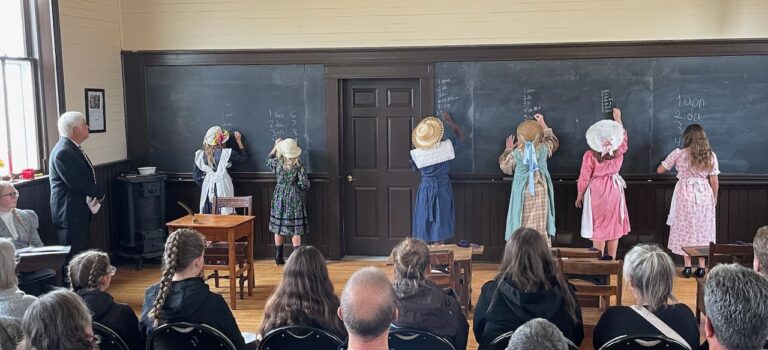
The Glencoe & District Historical Society was honoured to sponsor and support June Journey / Turas an Ògmhìos, a beautifully crafted Gaelic play written by Trevor Aitkens and hosted at the historic Tait’s Corners Schoolhouse. Over three sold-out performances on November 15–16, 2025, audiences filled the lovingly restored 1910 one-room school to experience a deeply moving, often humorous, always heartfelt return to the early school days of our region.
A Cast of 18 Bringing 1910 Back to Life
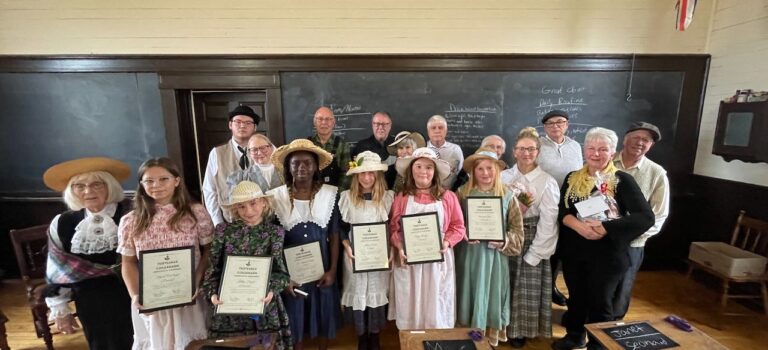
The production featured a remarkable cast of 18 local actors, intergenerational in age and representing families from across Southwest Middlesex and Strathroy-Caradoc. Their portrayals of teachers, students, elders, and neighbours transported audiences directly into a 1910 classroom at the very moment when Scots Gaelic—the language of their parents and grandparents—was slipping out of daily use.
The cast brought warmth, laughter, tenderness, and occasional heartbreak to the stage. Audience members noted that the play felt “like watching our great-grandparents speak again.”
The cast takes a bow. the students earned a certificate for their commitment to learning Gaelic and their lines.
Windows on the past Part 3 St James Anglican Church, Wardsville by Bill Simpson
St James Wardsville was torn down in 1942 after the foundations were fatally undermined by improvements to the adjoining Hagerty Road. Sadly, there are no known pictures of the interior of the church, and we have only an image of the exterior to let us know how it looked.
The design looks very similar to that of St John’s Glencoe, with the exception that the belltower is offset to the side of the entrance rather than where the entrance porch is shown. This explains how the reredos (wooden screen in the chancel) fit so snugly into the chancel at St John’s when it was moved there. (I am writing another post about this memorial reredos and altar table.)
It was noted in an Anglican News article that St James had many beautiful ornamental and memorial windows, but we have no pictures of them.
But, remarkably, a small part of one of these windows was discovered by Wilson Bowles while renovating his house on Talbot Street and was given over in to the care of Ken Willis, the Wardsville Historian. Ken speculates that this fragment was rescued by Abraham Linden, who occupied the house previously.
It was in the year 1839 that John Strachan became the first Bishop of Toronto. When he received this appointment, his diocese covered the land area now known as Southern Ontario.
The Rev John Gunne was licensed ‘To perform the office of Travelling Missionary’ by the Bishop, for the Townships of Zone, Euphemia, Brooke, Ekfrid and Mosa on June 30, 1845. On one Sunday of each month he would ride his horse from Zone Mills (Florence) which was his headquarters, to hold services in Wardsville, likely in private homes until a church building was erected.
The first official parish to be formed was Wardsville, Glencoe and Newbury, also in 1845. About the same time, land was given to the Church of England, for the purposes of a church building, by Dr. Abraham Francis. (This land, 102 acres, was on the south Part of Lot 20, Range one North of the Longwoods Road.) A parsonage was subsequently built on this property but the year is not known.
Lots 18 and 19, south of Church Street, were obtained by the Church Society of the Diocese of Toronto by a Bargain and Sale agreement with William Hatelie, et al, on August 22, 1849. This was a year or two after a wooden framed church building had already been constructed on the lot. This is known from a letter penned by Bishop Strachan on May 8, 1848, to Hatelie and the Churchwardens of the Church of Wardsville. He wrote, gentlemen: I have the honour to acknowledge your Memorial of the 2nd instant, in which you state that you have erected a church at Wardsville, Township of Mosa at considerable expense, but that since the erection of said building, you have only had divine service in it every third Sunday. This building served a congregation of approx. 150 members until the very early 1870s when it fell into disrepair.
Prepared by the Executive members for the members of G&DHS. For the AGM April 16, 2025.
Preserving Our Family Histories for Future Generations
Our ancestors—whether Indigenous, settler descendants, newer generations, or recent Canadians—have all contributed to the rich history of our communities. Each of us carries important stories that deserve to be told. Historians seek the truth, striving to understand what really happened and how people have worked together over time. We share a common past, woven together through generations. Consider this: each of us has two grandmothers, four great-grandmothers, eight great-great-grandmothers, and so on—each with their own unique stories waiting to be remembered.
Every family needs both storytellers and story keepers. The Glencoe & District Historical Society encourages families to record their histories—write down stories, label the backs of photographs, and document the details that future generations will cherish.
Some families are fortunate to collaborate with authors like CJ Frederick, who transform family histories into engaging historical novels. Others use platforms like Remento or StoryWorth to compile family memories into beautifully bound books that can be passed down for generations. Online genealogy tools such as Ancestry.ca have also made it easier than ever to trace our roots.
Many families bring their archives and precious artifacts to the Historical Society for safekeeping. In today’s digital world, we recognize what a treasure trove these collections are. While digitization allows for easy sharing, it does not guarantee long-term preservation. Whether in digital or physical form, historical records are always at risk. By working together to protect and document our shared past, we ensure that future generations will have access to the rich stories that shape our community.
These are our aims for 2024/2026:
Connect with membership and build close, working relationships with all our local groups, our regional heritage groups, and the elected reps and staff people of Southwest Middlesex and County of Middlesex.
Ramp up our outreach and channels. Mobilize an IT circle to support improved communication and decision-making.
Digitize and record our stories, curate, preserve, upload, and share. Figure out better platforms for working together. Facebook groups don’t cut it.
Learn the tools offered by dynamic governance, and the flourishing business canvas
Bring our elders and youth together. Tell all the stories. 10,000 years of local history. Place making.
Build a cultural network to link history with tourism. Nurture and support the arts in heritage and cultural communities.
Lead the interactive Barn Quilt Trail project, which features an alliance of four organizations plus FedDev Government of Canada, the funder. Link our cultural assets to local tourism strategies and investments. Work with Middlesex county tourism.
Advocate for county archives. Interpret history along the Thames river Watershed arts corridor
Invite skilled local people and support their history passions. Build teams around peoples’ interest. Assign domains. Delegate authority.
Update and revise our bylaws. Build a closer working relationship with the Ontario Historical Society.
Build out our organizational structure. We have a great foundation in our bylaws featuring managers. Build a circular hierarchy to support workers, facilitators, leaders, and admin support.
Engage the branding dream team to do an agile branding process for G&DHS, the interactive Barn Quilt Trail, and our various groups and projects that need a brand
Figure out how to tell our amazing stories, make sure they are preserved and interpret the amazing history of Ontario Southwest, that we want to share with family, friends, community, travelers, guests, youth, new, Canadians, refugees, children, all of the people that make up our Rural society people.
The Glencoe and District Historical Society welcomed members, volunteers and special guests for a Christmas open house on Thursday afternoon, December 12, 2024 to celebrate the season and the Society’s many partnerships.
Jim May and Harold Carruthers stand beside the Masons display. The Glencoe Masons ‘went dark’ in 2024.Tony Bruinink shares the story of the ‘Cookie with the Hole’ and the humble beginnings of Hollandia BakeryRead more →
For over two decades, Ken Willis has dedicated himself to preserving Wardsville’s history, curating a collection donated by residents that tells the story of Wardsville and its people. The Wardsville Museum is a cherished part of our community that houses a collection of artifacts and stories that showcase Wardsville and Mosa’s rich history. The museum depends on community support to preserve its treasures.
Ken Willis, the long-time curator of the Wardsville Museum, shares his personal story and an appeal for support.
Please denote your donation to benefit the Wardsville Museum and a tax receipt will be issued. Every dollar helps preserve Wardsville’s heritage for future generations.
Your support means the world to Ken and the entire Wardsville community. Thank you for helping us keep our history alive!
Great evening with James Carruthers, the story keeper; CJ Frederick, the story teller and author; and Patrick, the story champion. We packed the Archives and hosted a few people via zoom as well.
Stories ripple all around us, if only we’re willing to hear them. In 2012, CJ first learned of Ellwyne Ballantyne and the astonishing relationship he forged with two strangers after reading a short newspaper article about the dedication of an unusual tree to a long-dead soldier from World War One. With obligations to work and family filling her time, she wasn’t yet ready to hear his story. It took a global pandemic, with the prospect of lockdowns and unexpected forced time at home, to open her ears, mind, and heart and be ready to explore the roots of Ellwyne’s story that took place more than a century before.
August 21, 2024: Well over 100 visitors, including members of the Glencoe and District Historical Society, neighbours, community members and John Deere enthusiasts from far and wide, gathered at the home of Dave McEachren on Olde Dr. on Wednesday evening, August 21.
After self-guided tours of his outdoor displays, Dave spoke to the crowd explaining that, at age 10, he had first become involved in the Glencoe Fair farm toy competition. He recalled buying his “first toy that he didn’t play with” from Tips. Following the advice of his uncle, he chose to focus on one thing to collect and he chose John Deere. His focus grew from toys to signs, memorabilia, tractors and other equipment.
Having worked at the local John Deere dealership, Dave said he became fascinated with the history of the man named John Deere who was born in 1804. A blacksmith who found himself in debt, John Deere moved from Vermont to Illinois where he discovered and began making self-scouring steel plows in 1837. In 1847, Deere moved to Moline, Illinois where he built a factory, soon making over 100,000 plows a year. His son, Charles Deere, got his business degree and truly made the company what it is today. The business, now known world-wide, grew to produce other implements and gradually moved into making tractors in 1918.
McEachren shared the history of the company and some trivia before opening the door to his impressive indoor museum McEachren Collection at Forty-87, featuring everything from toys to John Deere literature. Historical Society past president Ken Beecroft thanked Dave for sharing the story of John Deere’s life and his fascinating collection.
The McEachren Collection @ Forty-87 ; As a 10-year old boy, Dave witnessed a few fellow neighborhood farm boys displaying their collections of farm toys at the Glencoe Fair. It was that day that he decided to stop “playing in the dirt” with his toys and start collecting them instead. More than a few decades later the dream of opening his own museum to share his ever-growing John Deere collection has come to light.
The McEachren Collection @ Forty-87 includes over 40 real tractors, thousands of farm toy models, and tens of thousands of pieces of memorabilia and sales-related literature. There will be something of interest for everyone, from local dealer history to samples of equipment you may never knew existed.
Presented to the Appin Memorial Day gathering August 1, 2000 by Jim May, whose family had a long association with Appin Cemetery. Jim’s first recollection of the cemetery was a phone call in the early 1950s: “Could my Dad come with his truck to help collect up stones for the cemetery gates?” This presentation tells the history of the Appin Cemetery, Appin, Ontario, Canada
By Bob Gentleman and Kathy Evans. Review printed with kind permission from the Middlesex Banner.
In July of this year, family and friends gathered at Arrowwood Farm, a beautiful property in Riverside, just south of Melbourne, to celebrate the publishing of a book written by my uncle, Bob Gentleman. The farm that is now called Arrowwood Farm (6460 Riverside Drive) has sentimental value to our family, as it was once owned by the Gentlemans, purchased in 1870.
Bob’s book, titled “They Settled in Riverside,” is largely a family history, documenting the arrival of our ancestors in the Riverside area and describing their family branches. But Bob also captures an era now decades past as he shares stories of early Riverside neighbours and of growing up in Melbourne in the 1930s. He recalls his paper route, the school, town merchants and businesses, the railroad, and the neighbours and friends who were important in his life.
As part of an annual commemoration of area cemeteries, Glencoe & District Historical Society (G&DHS) organized a presentation and community walk at the Appin Cemetery. Prayers, dedications, singing, and community conversation were key parts of the afternoon.
Marie Williams, Glencoe: The huge crowd that packed into the Glencoe and District Historical Society Archives on February 22 proved that the “Sage of Ekfrid” is as popular today as he was over 100 years ago. In addition to 30 viewing online, over 50 turned up in person.
Date & Venue: Wednesday, April 17th, 2024, at the Archives, 178 McKellar Street, Glencoe.
Attendance: A solid turnout of 30 members, with all executives present except President Ken Beecroft.
Opening: Vice President Mary Simpson initiated the meeting at 7:00 PM, welcoming members old and new.
Remembrance: A moment of silence was observed for the late Lorne Munro, a member for 20 years.
Business as Usual: The minutes from the previous year’s AGM for the year 2022/2023 were approved without issue, and discussions moved smoothly to current matters.
Financial Health: Treasurer Marilyn McCallum presented a detailed financial report and budget for the upcoming year, which were both accepted unanimously.
Membership Milestone: Harold Carruthers announced a record membership count, reflecting the society’s ongoing relevance.
Engaging Programs: Program Director Mary Simpson introduced upcoming events, including a talk by local author C.J. Fredericks.
Election Excitement: Nominations for the new executive team were made and approved smoothly.
Dynamic Presentations: Members shared updates on various projects, showcasing the society’s diverse activities.
Closing: The meeting concluded at 8:50 PM, setting the stage for the incoming executive team.
Report for the Glencoe & District Historical Society
Date & Venue: Wednesday, April 17th, 2024, at the Archives, 178 McKellar Street, Glencoe.
Attendance: A solid turnout of 30 members, with all executives present except President Ken Beecroft.
Opening: Vice President Mary Simpson initiated the meeting at 7:00 PM, welcoming members old and new.
Remembrance: A moment of silence was observed for the late Lorne Munro, a member for 20 years.
Business as Usual: The minutes from the previous year’s AGM were approved without issue, and discussions moved smoothly to current matters.
Financial Health: Treasurer Marilyn McCallum presented a detailed financial report and budget for the upcoming year, which were both accepted unanimously.
Membership Milestone: Harold Carruthers announced a record membership count, (over 80 members) reflecting the society’s ongoing relevance.
Engaging Programs: Program Director Mary Simpson introduced upcoming events, including a talk by local author C.J. Fredericks.
Election Excitement: Nominations for the new executive team were made and approved smoothly.
Dynamic Presentations: Members shared updates on various projects, showcasing the society’s diverse activities.
Denise Corneil reported on the alliance formed by Glencoe & District Historical Society, Creative Communities, barnquilttrails.ca, the Chippewa of the Thames cultural group, and EXAR Studios to build a story telling app to enhance the Barn Quilt Trails, a grassroots arts movement.
Harold Carruthers noted the 100th anniversary of the death of “The Sage of Ekfrid” Peter McArthur. There will be an interesting event on Father’s Day, June 16th at 1:00 p.m.
Norm McGill conducted a Show and Tell in which 8 people participated.
Closing: The meeting concluded at 8:50 PM, setting the stage for the incoming executive team.
Looking Ahead: With new leadership in place, the society is poised for another productive year.
Lorne Munro – I became interested in historical events in the 1970s. My interest grew after attending the 25th Anniversary banquet of the Glencoe & District Historical Society at the Glencoe Legion in 2003. We presently have eight family genealogy books in our home that I manage and update. Ancestry.ca has been a great help and I correspond with family members to gather information.
During my tenure as President in 2018, the Society’s collection moved from our rooms on Main Street to the old library at 178 McKellar Street, Glencoe. I have served as secretary, first vice president, president (a couple of times). I’m slowing down now, just working on Wednesday afternoons in The Archives and enjoying any other projects that come along.
Peacefully at Strathroy Middlesex General Hospital , Strathroy on Monday, March 18, 2024 William “Lorne” Munro passed away in his 91st year. Predeceased by his wife Phyllis (2023). Dear father to Janice and Tom McCallum, Susan Sinclair and Steve Schneider and Cheryl and Roy Neves. Cherished Grandpa to Matt and Becky, Kimberly and Paul, Adam and Kirissa, Andrew and Reilly, John and Stacey, Scott and Mandy, Jacob, Emily and Brandon. Great-Grandpa to Isabelle, Josephine and Elliott. Lorne will be missed by many nieces and nephews. Predeceased by his parents Neil and Florence Munro, his sister Anna and his brother Keith. Link to Photos reel