July 9, 2026 — Glencoe Public Library
Presented by Steve Robson | Model created by Steve Robson
Overview
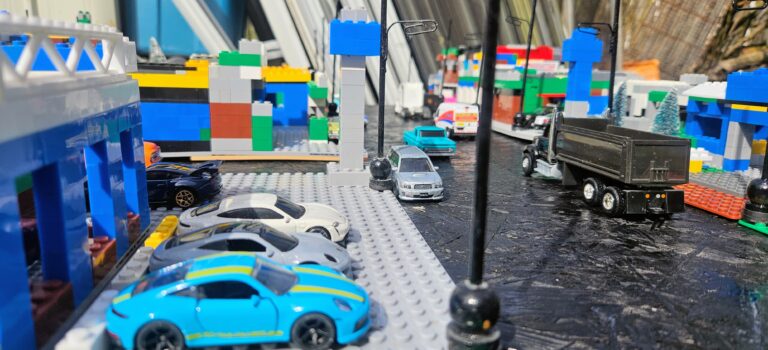
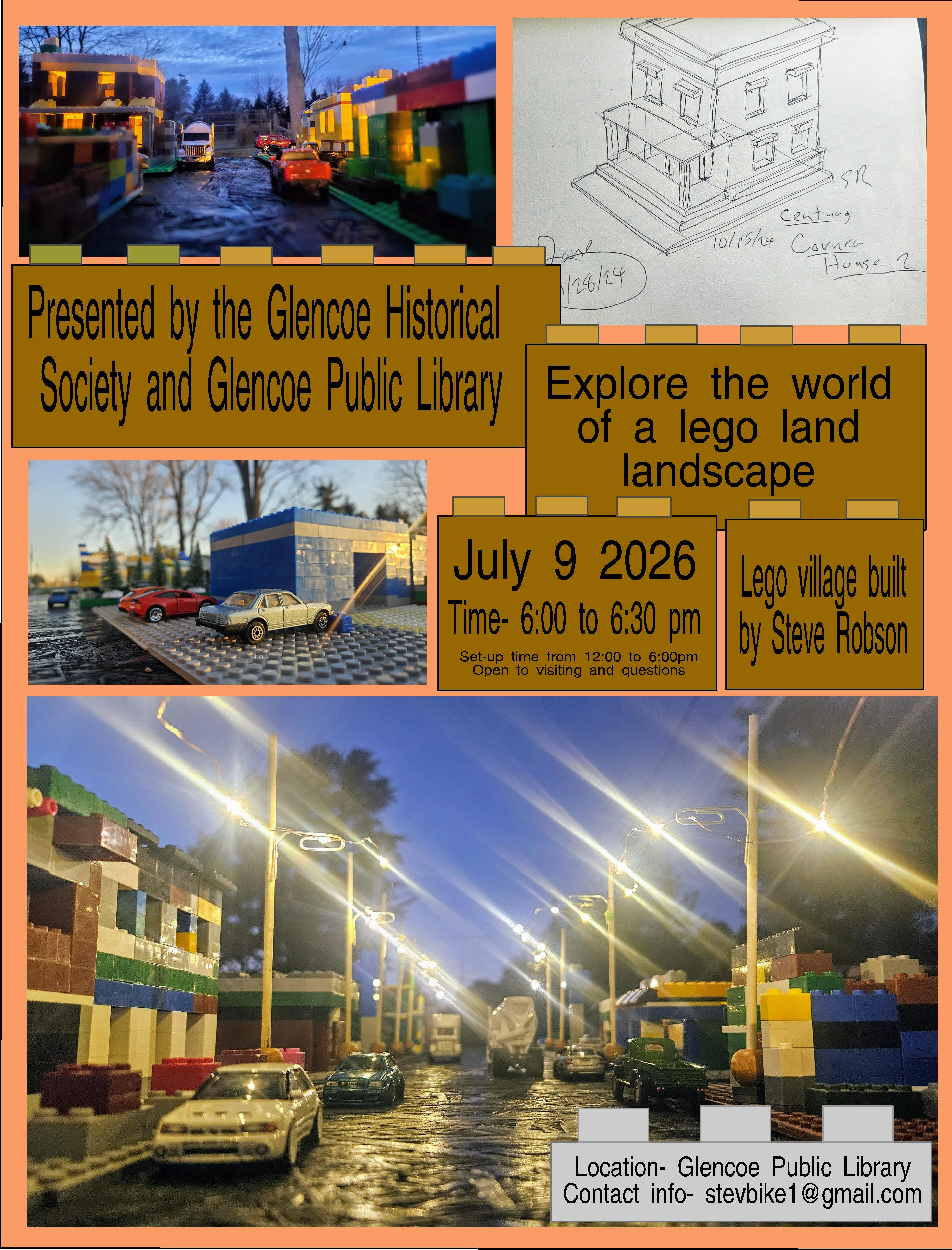
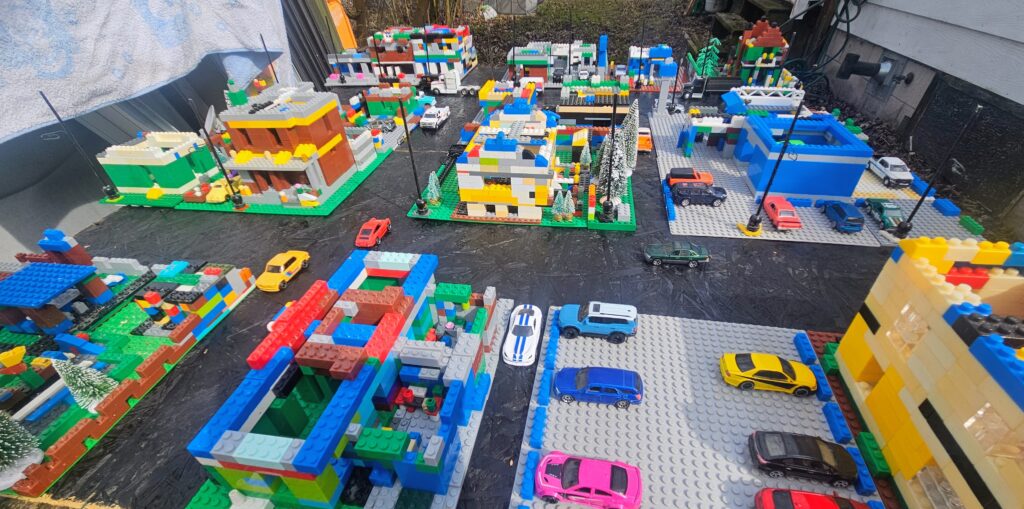
The Lego Village Project involves creating a mobile, movie-like set for photographing 1/64 scale model cars. The base of the project draws on various building designs from different towns and cities to create a fictional town. The end result is a compressed town showcasing a place with many elements of a working, living village.
How It Started
The project began with a single building structure, built simply to see how a Lego building would scale in appearance next to Hot Wheels and Matchbox cars. The test worked out well. At that point, there was no real plan to create a full village. Over time, plans developed into a complete village layout, involving a number of drawings covering both the overall plan and individual building designs. The end result is a very functional-looking village.
Setting Up the Village
Setting up the village involved several key decisions.
The first major consideration was compressing the scale of both the buildings and the space between property lines. Building scale was determined by the size of the plates the Lego design team produces. A 5″ × 5″ plate in 1/64 scale measures out to 26.5 feet. A 10″ × 10″ plate measures out to 53 feet. This is based on the 1/64 scale standard of 1″ equalling 5.3 feet.
The smaller blocks used to create walls carry a rough cost factor of about $7.00 per square foot — approximately 10 cents per block — averaging out to 70 blocks per square foot. This is based on a standard 4-stud brick.
Building height is determined by the style of the structure and its interior ceiling height. Using the 1″ = 5.3′ ratio, divide the height of a real-world measurement (for example, an 8-foot ceiling) to find the correct exterior wall height. Doors, windows, and other details follow the same method and can be made to look properly proportioned at this scale.
Some building designs are reduced further in size to allow for a tighter layout. If every building were built to fully correct scale, the village would contain only a fraction of the elements included in the current layout.
The Compressed Design
The compressed design approach allows for a modular layout that can be set up in any configuration. One of the primary reasons for this building style is to use the structures as photographic props. The slight downscaling can be minimized with this purpose in mind — a wide-angle lens creates the appearance of a larger environment than actually exists, while the remaining space still provides a believable sense of a living space.
These designs can be built at various levels of detail. Fully detailed structures work well for complete display setups, while simpler versions — recreating just home and storefront facades — make excellent display backgrounds for a die-cast car collection on a shelf, reflecting the era of the vehicle being showcased.
Colour
An important element is the use of colour in the design. A colour-coding system developed naturally during the build. Browns and greens were used in older building designs, while brighter colours go into newer structures. Combinations of these colours bridge the gap in between. Some business-themed models use colour patterns to create a corporate-looking feel.
A challenge can arise when materials run short during a build. If a strong colour theme is needed, purchase enough bricks to complete the design before starting. That said, budget is always a factor. Creative use of colour can fill out a design in interesting ways, adding a unique visual character that reflects your own vision for the scene.
Engineering the Structures
Engineering Lego structures is different from real-world construction. In effect, you are building with oversized blocks — similar in proportion to the concrete blocks used in parking lots and highway dividers. This affects the look of the finished model. Walls will be noticeably thicker, and small details will read as larger items at real-world scale. This is one of the things to accept when working with Lego as a building material.
For example, the top section of a house wall will be thicker than realistic in order to maintain structural strength. Roofs have been left off the buildings intentionally. This allows interior details to be seen and also provides a convenient pickup point when moving the buildings. The result is a slightly surreal, dream-like quality to the structures.
Keep in mind that although Lego is durable, it can break when dropped. These models should be handled like eggs — carefully.
Since these models need to travel, there is a balance to strike between detail and durability. There are limits to what can be achieved depending on the bricks being used, and some experimentation is required to find what works best for your build.
Reality vs. Illusion
One interesting question this project raises is: what is real, and what is fake?
Take a close-up photograph of the model village. The scene looks like a street, complete with cars and streetlights. At first glance, it reads as real. Only on closer inspection do the small details reveal the scale. At what point does the photo become “fake”? And yet, it isn’t truly fake — real physical objects are being used in a real scene.
This kind of setup is rooted in the practical special effects techniques of older films, and in some cases newer ones as well. It also opens a door to exploring the history of building design. An older version of a real town or city could be recreated to study its structure and character from a particular era — from a simple model to a complex and detailed layout.
Why Do This?
The last element worth considering is the reason to take on a project like this: it keeps the mind active.
Unlike AI, which is increasingly present in daily life, the process of sorting physical pieces, researching house designs, and studying architectural history creates a quiet space away from the world of technology. It can help in recreating memories of the past — either personal memories or general history from before your own time.
Building at a scale that must feel proportionally believable — using die-cast cars and trucks as reference — helps develop spatial thinking. Placing everything into a village setting helps in understanding how a working economy is structured: the business district versus the residential areas, the roadways, the flow of a community. The road of imagination is an important part of the planning process.
Hopefully, you end up with a design you are proud of.
— Steve Robson
About Steve Robson
Born in London, Ontario in 1961, Steve has spent a lifetime pursuing strong interests in photography and model building across multiple mediums. By combining these passions, he has found a unique way to recreate scenes full of personal memory and historical meaning — in three-dimensional, brick-built form. This project has transformed a long-held idea into reality, and Steve’s goal is simple: bring out the inner child in everyone as a great way to keep the mind active.
Organized by: Steve Robson & Paul Macdonald
Contact: Steve Robson, Creator | Courtney Joris, Glencoe Library