My Treaty Responsibilities –

My Treaty Responsibilities –

by Mary Simpson, Old River Farm, Mosa Township, Treaty 21.

Attending Mark French’s presentation at the Glencoe and District Historical Society (18 March 2026) felt like waking up to a responsibility I had never fully acknowledged. Mark, an Elder from Deshkan Ziibiing (Chippewas of the Thames First Nation) and husband of our G&DHS treasurer Diana Jedig, spoke about treaties not as dry legal relics but as living relationships. 

As a farmer and settler whose family names – Simpson, Moorehouse, Pearce, McEachran, Stalker – are written into this land, his words left me moved. We begin meetings with a land acknowledgement, yet what follows? Learning about the treaties themselves, understanding how they were made in good faith, and recognizing the complex histories and losses Indigenous peoples have endured are our next steps. This piece is my attempt to articulate what I learned.

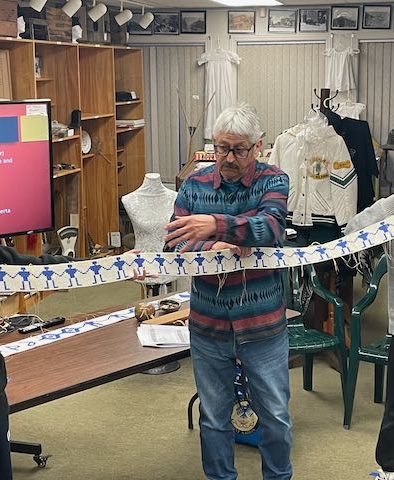
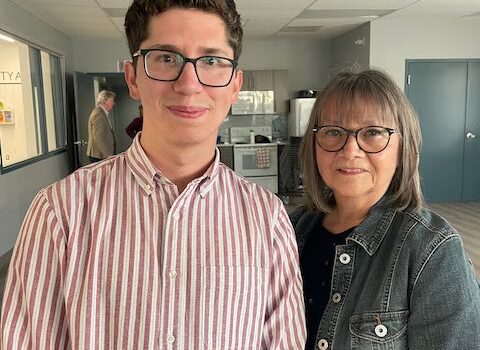
Mark French and his two grandchildren explain the significance of this wampum belt. March 19, 2026.

Treaties as Living Relationships

In Mark’s talk I learned that treaties are far more than legal documents. Indigenous peoples from this region have long understood treaties as formal agreements that create a framework for a relationship and an ongoing process for maintaining it. In Anishinaabe world views, all life is interconnected – plants, animals and other beings have spirit and agency, and humans carry reciprocal duties of care. A treaty establishes ongoing responsibilities to one another, to other beings and to the land.

Mark showed how Wampum belts (the ones shown here were crafted by his brother) are a powerful visual record of these agreements. Wampum belts are made of purple and white shell beads woven into symbolic designs that hold the words and pledges spoken in their presence. Each belt is a living presence that connects present treaty partners with generations past. When a belt is brought out, its story and obligations are renewed. These designs were not just art – they are instructions for relationship.

The originals back in the day were painstakingly crafted from small beads laboriously carved out of quahog shells.  No wonder wampum, a currency, was so highly prized.  No wonder the beads manufactured in Europe were welcomed along with other technological breakthroughs – iron pots, kettles, knives, and axes.  

Wampum beads were crafted from purple and white quahog clam shells (Mercenaria mercenaria). They signify a sacred, living record of history, diplomacy, and spiritual beliefs for Northeast Indigenous nations. Far beyond currency, these shells symbolize peace, authority, and the interconnectedness of life, used to bind treaties, honor leaders, and preserve ancestral wisdom.

Local Treaties in Southwestern Ontario

Middlesex County rests on multiple treaties. Locally, we acknowledge that we are on the traditional lands of the Anishinaabek, Haudenosaunee, Lūnaapéewak and Attawandaron and that the area is covered by several treaties: the Two Row Wampum/Silver Covenant Chain, the Beaver Hunting Grounds (Nanfan) Treaty of 1701, the McKee Treaty of 1790, the London Township Treaty of 1796, the Huron Tract Treaty of 1827, and the Dish with One Spoon Covenant

Responsibilities of Settlers

Settlers are treaty people. I had always thought treaty rights were something only Indigenous peoples had, but treaties are agreements that bestow rights and obligations upon both parties. Historic treaties established an ongoing relationship between settlers and First Nations where each group asserted rights and responsibilities in relation to the other. These agreements were meant to last “as long as the sun shines, the grass grows, and the river flows”, a phrase that emphasises permanence.

Being a settler treaty person means recognising both the rights granted to us and the responsibilities that accompany them. 

Settler rights under treaties included freedom of religion, the right to share the land, the right to pursue agriculture and economic activities, the right to political self‑determination and the right to peace and goodwill

These rights came with obligations: to respect Indigenous spiritual traditions, to recognise Indigenous control over reserves and resources, to honour Indigenous sovereignty and to maintain peace and goodwill. 

Non‑Indigenous Canadians have a responsibility to know the treaties they are part of and the rights and responsibilities they have through them. The Indigenous Foundation notes that to honour treaty responsibilities, we must hold the Canadian government accountable when it violates treaty obligations. This means educating ourselves, insisting that governments respect treaties, and supporting Indigenous communities when they assert their rights.

Mark also spoke about how Indigenous peoples have endured broken promises, land theft, residential schools and other systemic violations despite upholding their treaty responsibilities. Settlers often colluded in these injustices by refusing to understand their own history. Recognising our own ancestors’ complicity does not condemn them but calls us to do better.

Mark explains the design and significance of the wampum – a sacred, living record of history, and diplomacy.

Being a Treaty Person: Learning and Action

KAIROS Canada summarises what it means to be a treaty person: everyone living in North America – Turtle Island – is a treaty person, and treaties are living relationships meant to guide how we live together based on mutual respect, peace and sharing. Being a treaty person brings responsibilities:

  • Learn the truth about the land we live on. Start by discovering whose traditional and treaty territory we reside on. Tools like Native-Land.ca can help.
  • Uphold the spirit and intent of the treaties. Treaties were agreements to share the land, not to surrender it. We must honour sharing and reciprocity.
  • Listen to and follow the leadership of First Nations. Indigenous peoples continue to uphold their side of treaty responsibilities despite systemic injustices. Our role is to support and not override their leadership.
  • Reject erasure, stereotypes and colonial myths. This includes challenging narratives that depict treaties as mere land sales or Indigenous peoples as obstacles to progress.
  • Take action towards justice and reconciliation. This might include supporting Indigenous land claims, participating in treaty education and engaging in land stewardship initiatives.

As farmers, we can also take concrete steps. In Saskatchewan, there is an interesting program called the  Treaty Land Sharing Network which encourages non‑Indigenous landholders to voluntarily open their privately owned land to Indigenous peoples for cultural practices, ceremony, harvesting and gathering. This grassroots initiative recognises that treaties were meant to share land, not to exclude. By building relationships through land-sharing, the network renews treaty responsibilities and helps Indigenous land users reconnect with their traditional territories. 

Reflection from a Settler Farmer

I know that the land is not something owned outright but loaned to us by previous generations and entrusted to us for future ones. I love the matriarchal reverence for ancestors, respect for elders and for the earth that nurtures us.

Coming from a long line of settlers, the McEachrans, the Pearces, Stalkers…  I take pride in the hard work of my ancestors – particularly my many great grandmothers and their daughters.  The grinding labour to clear fields, plant, harvest, grind grain, feed and cloth their families.  But the truth is: my clans’ prosperity would not have been possible without treaties that opened land to settlement and the dispossession of Indigenous peoples.  -Mary

Mark spoke about how Indigenous communities view ancestors not as distant memories but as active participants in community life, guiding decisions and reminding us of responsibilities. 

I also learned that acknowledging the land is only the beginning. Many land acknowledgements emphasise gratitude and respect for the natural world, but they conclude by stressing that awareness means nothing without action and encouraging everyone to take steps toward decolonising practices. Mark challenged us to move beyond reciting acknowledgements and to engage with treaty education. Treaties involve complex histories; some include fair negotiations, while others involved coercion or misunderstanding. Many treaties were not honoured, leading to the erosion of culture, language and land.

The injustices that plagued Indigenous communities – broken treaties, residential schools, dispossession – are mirrored in today’s world where economic deals often harm those without power. As settlers’ descendants, we must see the patterns: the same disregard for human dignity continues when corporations put profit over people. When we understand that the exploitation of Indigenous peoples is part of a larger pattern of injustice, we can better align ourselves with those fighting for justice today.

Moving Forward: Commitments from the Heart

Writing this piece has prompted me to articulate personal commitments that flow from my treaty responsibilities:

  1. Educate myself and others. I will learn about the treaties that cover the land where I live and farm. I will seek out Indigenous perspectives on these treaties, recognising that official documents often omit Indigenous voices.
  2. Support Indigenous leadership and initiatives. When Indigenous communities call for action – whether it is opposing harmful development projects, asserting land rights or protecting water – I will listen, amplify and support them. This includes holding governments accountable for treaty obligations.
  3. Participate in land sharing. Maybe we can create a Treaty Land Sharing Network in Ontario and open parts of our farm for Indigenous cultural practices and harvesting. Sharing the land honours the spirit of treaties and builds relationships based on reciprocity, and sounds like fun. 
  4. Challenge colonial narratives. When conversations around me diminish Indigenous rights or depict treaties as outdated, I will challenge those views. I will share what I have learned about treaties as living agreements and about our shared responsibilities.
  5. Teach future generations. As a parent and community member, I will ensure that next gen farmers understand that they are treaty people, too. They need to know whose land they farm and the obligations that come with that privilege.

Writing from the heart means acknowledging both the pain and the hope. The pain lies in the injustices inflicted on Indigenous peoples and the realisation that my own prosperity is tied to that history. The hope lies in the possibility of renewed relationships based on honesty, respect and shared stewardship. Treaties are not relics; they are living promises

By Mary Simpson, Old River Farm, April 7, 2026

The Royal Proclamation

The Royal Proclamation

It’s been called the Indigenous Magna Carta and the Indigenous Bill of Rights. But what exactly does that mean? In this episode Falen and Leah dive into the history of the Royal Proclamation, a document that is often spoken about when discussing the history of Canada and Indigenous land rights. But what do we really know about it? link to podcast

Incudes detail from Rick Hill about wampum belts and the canoe analogy.

Source: The Secret Life of Canada

And then there are the Elders

And then there are the Elders

Allen Deleary of Bkejwanong (Walpole Island First Nation) speaking recently at a special Indigenous Lifeways Workshop locally. Allen shared teachings and insights from Anishinaabe traditions, exploring how Indigenous lifeways continue to guide relationships with the land, water, and one another. The evening included a community discussion, offering space for reflection, dialogue, and shared understanding:

Allen Deleary of Bkejwanong


And then there are the Elders:

Simon Winchester:

They keep a steady hand upon the tiller. That, in essence, seems to be the greatest and most enduring strength of aboriginal peoples around the world. The frantic pace of modern life, the endless bursts of technological advance, the alarums and excursions, and our various political and military adventures all come and go, but all the while and in the background, keeping their wary and watchful eyes upon us, are the wise ones…

Read more
Mohawk Warriors, Hunters and Chiefs

Mohawk Warriors, Hunters and Chiefs

What happens when the story gets twisted?  The story keeper and the storyteller got their wires crossed.  Bunny, the story keeper, decided to tell a different story about her son.  And the extended family all colluded. Eventually the son found out his true story – ‘the last man standing’.  Tom Wilson discovered he is a descendant of  mohawk warriors, hunters and chiefs …but he was denied the truth until he was in his 50s.  You can see his artwork at the TAP Centre of Creativity until December 21st.  Now he gets to tell his story – his story can be viewed here on film.  

Everyone has a story.  And all our stories are compelling and amazing.  Why not write yours down for your descendants?  Our children want to know about their ancestors and our ancestors want us to tell their stories. Truth preferred – the truth as we know it and have experienced it.   Story keepers and story tellers.   – Mary Simpson

Art by Tom Wilson

TAP Centre for Creativity presented Mohawk Warriors, Hunters and Chiefs, a solo exhibition of the artwork of Tom Wilson tehohåhake (two roads). Tom is a musician, writer and visual artist based in Hamilton, Ontario. Tom’s art exhibition ended December 21, 2024

Read more
Brown Tom’s School Days, 2nd Edition

Brown Tom’s School Days, 2nd Edition

Book about Life at Mt. Elgin Residential School, Chippewa of the Thames, a local Indian Residential School.

Books available for sale at The Archives or from the bookseller. University of Manitoba: https://uofmpress.ca/books/brown-toms-schooldays 

The Author: 

Reverend Enos Montour (1898-1985) was a United Church minister and writer from Six Nations of the Grand River Territory. 

Over the course of his retirement, Rev. Montour wrote a collection of stories about Mount Elgin Industrial School at the time he attended (ca.1910-1915). Mount Elgin is one the earliest United Church-run Indian Residential Schools and was located on the Chippewas of the Thames First Nation. With the help of Dr. Elizabeth Graham, Montour finished and titled his book Brown Tom’s Schooldays.

With no publisher in sight, photocopies were made and distributed to family members in the early 1980s. This important book is difficult to find today, so Professor McCallum, worked with the University of Manitoba Press,  Dr. Graham, and Montour’s two granddaughters Mary I. Anderson and Margaret Mackenzie, to issue a new edition.  
~~~~

“Trial By Fire, 1915″ – from Brown Tom’s Schooldays

By Reverend Enos Montour

Read more