June 20, 2026 at The Archives, Glencoe: The Glencoe & District Historical Society welcomed twenty attendees for a wonderful Saturday morning session featuring guest presenter Evan Abma. The workshop was organized by Denise Corneil, Secretary of the G&DHS, who is a passionate advocate for documenting our region’s historical structures before they’re lost.
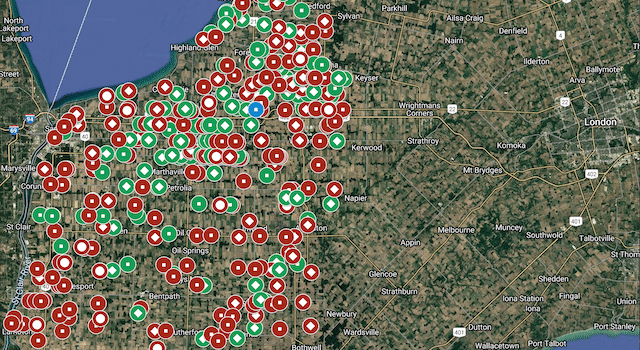
Evan, Chair of the Sarnia Heritage Committee and a leading voice in documenting Ontario’s disappearing rural heritage, shared the remarkable project he has built mapping historic farmhouses across Lambton County. Working from the observation that many homes featured in an old article on Warwick Township had since vanished, Evan’s small tracking project grew into a county-wide documentation effort. He has now catalogued 2500 historic farmhouses built in 1921 or earlier, recording their architectural styles and histories.
by Mary Simpson, Old River Farm, Mosa Township, Treaty 21.
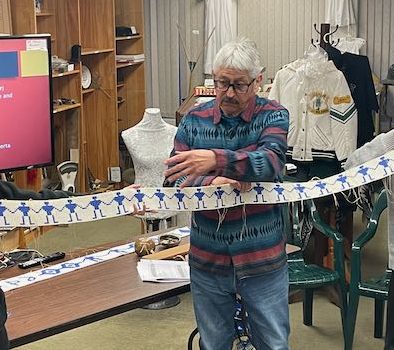
Attending Mark French’s presentation at the Glencoe and District Historical Society (18 March 2026) felt like waking up to a responsibility I had never fully acknowledged. Mark, an Elder from Deshkan Ziibiing (Chippewas of the Thames First Nation) and husband of our G&DHS treasurer Diana Jedig, spoke about treaties not as dry legal relics but as living relationships.
As a farmer and settler whose family names – Simpson, Moorehouse, Pearce, McEachran, Stalker – are written into this land, his words left me moved. We begin meetings with a land acknowledgement, yet what follows? Learning about the treaties themselves, understanding how they were made in good faith, and recognizing the complex histories and losses Indigenous peoples have endured are our next steps. This piece is my attempt to articulate what I learned.
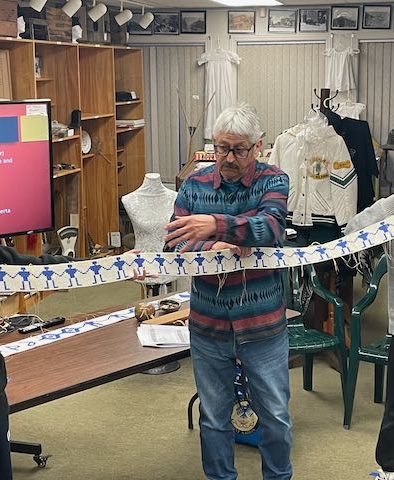
Mark French explains the significance of this wampum belt. March 18, 2026. Read more →
Among the many artifacts at the Glencoe and District Historical Society Archives are some personal items of Archibald William (A.W.) Campbell, who was born on May 14, 1863 in Wardsville.
His father had immigrated to western Upper Canada from Caithness, Scotland and his mother had been brought up on the family farm in Ekfrid Twp. The Campbells moved to the farm from Wardsville in 1864. Archibald received his early education in local schools and graduated from St. Thomas High School. He apprenticed in engineering and surveying for three years to the county engineer of Middlesex and Elgin before being commissioned as a provincial land surveyor in April 1885.
In 1888, he joined the Canadian Society of Civil Engineers and formed a private partnership, specializing in waterworks, drainage systems and bridges. In 1891 Campbell became city engineer and was a founding editor of the monthly “Municipal World” (St. Thomas). He compiled its “Engineering Section.”
Campbell was particularly interested in improved roadways and soon became recognized as a progressive advocate. “A good road-bed pays,” he wrote in May 1892. “It saves power, shortens distance and time, increases speed, insures comfort and safety, and is, in whatever way you state it, a good investment.” Public attention to roads had been eclipsed by enthusiasm for railways but, in the 1890s, the bicycle craze and the formation of the Ontario Good Roads Association spurred renewed interest. Campbell’s concern was practical: the construction and maintenance of good roads, from the farm gate to the markets and the grain elevators, meant that horses could easily pull heavier loads and that transportation costs could be lightened and consumers’ prices lowered. He was also interested in improving the professional status of engineering.
Norm McGill models Campbell’s uniform at The Archives in Glencoe.
Roadwork was the responsibility of municipalities, which in earlier deys often farmed the tasks out to influential citizens who then employed statute labour, at times resulting in shoddy standards. Campbell used the publication “Municipal World” to champion the use of trained engineers. Campbell’s advocacy led to his appointment in April of 1896 as provincial instructor in roadmaking, under the Minister of Agriculture. In 1900, he became Deputy Minister.
When Ron McRae first began researching how to build a cedar strip canoe, it was during the COVID outbreak and at the urging of his son, Steven. Ron had recently retired and he and his wife, Linda had purchased two plastic kayaks. They enjoyed getting out on the water, but Ron found the seating position painful on his lower back. So he began researching canoes.
“I found Bear Mountain Boats in Peterborough,“ Ron recalls. “They sell cedar-strip canoe kits and have all these resources for amateur builders. I contacted them, hoping to register for a workshop with Ted Moores, the founder of the company and the man who wrote Canoecraft, the definitive how-to book for canoe builders. But his wife told me Ted was now in his seventies and had given up his in-person courses. She then said something that stuck with me: ‘Why don’t you buy the book, read it, and call me back if you still think you can do it?’”
So he did.
And he could.
And he did.
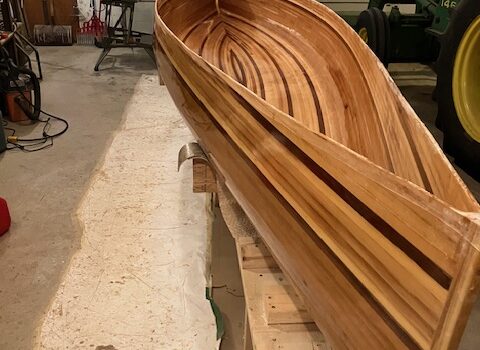
Ron ordered his first kit, which came with all the essential parts: carefully milled cedar strips in a range of colours from dark brown to nearly white, ash gunnels, deck pieces and seats and hardware. The key to a sound, straight tracking hull is the molds which shape it. Ron decided to purchase laser cut molds which were perfect, rather than risk cutting them by hand with a jigsaw. He chose a design that balanced form and function= something stable, not too long and suitable for beginners.
“I picked the Freedom 15 design,” he says. “It’s easy to paddle, good for two people or as a solo. I thought it would be a relatively easy build and perfect for novice paddlers like Linda and me.”
“I built that first canoe in about six months and really enjoyed the process. Linda and I have been exploring Southern Ontario paddling opportunities in it for the past three years and we seldom go out on the water without a comment on the beauty of our cedar strip canoe.”
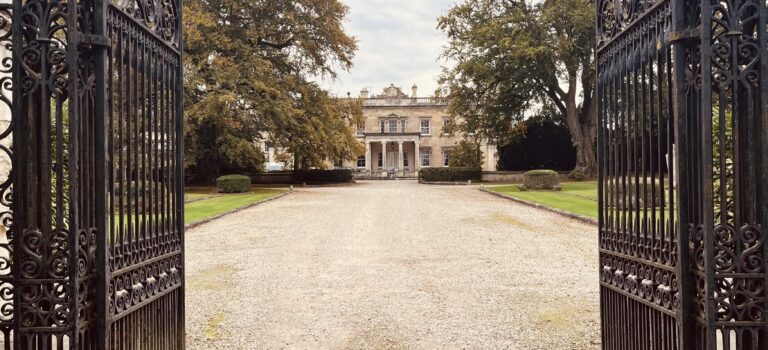
As our Uber approached the stately manor house at Grimston Park, a historic North Yorkshire estate about 25 minutes west of York, the size of the property immediately struck us. The sprawling 2,500-acre estate was a far cry from our quaint 200-acre family farm in Ekfrid Township near Melbourne, Ont.
But surprisingly, we felt right at home.
Along with my parents, Debbie and Alexander, we had travelled to this far-flung county to visit this rather impressive place because our ancestor James Alexander (1824-1895), my three-times great-grandfather, once lived, worked and worshipped here. (Though he likely arrived here via Scotland by horsedrawn coach, not electric car.)
Tracing a Journey of Faith: Author Maria Moore shares the migration history of Old Colony Mennonites and her own family’s story during a presentation hosted by the Glencoe Historical Society.
The Old Colony Mennonite story stretches across continents and centuries—a journey shaped by faith, identity, and the ongoing search for a place where religious convictions can be lived without interference. This history, and its enduring impact, was the focus of a recent presentation by author Maria Moore at the Glencoe Presbyterian Church, hosted by the Glencoe & District Historical Society.
Marie Williams: A large crowd packed into the Glencoe and District Historical Society Archives on Wednesday evening, March 12. Following announcements, a brief membership report and some unfortunate technical difficulties, Society president Mary Simpson introduced the evening’s guest speaker, Glencoe native and author Daniel Perry.
Perry spoke about his newest work, a non-fiction memoir focussed on his own research into the life of Thomas Gardiner and Gardiner’s connection to the hamlet of Cashmere in the former Township of Mosa.
Born in 1774 in Ireland, Singleton Gardiner sailed for New York State in 1804. He moved to the Talbot Settlement in 1816 and to Mosa Township in 1825. He built a mill in 1834 on the site of what became Cashmere.
His brother Thomas Gardiner, born in Ireland in 1767, sailed for New York in 1804 and arrived in Upper Canada in 1807. Perry outlined charges laid against Thomas Gardiner which were subsequently dismissed, the connections between Thomas Gardiner and John Parker Jr., tales from the War of 1812, his years serving as a teacher, disputes over land, family friction and his pleas for help as an aging man.
Singleton Gardiner was the first person buried at the Cashmere Cemetery in 1834 but there is no stone marking what could be the grave of Thomas Gardiner.
Reverend Enos Montour (1898-1985) was a United Church minister and writer from Six Nations of the Grand River Territory.
Over the course of his retirement, Rev. Montour wrote a collection of stories about Mount Elgin Industrial School at the time he attended (ca.1910-1915). Mount Elgin is one the earliest United Church-run Indian Residential Schools and was located on the Chippewas of the Thames First Nation. With the help of Dr. Elizabeth Graham, Montour finished and titled his book Brown Tom’s Schooldays.
With no publisher in sight, photocopies were made and distributed to family members in the early 1980s. This important book is difficult to find today, so Professor McCallum, worked with the University of Manitoba Press, Dr. Graham, and Montour’s two granddaughters Mary I. Anderson and Margaret Mackenzie, to issue a new edition.
As you enjoy the festivities, we invite you to support the Glencoe and District Historical Society by volunteering your time. Your participation helps us preserve and celebrate our community’s rich history.
Why Volunteer with Us?
Preserve Our Heritage: Assist with maintaining and sharing our unique local stories and artifacts.
Engage with History: Get hands-on experience with archival work, event planning, and outreach.
Connect with Community: Join a dedicated team and make meaningful connections.
How You Can Help:
Staff Our Archives: Help organize and manage historical collections.
Support Our Events: Assist with setup, coordination, and guest interactions.
Promote Our Mission: Contribute to outreach and public engagement.
Assist with Research: Aid in digitizing and cataloging historical records.
Interested in making a difference? It’s simple! Just fill out our volunteer form: bit.ly/4cVCIUw
Featured Image Above: The Crystal Palace
The Crystal Palace on the fairgrounds in Glencoe. It was home to about 50 Japanese Canadians in the summer of 1942 who were forcibly removed from their homes on the west coast. the men were paid 35 cents per hour to work on farms in the area before leaving November 11th. The building would later house prisoners of war from Germany and Italy.
Message from the Ag Society
For hundreds of years, the Glencoe Agricultural Society has hosted events, promoted new and established businesses, supporters, exhibitors and built upon Glencoe’s sense of pride and fellowship. Empowered by the incredible support of our sponsors and the exuberance of our townspeople, we look forward to continuously renewing – and building upon – our commitment to agricultural and philanthropic vitality. Throughout the year, Glencoe citizens and visitors from across the region can look forward to special events – large and small – that create the very best excuses to get out of the house and spend time with loved ones.
We always welcome feedback from our community members and monthly meetings are held to ensure we are aligning with the best interests of the people and personalities who sustain our vibrant community. The Glencoe Agricultural Society is bolstered by the thoughtfulness and dedication of our board members and volunteers as well as the continued support of our constituents. We invite you to learn more about our long, rich history and to see what exciting new initiatives we are looking forward to implementing. Should something spark your interest, please don’t hesitate to reach out to find out more about getting involved.
Marie Williams: An impressive crowd gathered for the “Haunts of Peter McArthur” road trip Sunday afternoon, June 16, starting out at what was the McArthur homestead on McArthur Rd. before moving onto the Eddie Cemetery on Glendon Dr. and finally back to the Archives in Glencoe. Two plaques were unveiled along the way as McArthur trivia and memories were shared. Both young and more established fans of the works of the “Sage of Ekfrid,” family members and historians enjoyed the afternoon which was organized by the Glencoe and District Historical Society. The Society is marking the 100th anniversary of the death of Peter McArthur in 2024. See photos on Facebook Post.
Marie Williams, Glencoe: The huge crowd that packed into the Glencoe and District Historical Society Archives on February 22 proved that the “Sage of Ekfrid” is as popular today as he was over 100 years ago. In addition to 30 viewing online, over 50 turned up in person.
February 22, 2024 – “Peter McArthur: Our Famous Canadian – 1866 – 1924”
A large crowd attended the Glencoe and District Historical Society Archives to experiencePeter McArthur, the “Sage of Ekfrid”. It would appear that McArthur is as popular today as he was over 100 years ago. In addition to 30 viewing online, over 50 turned up in person.Norm McGill welcomed guests before president Ken Beecroft made some announcements. Kosta Vaklev offered a reading by McArthur before historian Harold Carruthers described his lifelong interest in the farmer/author.
Joining from Ireland, guest speaker Stephanie McDonald, described McArthur’s life and works, focussing on the last 16 years of his life after he moved back to the home farm in Ekfrid Township. Another long- time McArthur enthusiast, Don Sinclair closed the afternoon event, speaking about his connection to McArthur through the home farm and, in particular, the demonstration woodlot where McArthur wrote about his unique appreciation for rural life and nature.
In 1908, at the age of 42, Peter McArthur returned to his family farm in Ekfrid Township with his wife and five children after living and working in Toronto, New York and London, England. For the next 16 years he wrote weekly columns in The Globe, amusing and enlightening his readers about life on a rural Ontario farm.
October 28, 2024 will mark the centenary of McArthur’s death at the age of 58 following an operation. The man dubbed the “Sage of Ekfrid”, who had the most famous farm in Canada, is now nearly forgotten. With wit and wisdom, McArthur interrogated questions that we’re still asking today – how to bridge the rural/urban divide, how to protect the natural environment, and how to spend our days and live a good life.
Stephanie McDonald grew up on a mixed farm in Ekfrid Township. She has worked as a newspaper reporter in the Canadian Arctic, and in communications, policy and administration roles in Dar es Salaam, Tanzania, Ottawa and now Dublin, Ireland. Stephanie has had articles published in various newspapers and magazines, mostly about farmers, farming, food security and the climate crisis.
Wonderful event held at the Appin Park. Forty people enjoyed the new community garden, congratulating the local team who have built the raised beds, set up a watering system, and nurtured the plants. Many thanks to our elected municipal leaders for taking the time to attend.
The highlight of the evening was listening to the stories regaled by Bonnie Sitter and Shirleyan English about the farmerettes, the teenagers that harvested Ontario crops from about 1942 – 1952.
Thank you Bonnie and Shirleyann. You have documented a wonderful part of agricultural history that otherwise would have been lost.
And here’s some links to the buzz created by the release of Onion Skins and Peach Fuzz: Memories of Ontario Farmerettes. (2019). by Shirleyan English and Bonnie Sitter
Bonnie Sitter, “Farmerettes: Get Out on the Farm” in The Rural Voice. June, 2018.
My name is Andrew McGill, I’m a young farmer and a photographer. I grew up on a farm 6 kilometres north of Glencoe, Ontario. In mid 1940 my great grandfather Fred McGill purchased a farm building which was to be moved from the site of the No. 4 Bombing and Gunnery School at Fingal Ontario. The building was dismantled and moved 45 kilometres north of Fingal to its final resting place on the McGill farm at Taits rd. Glencoe where it has sat to this day. My father and I think the building was then reassembled with a new roof sometime in 1941. The site of No. 4 B&G school sat on a swath of 724 acres of land that was returned to the crown for the purpose of building the training facility. One can imagine the numerous agricultural buildings on the land that would have had to be dismantled and moved in short order to make way for the multiple airplane hangers and triangle runway of the Fingal school.
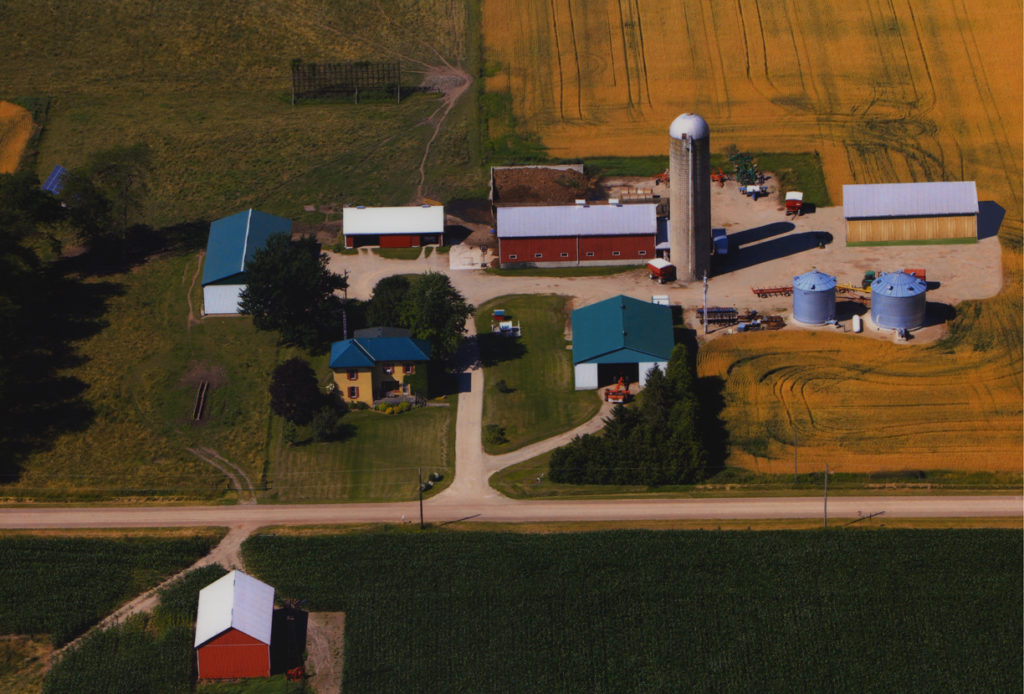
Aerial photo of the McGill farm circa 1977. The building in question can be seen directly to the left of the barn. (Photo care of McGill family Archive, 1977.)
McGill farm building moved from Fingal Bombing And Gunnery School site in 1940. (Photo: Andrew McGill. September, 2022.)
Aerial photo of the site of the Fingal Bombing and Gunnery School. (Photo: Commonwealth Air Training Plan Museum.)
Route from Fingal B&G school site to the McGill farm. (Photo: Google Maps)
Interior detail of the McGill farm building which continues to house tools and horse equipment which would have been used by the late Fred McGill circa 1940’s. (Photo: Andrew McGill, 2016.)
A restored 1942 Minneapolis Moline “Waterloo” tractor stored in the building on the McGill farms site. (Photo: Andrew McGill, 2022.)
Winifred (Eddie), Fred, and Blake McGill using their 1942 Minneapolis Moline Tractor to plant sugar beets for seed to aid the allied forces war effort. (Photo care of McGill family Archive, 1942.)
Alternate angle of Winifred (Eddie), Fred, and Blake McGill using their 1942 Minneapolis Moline Tractor to plant sugar beets for seed to aid the allied forces war effort. (Photo care of McGill family Archive, 1942.)
Clare McGill and Dorothy Brown in front of the McGill homestead with the 1942 Minneapolis Moline “Waterloo” tractor. (Photo care of McGill family Archive, 1942.)
Clare, Winifred (Eddie), and Blake McGill in front of the McGill homestead to mark the moment King George VI announced enlistment of eligible men into the military in Canada. (Photo care of McGill family Archive, 1941.)
Blake McGill standing with his newly restored 1942 Minneapolis Moline tractor on the McGill farm in 1993. (Photo care of McGill family Archive, 1993.)
Aerial photo of the McGill farm taken the year of its 100th anniversary in 2016. The relocated building can be seen clearly to the left of the barn. (Photo care of McGill family Archive, 2016.)
Dorothy (Knapp), Doug, and Ron McRae in Ilderton Ontario, 1955. During WWII, as a 13 year old, my grandmother Dorothy along with her schoolmates were tasked with finding a plant called Alder Buckthorn, which because of its consistent burn time was used to create fuses for depth charges used to sink German navy vessels. It is told that Dorothy found enough of the valuable plant for her father to pay off the mortgage of their farm. (Photo care of the McRae family Archive, 1955.)
Eric Simpson is an egg farmer on Longwoods Road who farms with his brother, Owen, his mother Vicky , wife Sarah, two boys and a couple of staff. Eric was interested in following the YouTube channels of other farmers and decided his family farm had a story to tell too.
Simpson Poultry Farms makes their own feed, so Eric’s egg farm story starts with the corn and soybeans he grows to feed his chickens. Enjoy the day with Eric.
Search through your family photos and try to find a record of the family farm, or Mother and kids at work in the garden, or photographs of the farmstead buildings. Nothing. The older the photos, the more we are interested in what we see in the background. People didn’t have the cameras to document their lives. Or if they did, they documented their trips to other places, never appreciating the value of documenting their daily work.
Today, with social media our local farmers are documenting ‘ A Day on Farm’. Check out dairy farmer and key note speaker, Andrew Campbell, and his YouTube Channel. A treasure trove of information about today’s family farm. https://www.youtube.com/channel/UCYcqz2M9zDDO0B-Ley1itkw
“I’m Andrew Campbell & we’ve milked cows on our farm for a lot of years. And we’ve done it pretty much the same way since the milking machine came along. But now with new technology on dairies around the world, we’re jumping in with both feet. Follow along as we build a brand new barn with brand new equipment – all in an effort to make the cows as comfortable as possible.”
Andrew’s Website. Andrew’s YouTube channel includes other farms he has filmed in the past.
Andrew, your community is proud of you and your family. Thanks for sharing the life of the dairy farmer. It will be interesting to see how long this historical record will last on the Internet.