A Canoe for His Grandfather

By Mary Simpson with Ron McRae.

When Ron McRae first began researching how to build a cedar strip canoe, it was during the COVID outbreak and at the urging of his son, Steven. Ron had recently retired and he and his wife, Linda had purchased two plastic kayaks. They enjoyed getting out on the water, but Ron found the seating position painful on his lower back. So he began researching canoes. 

“I found Bear Mountain Boats in Peterborough,“ Ron recalls. “They sell cedar-strip canoe kits and have all these resources for amateur builders. I contacted them, hoping to register for a workshop with Ted Moores, the founder of the company and the man who wrote Canoecraft, the definitive how-to book for canoe builders. But his wife told me Ted was now in his seventies and had given up his in-person courses. She then said something that stuck with me: ‘Why don’t you buy the book, read it, and call me back if you still think you can do it?’”

So he did.

And he could.

And he did.

Ron ordered his first kit, which came with all the essential parts: carefully milled cedar strips in a range of colours from dark brown to nearly white, ash gunnels, deck pieces and seats and hardware. The key to a sound, straight tracking hull is the molds which shape it. Ron decided to purchase laser cut molds which were perfect, rather than risk cutting them by hand with a jigsaw. He chose a design that balanced form and function= something stable, not too long and suitable for beginners.

“I picked the Freedom 15 design,” he says. “It’s easy to paddle, good for two people or as a solo. I thought it would be a relatively easy build and perfect for novice paddlers like Linda and me.”

“I built that first canoe in about six months and really enjoyed the process. Linda and I have been exploring Southern Ontario paddling opportunities in it for the past three years and we seldom go out on the water without a comment on the beauty of our cedar strip canoe.”

Cedar strip kit – centre line hull
Read more
The Alexanders: A Migrant Story 

The Alexanders: A Migrant Story 

By Kellie Davenport 

As the agent of his excellency the Right Honourable Lord Howden, Her Majesty’s Ambassador at Madrid, I hereby certify that Mr. James Alexander has been employed as a farm manager on his Lordship’s Grimston Estate for six years.

By his own desire, he will leave this country to try his fortune in America. I have great pleasure in testifying that his conduct has always been most trustworthy, steady and exemplary in the extensive farm works carried on here. 

Also, from his good education and experience in farming, I consider him well qualified to conduct and manage any agricultural operation in all its branches.

—M. Harington, Grimston Park, Tadcaster, Yorkshire. 

Penned in 1853, this letter of reference launched the Alexander family legacy in Canada—and a long line of dedicated Ontario farmers. More than 170 years later, the Alexanders’ original crown settlement south of Melbourne, Ont. is still a working cattle farm, now into its sixth generation of the family. 

These deep agricultural roots sprouted in rural Forfarshire, Scotland, before blossoming on a Yorkshire estate owned by a British lord and later blooming across the ocean in Southwest Middlesex. The Alexander story is a true migrant tale, showcasing the upheaval, ambition, dedication and success of newcomers to Canada.  

Read more
From Yorkshire to Ekfrid and Back Again

From Yorkshire to Ekfrid and Back Again

By Kellie Davenport 

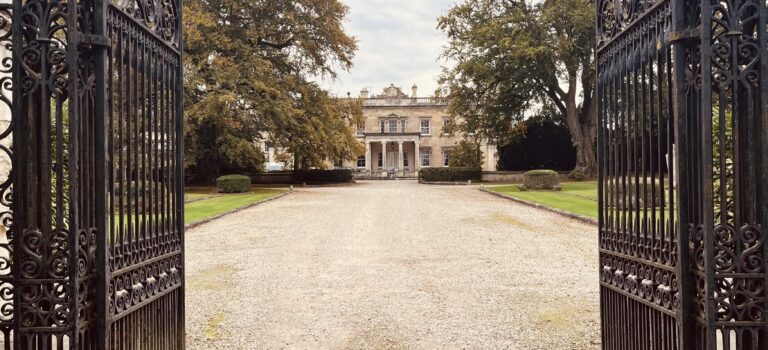
As our Uber approached the stately manor house at Grimston Park, a historic North Yorkshire estate about 25 minutes west of York, the size of the property immediately struck us. The sprawling 2,500-acre estate was a far cry from our quaint 200-acre family farm in Ekfrid Township near Melbourne, Ont. 

But surprisingly, we felt right at home. 

Along with my parents, Debbie and Alexander, we had travelled to this far-flung county to visit this rather impressive place because our ancestor James Alexander (1824-1895), my three-times great-grandfather, once lived, worked and worshipped here. (Though he likely arrived here via Scotland by horsedrawn coach, not electric car.) 

Read more
A Remarkable Revival of Scots Gaelic Heritage at Tait’s Corners

A Remarkable Revival of Scots Gaelic Heritage at Tait’s Corners

June Journey / Turas an Ògmhìos

A Remarkable Revival of Scots Gaelic Heritage at Tait’s Corners

Written by Trevor Aitkens | Directed by Antje Giles
Performed November 15–16, 2025

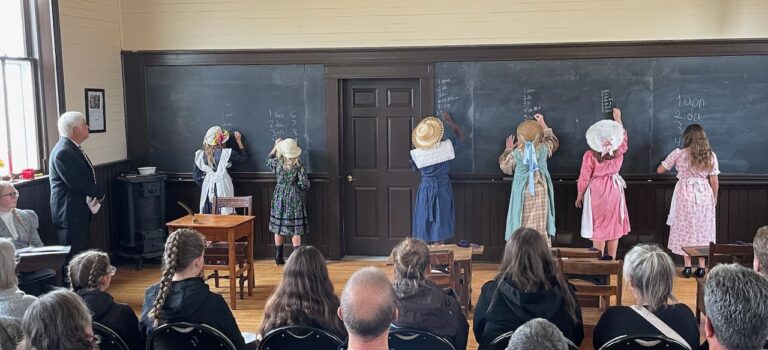
The Glencoe & District Historical Society was honoured to sponsor and support June Journey / Turas an Ògmhìos, a beautifully crafted Gaelic play written by Trevor Aitkens and hosted at the historic Tait’s Corners Schoolhouse. Over three sold-out performances on November 15–16, 2025, audiences filled the lovingly restored 1910 one-room school to experience a deeply moving, often humorous, always heartfelt return to the early school days of our region.

A Cast of 18 Bringing 1910 Back to Life

The production featured a remarkable cast of 18 local actors, intergenerational in age and representing families from across Southwest Middlesex and Strathroy-Caradoc. Their portrayals of teachers, students, elders, and neighbours transported audiences directly into a 1910 classroom at the very moment when Scots Gaelic—the language of their parents and grandparents—was slipping out of daily use.

The cast brought warmth, laughter, tenderness, and occasional heartbreak to the stage. Audience members noted that the play felt “like watching our great-grandparents speak again.”

The cast takes a bow. the students earned a certificate for their commitment to learning Gaelic and their lines.

A Story Rooted in a Lost Language

Read more
Gaelic Heritage

Gaelic Heritage

The Glencoe area was settled predominately by Scottish immigrants many of whom spoke Gaelic.

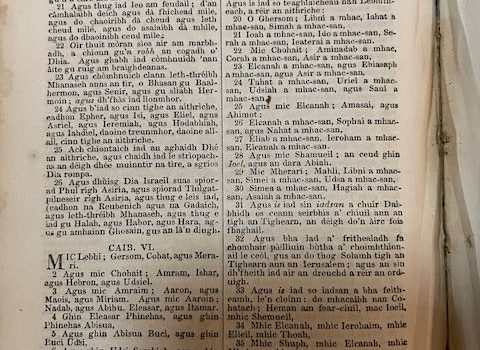
Duncan Mitchell (1838-unknown) from Metcalfe Township lived on the South 1/2 of Lot 18, Conc 13. He had this book of 41 Gaelic poems published localy in Rodney, Ontario in 1887. This book was generously donated to the Historical Society from the McAlpine family in 1986, and several poems were translated by Donald Campbell in 1999. 

D. Campbell included notes with the translation explaining that most Gaelic speakers did not learn to read and write from formal education, and that to a modern reader his spelling is very poor. He surmises that Duncan was likely quite a fluent speaker who wrote in Gaelic using what he had learned from personal study and practice. Campbell also states that he clearly used a regional dialect of Gaelic and that he was writing according to his accent, which was common. 

Druchd Na Beinne (Original Gaelic Text)
Druchd na beinne, druchd na beinne,
Druchd na beinne, o anail Chriosd,
Druchd na beinnes’s Dia bhi lienne
‘N am na gainne’s gus a chtioch.

Druchd na beinne, gu ar comhdach,
Air an lon anar bhios sin sgith;
druchd na beinne bheiradh beos dhuinn
Air an rod san tsaoghal shios.

Druchd na beinne ann’s an fhasach,
Gu ar sasachadh gu sior:
Leis an dochas chaoidh nach basaich;
Ach gu brath a mhareas fior.

Druchd na beinne ‘n am an earraich,
Gu ar tarruinn dhionnsuidh Chriosd
Druchd na beinne tha toirt barrachd:
Bheir nach fannaich sin gu sior.

Druchd na beinne tha cho beodhach,
Air na rosaibh sruthadh sios;
‘S leam bu tatneach e bhi dortadh;
Air gach neonnan buidhe blion.

Druchd na beinne ‘n am an t’samhraidh,
‘S e a b’ansuidh lainn gu fior;
Gu ar cumail dlu r’ar n’annsachd:
‘S tiormachd samhraidh orn’ a crion.

Druchd na beinne ‘n am an fhaoghair,
Gu ar cumail dlu ri Criosd;
Gu ar neartacha ‘S g’ar cobhair:
Ann’s gach obair gus a chrioch.

Druchd na beinne’n am a gheamhraidh,
‘N nar bhios teanndtachd air tir;
Druchd na beinne chum na cranndachd:
Chuir a dh’ anntaobh chaoidh gu sior.

Druchd na beinne ann’s an t’siorruitrheachd,
‘S mi nach iarradh uaith gu fior;
Ach bhi’m shuidhe’n sgail na diadhachd:
‘N glachdadh Chriosd gu suthinn sior.

The Dew of the Mountain (English Translation)
The dew of the mount, the dew of the mount,
The dew of the mount from the breath of Christ,
The dew of the mount God being with us
In the time of famine, to the end.

The dew of the mount, to cover us,
on the morass when we are tired;
dew of the mount that would enliven us
on the road in the earth below.

Dew of the mount in the wilderness,
To give us satisfaction never ending:
with the hope that will never die;
But forever will last true.

Dew of the mount in the spring time,
Drawing us toward Christ
Dew of the mountain that surpasses:
Enabling that we shall not faint ever.

Dew of the mount that is so enlivening,
On the roses dripping down;
With me would be desirable to be pouring;
On each small wilted yellow flower.

Dew of the mount during summer time,
It would be preferable to us;
to keep us close to our attachment:
while drought of summer withers us.

Dew of the mount in time of autumn,
To keep us close to Christ;
Strengthening us, relieving us:
in every toil to the end.

Dew of the mount in time of winter,
When the land is paralyzed;
Dew of the mount to put anger:
To one side always and forever.

Dew of the mount in eternity truly,
I would not desire to be without;
But that I’d be sitting in the shadow of God:
in the everlasting embrace of Christ.

Burns Presbyterian Church Mosa Celebrates 190 Years

Burns Presbyterian Church Mosa Celebrates 190 Years

Stories about the Kilmartin community who established Burns Presbyterian Church in the hills of North Mosa.  

Jennifer Grainger reporting from Mosa Township: On Sunday, March 30 at 2:00 pm I attended a rare event, an historic church celebrating an anniversary. At a time when many rural churches are closing, it’s a pleasure to see one commemorating the 190th anniversary of the congregation. 

The March 30th event wasn’t an actual church service, mind you, but a celebration of the surrounding community and the role Burns Presbyterian played in it. The occasion, more historical than religious, was entitled “A Stroll Through Time.” Actors portrayed fictional, but plausible, characters from the church’s past, including an early Scottish settler, a later Dutch arrival, the last Precentor, a member of the women’s auxiliary, etc. Sometimes amusing and often poignant, the stories of former congregants were well written and allowed the modern audience to imagine life in Middlesex County, Ontario in the Good Old Days. 

Read More