I am at a bit of a disadvantage writing about a man I never met. Those who remember him will each have their personal remembrances, that I know nothing about, but wish I did.
I have a hard time using the term “Grandfather” to describe this man. The name “Bill” comes easier and I will use it as I relate information about him. To a lot of people, Bill Edwards was “Stubbles from the Farm” in the person of “Claud Hopper” the central character in this farm based series.
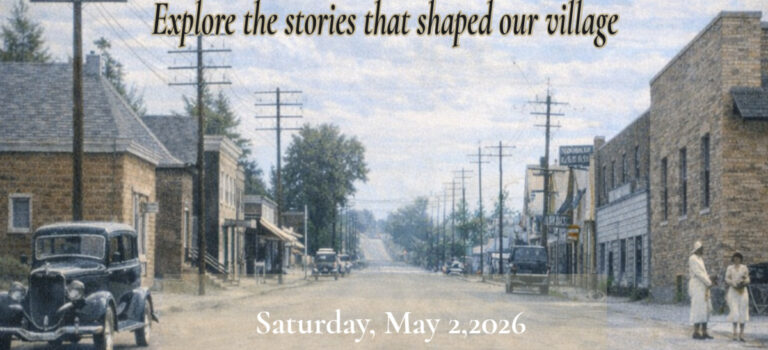
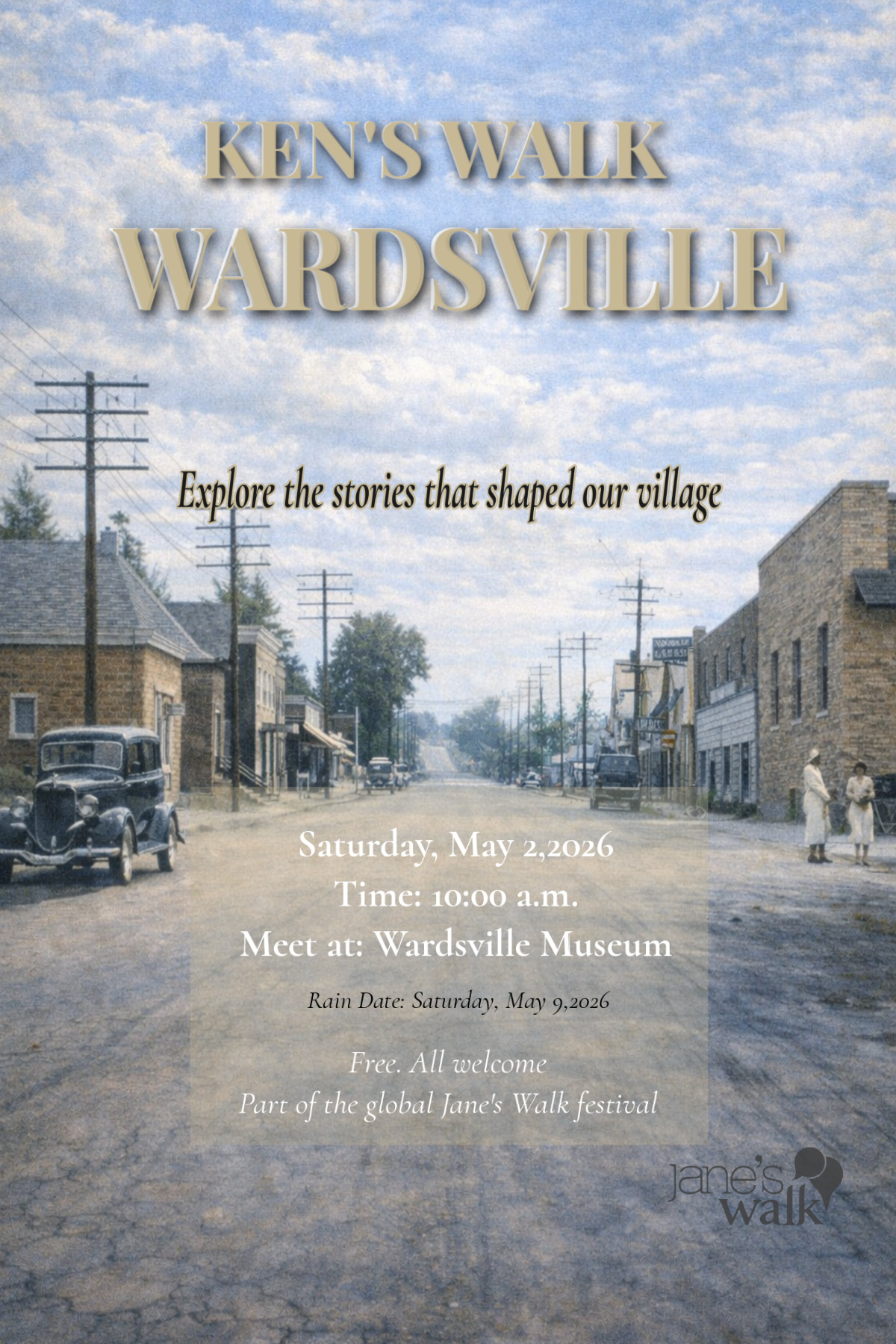
Join local historian Ken Willis for a guided walk through Wardsville. This walking tour highlights the history of Main Street, sharing stores of the buildings, people and events that have shaped the village. Link to fb Event: Ken’s Walk
Meet at 10 a.m. at the Wardsville Museum. Rain date is May 9, 2026
What is Jane’s Walk?
This walk is part of the global Jane’s Walk festival (https://www.janeswalk.org), a weekend of community-led walking tours held around the world.
Among the many artifacts at the Glencoe and District Historical Society Archives are some personal items of Archibald William (A.W.) Campbell, who was born on May 14, 1863 in Wardsville.
His father had immigrated to western Upper Canada from Caithness, Scotland and his mother had been brought up on the family farm in Ekfrid Twp. The Campbells moved to the farm from Wardsville in 1864. Archibald received his early education in local schools and graduated from St. Thomas High School. He apprenticed in engineering and surveying for three years to the county engineer of Middlesex and Elgin before being commissioned as a provincial land surveyor in April 1885.
In 1888, he joined the Canadian Society of Civil Engineers and formed a private partnership, specializing in waterworks, drainage systems and bridges. In 1891 Campbell became city engineer and was a founding editor of the monthly “Municipal World” (St. Thomas). He compiled its “Engineering Section.”
Campbell was particularly interested in improved roadways and soon became recognized as a progressive advocate. “A good road-bed pays,” he wrote in May 1892. “It saves power, shortens distance and time, increases speed, insures comfort and safety, and is, in whatever way you state it, a good investment.” Public attention to roads had been eclipsed by enthusiasm for railways but, in the 1890s, the bicycle craze and the formation of the Ontario Good Roads Association spurred renewed interest. Campbell’s concern was practical: the construction and maintenance of good roads, from the farm gate to the markets and the grain elevators, meant that horses could easily pull heavier loads and that transportation costs could be lightened and consumers’ prices lowered. He was also interested in improving the professional status of engineering.
Norm McGill models Campbell’s uniform at The Archives in Glencoe.
Roadwork was the responsibility of municipalities, which in earlier deys often farmed the tasks out to influential citizens who then employed statute labour, at times resulting in shoddy standards. Campbell used the publication “Municipal World” to champion the use of trained engineers. Campbell’s advocacy led to his appointment in April of 1896 as provincial instructor in roadmaking, under the Minister of Agriculture. In 1900, he became Deputy Minister.
George Ward – the founder of Wardsville and for whom the town is named – had an impressively interesting life that took him from his native Ireland and, as part of his military service, to many parts of the burgeoning British Empire. He ended up in Southwest Ontario, retired from the army and established an inn at Paint Creek (now Wardsville). He survived – just- the American invasion of 1813, and suffered, in addition to the loss of his property, the accusation of treachery due to his confused involvement in the Battle of Longwoods. Nevertheless he lived to the ripe old age of 87, and established a family that cherishes their ancestor to this day.
The connection to St John’s Anglican is through the oak altar table and reredos, seen here in the chancel under the stained glass window, and which memorialises George Ward and his immediate family:
Zooming in the altar table reveals the memorial plaque:
Windows on the past Part 3 St James Anglican Church, Wardsville by Bill Simpson
St James Wardsville was torn down in 1942 after the foundations were fatally undermined by improvements to the adjoining Hagerty Road. Sadly, there are no known pictures of the interior of the church, and we have only an image of the exterior to let us know how it looked.
The design looks very similar to that of St John’s Glencoe, with the exception that the belltower is offset to the side of the entrance rather than where the entrance porch is shown. This explains how the reredos (wooden screen in the chancel) fit so snugly into the chancel at St John’s when it was moved there. (I am writing another post about this memorial reredos and altar table.)
It was noted in an Anglican News article that St James had many beautiful ornamental and memorial windows, but we have no pictures of them.
But, remarkably, a small part of one of these windows was discovered by Wilson Bowles while renovating his house on Talbot Street and was given over in to the care of Ken Willis, the Wardsville Historian. Ken speculates that this fragment was rescued by Abraham Linden, who occupied the house previously.
It was in the year 1839 that John Strachan became the first Bishop of Toronto. When he received this appointment, his diocese covered the land area now known as Southern Ontario.
The Rev John Gunne was licensed ‘To perform the office of Travelling Missionary’ by the Bishop, for the Townships of Zone, Euphemia, Brooke, Ekfrid and Mosa on June 30, 1845. On one Sunday of each month he would ride his horse from Zone Mills (Florence) which was his headquarters, to hold services in Wardsville, likely in private homes until a church building was erected.
The first official parish to be formed was Wardsville, Glencoe and Newbury, also in 1845. About the same time, land was given to the Church of England, for the purposes of a church building, by Dr. Abraham Francis. (This land, 102 acres, was on the south Part of Lot 20, Range one North of the Longwoods Road.) A parsonage was subsequently built on this property but the year is not known.
Lots 18 and 19, south of Church Street, were obtained by the Church Society of the Diocese of Toronto by a Bargain and Sale agreement with William Hatelie, et al, on August 22, 1849. This was a year or two after a wooden framed church building had already been constructed on the lot. This is known from a letter penned by Bishop Strachan on May 8, 1848, to Hatelie and the Churchwardens of the Church of Wardsville. He wrote, gentlemen: I have the honour to acknowledge your Memorial of the 2nd instant, in which you state that you have erected a church at Wardsville, Township of Mosa at considerable expense, but that since the erection of said building, you have only had divine service in it every third Sunday. This building served a congregation of approx. 150 members until the very early 1870s when it fell into disrepair.
For over two decades, Ken Willis has dedicated himself to preserving Wardsville’s history, curating a collection donated by residents that tells the story of Wardsville and its people. The Wardsville Museum is a cherished part of our community that houses a collection of artifacts and stories that showcase Wardsville and Mosa’s rich history. The museum depends on community support to preserve its treasures.
Ken Willis, the long-time curator of the Wardsville Museum, shares his personal story and an appeal for support.
Please denote your donation to benefit the Wardsville Museum and a tax receipt will be issued. Every dollar helps preserve Wardsville’s heritage for future generations.
Your support means the world to Ken and the entire Wardsville community. Thank you for helping us keep our history alive!