Explore the families who shaped our communities. Discover family histories, genealogical research, photographs, obituaries, cemetery records, and personal stories that help connect past generations to the present. Whether you are tracing your roots or sharing your family’s story, this is a place to preserve and celebrate our local heritage.
As the agent of his excellency the Right Honourable Lord Howden, Her Majesty’s Ambassador at Madrid, I hereby certify that Mr. James Alexander has been employed as a farm manager on his Lordship’s Grimston Estate for six years.
By his own desire, he will leave this country to try his fortune in America. I have great pleasure in testifying that his conduct has always been most trustworthy, steady and exemplary in the extensive farm works carried on here.
Also, from his good education and experience in farming, I consider him well qualified to conduct and manage any agricultural operation in all its branches.
—M. Harington, Grimston Park, Tadcaster, Yorkshire.
Penned in 1853, this letter of reference launched the Alexander family legacy in Canada—and a long line of dedicated Ontario farmers. More than 170 years later, the Alexanders’ original crown settlement south of Melbourne, Ont. is still a working cattle farm, now into its sixth generation of the family.
These deep agricultural roots sprouted in rural Forfarshire, Scotland, before blossoming on a Yorkshire estate owned by a British lord and later blooming across the ocean in Southwest Middlesex. The Alexander story is a true migrant tale, showcasing the upheaval, ambition, dedication and success of newcomers to Canada.
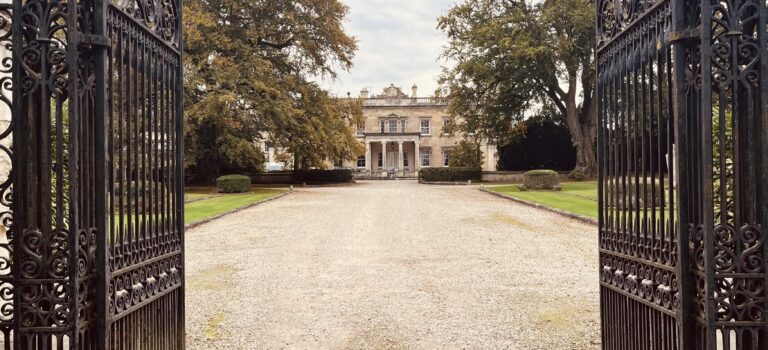
As our Uber approached the stately manor house at Grimston Park, a historic North Yorkshire estate about 25 minutes west of York, the size of the property immediately struck us. The sprawling 2,500-acre estate was a far cry from our quaint 200-acre family farm in Ekfrid Township near Melbourne, Ont.
But surprisingly, we felt right at home.
Along with my parents, Debbie and Alexander, we had travelled to this far-flung county to visit this rather impressive place because our ancestor James Alexander (1824-1895), my three-times great-grandfather, once lived, worked and worshipped here. (Though he likely arrived here via Scotland by horsedrawn coach, not electric car.)
Dec 6, 2025. The Archives, Glencoe – Donation and provenance provided by Kathleen Scott, great grand daughter, St. Thomas, Ontario. Received by Mary Simpson and Norm McGill.
This collection of items belonged to the McAlpine and Smith families of 3528 Oil Field Road, near Glencoe, Ontario. At the center of the family story is the marriage of Rebecca Smith and Alexander McAlpine, who were married on April 12, 1899. Their illustrated marriage certificate, preserved inside Alexander’s family Bible, is one of the key artifacts in this collection.
Rebecca and Alexander lived on the family farm on Oil Field Road. After Alexander’s death, the property was eventually purchased by Jim Schieman, and the McAlpine family maintained a warm friendship with the Schieman family for many years afterward. Several items in the collection reflect this long community connection.
Also included are photographs and records connected with the Zavitz, Schieman, and Peters families, who were neighbours and later stewards of the original McAlpine farm. A wedding photo of Peter Schieman’s son is part of this grouping.
Rebecca and Alexander lived on the family farm on Oil Field Road. After Alexander’s death, the property was eventually purchased by Jim Schieman, and the McAlpine family maintained a warm friendship with the Schieman family for many years afterward. Several items in the collection reflect this long community connection.
These artifacts—Bibles, hymnals, books, and photographs—together illuminate more than a century of rural family life in Southwest Middlesex, documenting marriages, migration, faith, work, and community connections passed down through generations. Thank you Heather for entrusting these treasures to the Glencoe & District Historical Society.
It was in the year 1839 that John Strachan became the first Bishop of Toronto. When he received this appointment, his diocese covered the land area now known as Southern Ontario.
The Rev John Gunne was licensed ‘To perform the office of Travelling Missionary’ by the Bishop, for the Townships of Zone, Euphemia, Brooke, Ekfrid and Mosa on June 30, 1845. On one Sunday of each month he would ride his horse from Zone Mills (Florence) which was his headquarters, to hold services in Wardsville, likely in private homes until a church building was erected.
The first official parish to be formed was Wardsville, Glencoe and Newbury, also in 1845. About the same time, land was given to the Church of England, for the purposes of a church building, by Dr. Abraham Francis. (This land, 102 acres, was on the south Part of Lot 20, Range one North of the Longwoods Road.) A parsonage was subsequently built on this property but the year is not known.
Lots 18 and 19, south of Church Street, were obtained by the Church Society of the Diocese of Toronto by a Bargain and Sale agreement with William Hatelie, et al, on August 22, 1849. This was a year or two after a wooden framed church building had already been constructed on the lot. This is known from a letter penned by Bishop Strachan on May 8, 1848, to Hatelie and the Churchwardens of the Church of Wardsville. He wrote, gentlemen: I have the honour to acknowledge your Memorial of the 2nd instant, in which you state that you have erected a church at Wardsville, Township of Mosa at considerable expense, but that since the erection of said building, you have only had divine service in it every third Sunday. This building served a congregation of approx. 150 members until the very early 1870s when it fell into disrepair.
On April 5, 2025, Carrie Jeffery conducted a workshop on capturing oral histories. We had members of our community, visiting members of other heritage groups, and members of our own historical society in attendance. The engaging and interactive talk was followed by an informative presentation that showcased the various aspects of modern record-keeping that are now accessible for ancestral storytelling. Left to right: Donna Lynam, David Campbell, Carrie Jeffery, Susan McWilliam. Mary Simpson, the president of our historical society, also presented.
L-R: Donna Lynam, David Campbell, Carrie Jeffery, Susan McWilliam.
Imagine for a moment the mystery of your history.
By Carrie Jeffery. Published in the March 2025 issue of Middlesex Banner’s ‘Archive Alley’
Personal storytelling can be both fun and provide new perspectives on how we came to be. These stories can challenge our understanding of the past and give a voice to people who are often left out of traditional historical records: the everyday people that played a role not just in our own lives but also in the communities we live in that they helped shape.
With the help of today’s technology, we can translate an afternoon visit with our elders into a published collection of stories that honour their lives and their place in history.
They get to relive their younger days while we either transcribe them ourselves or even utilize voice memo software to transcribe them for us automatically!
In doing this now while this aging generation is still here, we are able to ask questions like “What year would that have been?” and “Why did you do things that way?” before it’s too late. We can learn about the passions and values they may have held that were similar to our own and what shaped their career or other interests. We can witness and capture the changes that have occurred in just one or two generations.
Over 60 history buffs gathered, in person and online, to listen to Doug Ferguson as he described his “Ancestral Odyssey” at the Glencoe and District Historical Society Archives on Wednesday evening, January 17, 2024. His Ferguson ancestors had left Craignish, Argyleshire for Aldborough Twp. in 1818 and then moved to northern Mosa Twp. in 1827. The McDonalds left Inverness for Quebec in 1830, before settling in Ekfrid Twp. in 1835.
Presented to the Appin Memorial Day gathering August 1, 2000 by Jim May, whose family had a long association with Appin Cemetery. Jim’s first recollection of the cemetery was a phone call in the early 1950s: “Could my Dad come with his truck to help collect up stones for the cemetery gates?” This presentation tells the history of the Appin Cemetery, Appin, Ontario, Canada
By Bob Gentleman and Kathy Evans. Review printed with kind permission from the Middlesex Banner.
In July of this year, family and friends gathered at Arrowwood Farm, a beautiful property in Riverside, just south of Melbourne, to celebrate the publishing of a book written by my uncle, Bob Gentleman. The farm that is now called Arrowwood Farm (6460 Riverside Drive) has sentimental value to our family, as it was once owned by the Gentlemans, purchased in 1870.
Bob’s book, titled “They Settled in Riverside,” is largely a family history, documenting the arrival of our ancestors in the Riverside area and describing their family branches. But Bob also captures an era now decades past as he shares stories of early Riverside neighbours and of growing up in Melbourne in the 1930s. He recalls his paper route, the school, town merchants and businesses, the railroad, and the neighbours and friends who were important in his life.
As part of an annual commemoration of area cemeteries, Glencoe & District Historical Society (G&DHS) organized a presentation and community walk at the Appin Cemetery. Prayers, dedications, singing, and community conversation were key parts of the afternoon.
Lorne Munro – I became interested in historical events in the 1970s. My interest grew after attending the 25th Anniversary banquet of the Glencoe & District Historical Society at the Glencoe Legion in 2003. We presently have eight family genealogy books in our home that I manage and update. Ancestry.ca has been a great help and I correspond with family members to gather information.
During my tenure as President in 2018, the Society’s collection moved from our rooms on Main Street to the old library at 178 McKellar Street, Glencoe. I have served as secretary, first vice president, president (a couple of times). I’m slowing down now, just working on Wednesday afternoons in The Archives and enjoying any other projects that come along.
Peacefully at Strathroy Middlesex General Hospital , Strathroy on Monday, March 18, 2024 William “Lorne” Munro passed away in his 91st year. Predeceased by his wife Phyllis (2023). Dear father to Janice and Tom McCallum, Susan Sinclair and Steve Schneider and Cheryl and Roy Neves. Cherished Grandpa to Matt and Becky, Kimberly and Paul, Adam and Kirissa, Andrew and Reilly, John and Stacey, Scott and Mandy, Jacob, Emily and Brandon. Great-Grandpa to Isabelle, Josephine and Elliott. Lorne will be missed by many nieces and nephews. Predeceased by his parents Neil and Florence Munro, his sister Anna and his brother Keith. Link to Photos reel
“Beyond the gates of the cemetery lives an historical account of our past, a rich heritage populated by friends and relatives. Loved ones who can no longer be with us, but whose memories live on.”
– Josh Kekosz
Each year the Historical Society honours those who came before us. On July 24, 2022, the Cemetery Memorial Service was held at Oakland Cemetery, which was opened May 1894 by a group of ten men who formed a Board of Directors.
Five acres was purchased from a local farmer in Mosa Township and surveyed into plots of 16 feet X 16 feet. These plots were purchased by families. One plot had room for 8 burials. The first burial was Thomas Hopkins in May 1894.
The area was previously served by small family plots and St. Andrew’s (Graham) Cemetery at 112 Main Street Glencoe (Concession 1, Lot 1). St. Andrew’s Cemetery eventually contained approximately 500 burials between 1841 – 1931. It still exists and is classified as ‘abandoned’.
After the new Oakland Cemetery opened and families started purchasing plots, new stones were installed and the names of beloved previously-deceased family members were commemorated. This could explain why there are 175 inscriptions whose dates of death are prior to May 1894.
Records are poor but we surmise that sometimes stones were moved to the new Oakland and sometimes the stones might have been buried or lost from their original family plot locations. And what of the bodies? We guess that bodies probably remain in their original resting places. It seems doubtful if they would have been disinterred and moved. May they continue to rest in peace.
On December 21, 2020, Arnold Nethercott passed away at Country Terrace Nursing Home, Komoka, Ontario. Arnold was the beloved husband of 32 years of Barbara (Balch) Nethercott nee: Dadswell. He was a dear stepfather of Ruth Truesdale (Brian), Kathy Bedford (Larry), Greg Balch (Kim), Mark Balch (Linda), Bruce Balch (Kim) and Chris Balch (Yvonne). Loving grandfather of 14 and great-grandfather of 15.
Arnold is also survived by his brothers Marv Nethercott (Mary) and Bill Nethercott (Roxann) and by his sisters Lois McLean and Phyllis Munro (Lorne). He was the loving uncle of 13 nieces and nephews and many great-nieces and great-nephews. Predeceased by his parents James Percy Nethercott and Mary Louise (Warren) Nethercott, his sister Eleanor Wells and his brothers-in-law Vin Wells and Jack McLean.
Arnold achieved the rank of Captain as a Forward Air Controller in fixed-wing aircraft and as a helicopter pilot while in the Canadian Armed Forces. He served in peacekeeping duties in various locations around the world including Cyprus. He was also a respected Past President of the Ontario Genealogical Society (www.ogs.on.ca) and the United Empire Loyalists Society of Canada. (www.uelac.org)
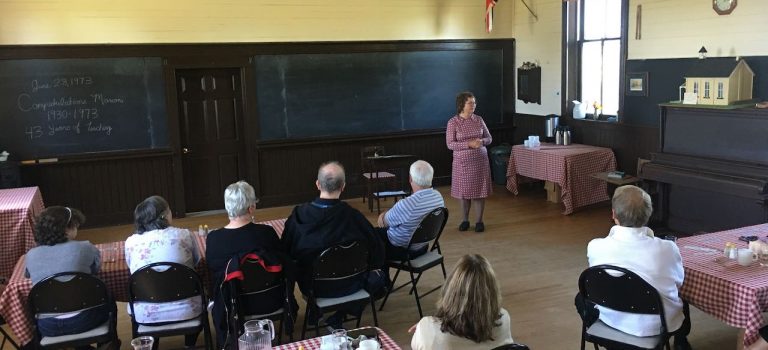
Giles took on the persona of Miss Dobie and presented three acts interspersed with a delicious ham and scalloped potatoes meal served up COVID-19 style with the help of one assistant.
When COVID-19 struck, Antje Giles, community spark plug and entrepreneur, moved her back burner projects to the front burner and dove into the history of long-term local school teacher, Marion Dobie. Miss Dobie taught at Tait’s Corners school house 43 years.
Miss Dobie was “married” to her beloved school and worshipped by her students.
Back Row L – R: ______, Mary Eardley, Mary Margaret McEachren, Marion Dobie, Mildred Ayres, Eileen Poole. Front row: Lucy McRae, Stanley Jackson, Gordie Urquhart, ____, Dorothy Jean McCallum. As remembered by Dorothy Jean, who was in the audience. Photo taken in th early 1950s.
Giles took on the persona of Miss Dobie and presented three acts interspersed with a delicious ham and scalloped potatoes meal served up COVID-19 style with the help of one assistant.
Two performances on Saturday, September 19. Twenty people attended each sold out performance.
L-R: David Nelms, Ina Nelms, and Alicia NelmsAntje Giles brings history to life on September 20 at the Tait’s Corner’s School HouseThe original bell.
Photos by Mary Simpson. Many thanks to Hayter Publications Inc. and Marie Gagnon-Williams for publishing the story.
Transcription of JoAnn Lucas Galbraith’s presentation:
JoAnn Lucas Galbraith’s roots in the area began in 1866 when her great-grandparents Charlie and Annie Zimmerman Lucas acquired property in the former Ekfrid Township in 1866 which now would be described as property just east of Springfield Road and Riverside Drive in Southwest Middlesex. The subject of her presentation was two of her United Empire Loyalists lineages, Clement Lucas the first, was born 1725 in England and Robert Land born 1738 in the state of New York and of their descendants, she had on display all the paperwork required to prove she is a direct descendant of a United Empire Loyalists which qualifies her to be able to affix the initials U.E. to her name. Clement Lucas and his family emigrated from Ireland to the state of New York in 1772.
Robert and his wife Phoebe Scott Land settled in the Delaware Valley in 1856 where he was appointed a Magistrate or Justice of the Peace, a position he held when the 13 colonies broke from England in 1775. He was also a veteran of the seven year war. Robert and Phebe move to and settled at Cushutank Pennsylvania where he was also a farmer and a wood turner. At the outbreak of the Revolutionary War he was a courier for the British along with being one of Chief Joseph Brant’s volunteers and worked as a spy and recruiter for the British Indian Department in Pennsylvania and New York. In 1779 he was captured by the militia brought to court and charged as a British spy found guilty and sentenced to hang. His conviction was overturned by George Washington and while out on bail, Joseph Brant and Band and escaped to Canada West and settled in the Niagara area.
JoAnn Lucas Galbraith of Middlemiss was guest speaker at the Glencoe District Historical Society meeting in Glencoe on Wednesday night October 16th.
A Quaker friend of Roberts by the name of Ralph Morden was hung in his place. While en route to Niagara Falls , Joseph and his band met a group of natives who had captured Roberts son Abel as a slave. If Abel could run the gauntlet Brant could claim him as a slave. Robert settled in the Niagara area near Lundy’s Lane 1782, he hunted and fished for a living and is said to have grown the first wheat and corn in the area. Phebe Land and her family had taken Refuge along with Clement Lucas and his family in New York City a safe British Haven. In 1783 after the war the Loyalists who had gathered in New York we’re loaded on sailing ships and evacuated to Nova Scotia / New Brunswick. Clement Lucas and his son Clement II, who had married Phoebe Land, a daughter of Robert Land and Phebe Land (wife of Robert) and her son Abel all acquired land in Nova Scotia / New Brunswick. In 1791 lieutenant John Graves Simcoe’s land-grants in Upper Canada sounded attractive. Phebe and Abel having heard rumours that an English man by the name of Land was living at the head of the lake in the Niagara area.
Phebe, daughter Abigail and son Abel packed up and decide to move from New Brunswick. Robert and Phebe who had lost contact for 11 years were finally reunited 1791. By 1794 Robert Land, his sons and daughters had acquired over 1000 Acres of what today is downtown Hamilton. Robert and his sons and daughters laid the foundation of what today is the city of Hamilton. Robert and Phebe had eight children, seven who grew to adulthood, William died, while Phebe was living in New York and is buried there.
Ephraim Land was a son of Robert and Phebe and was a signer of the first bylaws of the Barton Masonic Lodge. The Land men were very involved with the Masonic order. The Masonic apron worn by Chief Joseph Brant is in a museum in Hamilton. Joseph joined the Masonic order being one of the first natives to join. During the War of 1812-15 Ephraim’s wife Mary , hid the Masonic regalia and jewels and their values under a peony bush in their garden.
I have a list of all the descendants of Robert and Clement who fought in the 1812-15 war. There are a number of those who left their mark in Canadian and American history descended from Robert and Phebe. Here are a few examples John Land Birney 1836-1921, son of Abigail was said to have invented the first glass milk bottle. John, Robert and Phebe Lands oldest son was imprisoned during the American Revolution. He was able to retain some of his dad’s land after the Revolution. Today his home “The Old Red House” is a landmark in Wayne County Pennsylvania, being one of the oldest houses still remaining in Pennsylvania.
Mary Christina Pettigrew was a founding member of the Toronto branch of the U.E.L. Society. Charles Henry Land, grandson of Ephraim married Evangeline Lodge. He was a dentist who invented a gold and porcelain inlay system, a process of artificially replacing enamel on defective teeth. Evangeline Lodge Land married Charles August Lindbergh a lawyer and US Congressmen they had one son. Charles Augustus Lindbergh who started out as an engineer but after two years he enrolled in a flying School in Lincoln Nebraska. He served as a Wingwalker , Barnstormer, and was one of a small band of hardy Aviation Pioneers who risked their lives by flying mail. He was lured into his great adventure by a $25,000 prize for the first transatlantic non-stop flight from New York to Paris. He is still today known by his nickname The Lone Eagle.
JoAnn Lucas Galbraith has traced her Lucas line back through DNA to the Vikings. The original name Lucas possibly comes from Latin word Lucca or Luce which means light bright or shining which may mean to lighten dark places. It can be either Greek or Celtic. According to my grandfather they were Huguenots who emigrated from Hungary during the time of Mary Queen of Scots and William of Orange. Through family research I’ve traced them back to the 1600s in England. My 4th great-grandfather Clement the first, was born in England 1725. Clement the second, my third great-grandfather was born in Ireland 1764.
Clement the first and his family emigrated from Ireland to the United States in 1773 hoping for a better life. During the American Revolution he and his family like a number of other British subjects took refuge in the city of New York. In 1783, the Clement the first and his family were loaded onto a ship called Bridgewater and relocated to a spot called Parrtown in New Brunswick. Clement as a UEL was given Land by King George the third for his loyalty to the British Crown. Clement the first died in 1806 and is buried in New Brunswick. Clement the second , who had married Phoebe, a daughter of Robert Land and Phoebe (Scott) Land, left New Brunswick with some of their family in 1807.
As a son and daughter of a UEL where allotted land in Nelson Township, in what today is part of the City of Burlington. Clement the second and Phoebe had eight children, their eldest son Thomas as a son and Grandson of a UEL was able to purchase 200 Acres of Crown Land for a 6 lb 19 Shillings and four pence in Nelson Township. Thomas who married Mary Llewelyn daughter of another UEL had a family of 11. In 1861 Thomas and Mary decided to join his younger brother Clement the third who had acquired land in 1855 near what today is the Village of Mount Brydges. Clement and a number of his family are buried in Cook Cemetery as well, Thomas and Mary were buried in Cade Cemetery in Caradoc Township now Strathroy-Caradoc.
Charles the eldest son of Thomas and Mary decided to move closer to the family, purchasing land in Ekfrid Township in 1866. Following the death of his father Thomas, Charles had married Annie Zimmerman whose family had moved from Pennsylvania in 1793 and settled near Beamsville. Charles and Annie had a family of 13, two of the youngest Charles II my grandfather was born Ekfrid Township in 1868 and Matilda in 1870. Today 153 years later there are number of 10th Generation descended from Clement Lucas and Robert Land who live in the Municipality of Southwest Middlesex and and 164 years in Municipality of Strathroy-Caradoc.
Lucasville near Petrolia was settled by another Lucas line that came to the area and from Ireland in 1811 Landing first in Quebec and then settling in Brook Township in 1820.
The history of my family was taught to me , one would say the day I was born. I had a great aunt born in 1850 , great uncle 1852, great aunt 1857, my grandfather Charles 1868 , and my dad 1909, who loved to pass the family history on. In 1977, I inherited genealogy that had been researched back to Clement the second , which my Uncle George born in 1893 had helped to compile from 1864-1937. The house my grandparents Charles and Elizabeth Bawden Lucas purchased in 1896 and raised their family of 11 in , still exists today in Middlemiss. The house I live in was built in 1890, and one time was owned by my great grand-mother Annie Zimmerman Lucas. Today there are 11 houses in Middlemiss that one time or another were owned by descendants of Charlies and Annie Lucas.
On Sunday October 20th , the Dutton-Dunwich Doors Open Heritage Tour , featured as one of the sites the Bobier/Lucas house near Tryconnell purchased in 1883 by John Lucas, eldest son of Charles and Annie where a number of his descendents occupied the house for 85 years. Another home as part of the family history is the John Lucas house where Clement the second passed away in , is a tourist site at the Agricultural Museum near Milton since it opened in 1975. The Clement Family through generations have been recognized for their musical and artistic, medical and writing talents. There are so many in the family who have excelled with their talent but I have just selected four.
Clarence Reynolds Lucas born 1866, great great grandson of Clement the first, a composer, writer and music critic, was born near Brantford on the First Nation Reservation where his father Daniel Van Norman Lucas was a missionary. He died in Paris France in 1947. In 1997 the National Library of Canada received 350 original lost works by Clarence of compositions, for voice, choir, piano, organ, chamber, ensemble, band, and full orchestra, several overtures, as well as correspondents, photographs, books, and newspaper collection.
Clarence’s documents will be preserved as part of Canada’s publishing heritage. Clarence is recognized as one of Canada’s leading composers of music and was well-known throughout Europe and the United States. Wilfred Lucas third son of Daniel was born 1871 in Canada, died 1940 in Hollywood California. In 1908 he got caught up in the excitement of the film industry to work in the flickers, in the United States. He started directing a number of films from 1908 to 1939. He was bested known for starring in the Laurel and Hardy comedy rolls. Wilfred had one son John Meredith Lucas 1919 to 2002 who was born in Hollywood.
“The history of my family was taught to me, one would say, the day I was born.”
He was a director writer and producer and served as crew on several films in production. He is known for directing and producing screenwriting, some of which are Zorro TV series 1957, Sign of Zorro 1958, Alfred Hitchcock 1955 TV, Ben Casey 1961 TV, Star Trek episodes number 37 to 69, and Star Trek TV series 1966. Professor G. H. W. Lucas son of Charles and Elizabeth was born in 1894 until 1974 B.A. M.A. and PHD. , attended Public School in Middlemiss, High School in Melbourne, London Central Collegiate, University of Toronto. He held a number of medical appointments one being The Banting and Best chair of medical research 1924-1926, Professor of Pharmacology 1926-1963 University of Toronto, Professor of Emeritus 1963.
He was author and joint author of over 30 scientific publications, member of some 30 scientific Societies in Canada and U.S.. He was a co-discoverer of the cyclopropane anaesthetic gas with V.E. Henderson. In a new subdivision in Mount Brydges the streets are named honouring Veterans. Lucas Ave, is named after Thomas Lucas War of 1812-1815, Alonzo Lucas WWI, who gave the supreme sacrifice, and Charles Hazel Bawden Lucas WWII, all of who at one time reside in Caradoc Township.
by Marie Williams-Gagnon, Hayter Publications Inc.
Seated in the shade of an old pine tree, a group of over 40 gathered to honour those interred at the Gough Cemetery on Sunday afternoon, July 28, 2019. The community memorial service, an annual event held at a different cemetery each year, was hosted by the Glencoe & District Historical Society.
The Gough Cemetery is located at 5018 Scotchmere Dr. in Adelaide-Metcalfe.After Society president Ken Beecroft welcomed guests and area historian Ken Willis offered a dedication and prayer, historian Harold Carruthers provided some background on the Cemetery itself which is on the property settled by the John and Eliza (Kellestine) MacGoughr (later Gough) family in 1845.
The couple had a large family of 13 but their son Nelson died in 1849. His was likely to be the first burial at the site, followed by those of his sisters Hannah in 1855 and Elizabeth in 1865. Since that time, the predominant family names of those interred on the tiny property are Ash, Boyd, Gough, Hetherington, Moore, Olde, Towers, Williams and Yager. Society member Marilyn (Gough) McCallum provided a detailed history of the “MacGoughr” family that voyaged to Canada from Ireland in 1831.
The family was among the earliest settlers of township in the early 1830s with Metcalfe itself not existing prior to 1846 when Ekfrid and Adelaide were divided. “They endured all the hardships of pioneer life having cut out of the wilderness homes for themselves on land given to them by the Crown.” McCallum detailed the life of settlers John and Eliza MacGoughr who received title on the property.
Sometime in the 1850s, the “Mac” and the “r” were dropped from their name. She shared details about family members, including those buried at that particular cemetery. She recalled visiting the cemetery as a child. “We would tread softly, touch the stones, speak the names…of those who came before.”
Lorne Munro added some information about the Kellestine family before the service closed. The property was sold to Charles Towers in 1909. The Cemetery is personally maintained by Heather and Charlie Towers who were recognized for their efforts and the new fence they constructed at the front of the property. They took over the responsibility from Reta and Alex Johnson and Vern and Shirley Towers who had maintained it over the years.
Staying out of the heat while gathered in the shade, Glencoe historians and family members joined together at the Gough Cemetery in Adelaide-Metcalfe for a service of remembrance. The Glencoe and District Historical Society holds services at a different community cemetery each year. Photo by Marie Williams-Gagnon, Hayter Publications
This story printed with permission from Marie Williams-Gagnon.
The descendants of Archibald and Nancy McKellar gathered together, Saturday, August 25, 2018 to celebrate the milestone anniversary of their arrival and settlement in Metcalfe Township. The reunion was held at A.W. Campbell Conservation Area at Alvinston. Although it was a rainy and inhospitable day, about 100 interested family attendees enjoyed food, games, contests, stories and photos, and exchanged genealogy information.
The McKellars, both natives of the parish of Kilmicheal-Glassary, Argyll, Scotland, migrated to Canada in 1831 and eventually made their way to Metcalfe Township in west Middlesex County. This was certainly a time of hardship and toil for the early pioneer family.
The original homestead farm located at Lot 24, Concession 6, was purchased and carved from the forest in 1838 and has been continuously in the family since then, handed down, inherited and purchased by direct descendants. The current owners are sixth generation, Hugh McKellar and his wife Andrea Boyd.