And then there are the Elders

And then there are the Elders

Allen Deleary of Bkejwanong (Walpole Island First Nation) speaking recently at a special Indigenous Lifeways Workshop locally. Allen shared teachings and insights from Anishinaabe traditions, exploring how Indigenous lifeways continue to guide relationships with the land, water, and one another. The evening included a community discussion, offering space for reflection, dialogue, and shared understanding:

Allen Deleary of Bkejwanong


And then there are the Elders:

Simon Winchester:

They keep a steady hand upon the tiller. That, in essence, seems to be the greatest and most enduring strength of aboriginal peoples around the world. The frantic pace of modern life, the endless bursts of technological advance, the alarums and excursions, and our various political and military adventures all come and go, but all the while and in the background, keeping their wary and watchful eyes upon us, are the wise ones…

Read more

A Canoe for His Grandfather

By Mary Simpson with Ron McRae.

When Ron McRae first began researching how to build a cedar strip canoe, it was during the COVID outbreak and at the urging of his son, Steven. Ron had recently retired and he and his wife, Linda had purchased two plastic kayaks. They enjoyed getting out on the water, but Ron found the seating position painful on his lower back. So he began researching canoes. 

“I found Bear Mountain Boats in Peterborough,“ Ron recalls. “They sell cedar-strip canoe kits and have all these resources for amateur builders. I contacted them, hoping to register for a workshop with Ted Moores, the founder of the company and the man who wrote Canoecraft, the definitive how-to book for canoe builders. But his wife told me Ted was now in his seventies and had given up his in-person courses. She then said something that stuck with me: ‘Why don’t you buy the book, read it, and call me back if you still think you can do it?’”

So he did.

And he could.

And he did.

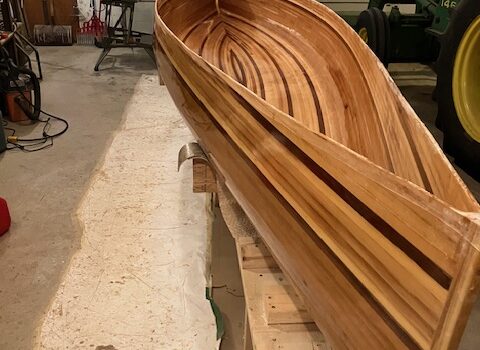
Ron ordered his first kit, which came with all the essential parts: carefully milled cedar strips in a range of colours from dark brown to nearly white, ash gunnels, deck pieces and seats and hardware. The key to a sound, straight tracking hull is the molds which shape it. Ron decided to purchase laser cut molds which were perfect, rather than risk cutting them by hand with a jigsaw. He chose a design that balanced form and function= something stable, not too long and suitable for beginners.

“I picked the Freedom 15 design,” he says. “It’s easy to paddle, good for two people or as a solo. I thought it would be a relatively easy build and perfect for novice paddlers like Linda and me.”

“I built that first canoe in about six months and really enjoyed the process. Linda and I have been exploring Southern Ontario paddling opportunities in it for the past three years and we seldom go out on the water without a comment on the beauty of our cedar strip canoe.”

Cedar strip kit – centre line hull
Read more
The Alexanders: A Migrant Story 

The Alexanders: A Migrant Story 

By Kellie Davenport 

As the agent of his excellency the Right Honourable Lord Howden, Her Majesty’s Ambassador at Madrid, I hereby certify that Mr. James Alexander has been employed as a farm manager on his Lordship’s Grimston Estate for six years.

By his own desire, he will leave this country to try his fortune in America. I have great pleasure in testifying that his conduct has always been most trustworthy, steady and exemplary in the extensive farm works carried on here. 

Also, from his good education and experience in farming, I consider him well qualified to conduct and manage any agricultural operation in all its branches.

—M. Harington, Grimston Park, Tadcaster, Yorkshire. 

Penned in 1853, this letter of reference launched the Alexander family legacy in Canada—and a long line of dedicated Ontario farmers. More than 170 years later, the Alexanders’ original crown settlement south of Melbourne, Ont. is still a working cattle farm, now into its sixth generation of the family. 

These deep agricultural roots sprouted in rural Forfarshire, Scotland, before blossoming on a Yorkshire estate owned by a British lord and later blooming across the ocean in Southwest Middlesex. The Alexander story is a true migrant tale, showcasing the upheaval, ambition, dedication and success of newcomers to Canada.  

Read more
From Yorkshire to Ekfrid and Back Again

From Yorkshire to Ekfrid and Back Again

By Kellie Davenport 

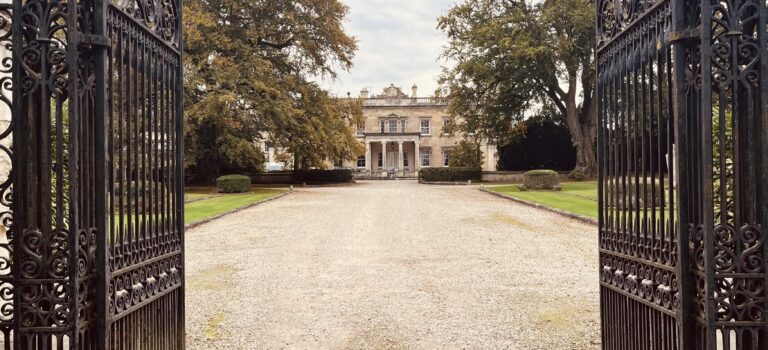
As our Uber approached the stately manor house at Grimston Park, a historic North Yorkshire estate about 25 minutes west of York, the size of the property immediately struck us. The sprawling 2,500-acre estate was a far cry from our quaint 200-acre family farm in Ekfrid Township near Melbourne, Ont. 

But surprisingly, we felt right at home. 

Along with my parents, Debbie and Alexander, we had travelled to this far-flung county to visit this rather impressive place because our ancestor James Alexander (1824-1895), my three-times great-grandfather, once lived, worked and worshipped here. (Though he likely arrived here via Scotland by horsedrawn coach, not electric car.) 

Read more
McAlpine–Smith Family Fonds

McAlpine–Smith Family Fonds

Dec 6, 2025. The Archives, Glencoe – Donation and provenance provided by Kathleen Scott, great grand daughter, St. Thomas, Ontario. Received by Mary Simpson and Norm McGill. 

This collection of items belonged to the McAlpine and Smith families of 3528 Oil Field Road, near Glencoe, Ontario. At the center of the family story is the marriage of Rebecca Smith and Alexander McAlpine, who were married on April 12, 1899. Their illustrated marriage certificate, preserved inside Alexander’s family Bible, is one of the key artifacts in this collection.

Rebecca and Alexander lived on the family farm on Oil Field Road. After Alexander’s death, the property was eventually purchased by Jim Schieman, and the McAlpine family maintained a warm friendship with the Schieman family for many years afterward. Several items in the collection reflect this long community connection.

Also included are photographs and records connected with the Zavitz, Schieman, and Peters families, who were neighbours and later stewards of the original McAlpine farm. A wedding photo of Peter Schieman’s son is part of this grouping.

Rebecca and Alexander lived on the family farm on Oil Field Road. After Alexander’s death, the property was eventually purchased by Jim Schieman, and the McAlpine family maintained a warm friendship with the Schieman family for many years afterward. Several items in the collection reflect this long community connection.

These artifacts—Bibles, hymnals, books, and photographs—together illuminate more than a century of rural family life in Southwest Middlesex, documenting marriages, migration, faith, work, and community connections passed down through generations. Thank you Heather for entrusting these treasures to the Glencoe & District Historical Society. 

Read more
Historic Step Forward: County to study potential for Archives

Historic Step Forward: County to study potential for Archives

Middlesex County Approves Feasibility Study for County Archives

In a landmark and unanimous decision, Middlesex County Council has voted to move ahead with a Middlesex County Archives Feasibility Study, marking the most significant progress to date toward establishing a permanent county-wide archives.

In November 2025, the motion—brought forward by Mayor McMillan and seconded by Mayor DeViet—sparked thoughtful questions around the council table, with councillors expressing both strong support and prudent concern for the project’s long-term sustainability. Following discussion, the vote passed unanimously, prompting applause from the gallery filled with advocates, historians, and community supporters.

For the Committee to Establish a Middlesex County Archives (CEMCA), this moment represents a breakthrough many years in the making. The idea of a county archives has circulated for decades. CEMCA has spent the past several years building awareness, engaging municipalities, and championing the need for proper stewardship of Middlesex County’s more than 225 years of documentary heritage.

While the vote does not commit the County to building an archives at this stage, it does confirm the County’s intention to undertake a comprehensive, professionally guided study. This study will assess needs, gaps, costs, and opportunities—ensuring that decisions about preserving local history are grounded in strong evidence and reflect today’s economic realities.

CEMCA emphasizes that all heritage, cultural, and community organizations throughout Middlesex County will be encouraged to participate in the study process if invited. Broad input will be essential to reflect the diversity of local collections, stories, and archival needs.

This important step could not have happened without the many residents, volunteers, historians, journalists, and local groups who wrote letters, attended meetings, raised awareness, and kept the conversation alive.

CEMCA extends heartfelt thanks to all supporters and media partners.
The work continues—but the door is now open.

Mary Simpson, President, 2024-2026, Glencoe & District Historical Society

Read more