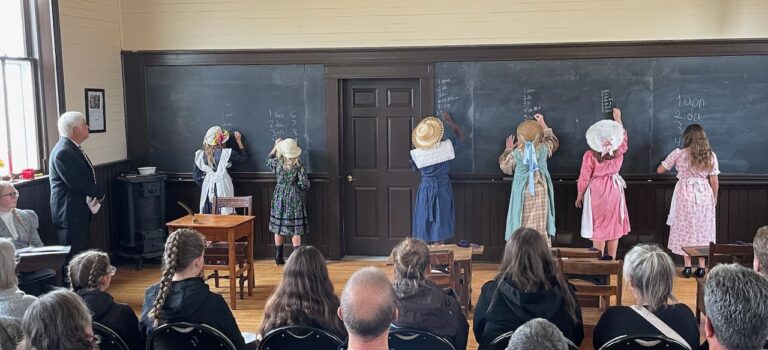
The Glencoe area was settled predominately by Scottish immigrants many of whom spoke Gaelic.
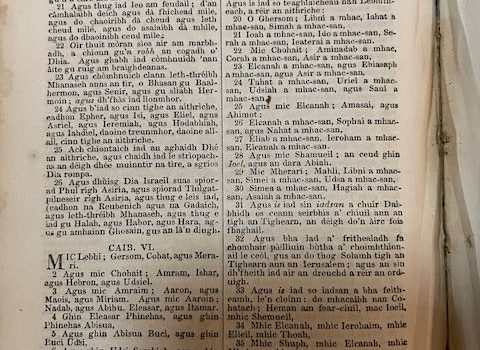
Duncan Mitchell (1838-unknown) from Metcalfe Township lived on the South 1/2 of Lot 18, Conc 13. He had this book of 41 Gaelic poems published localy in Rodney, Ontario in 1887. This book was generously donated to the Historical Society from the McAlpine family in 1986, and several poems were translated by Donald Campbell in 1999.
D. Campbell included notes with the translation explaining that most Gaelic speakers did not learn to read and write from formal education, and that to a modern reader his spelling is very poor. He surmises that Duncan was likely quite a fluent speaker who wrote in Gaelic using what he had learned from personal study and practice. Campbell also states that he clearly used a regional dialect of Gaelic and that he was writing according to his accent, which was common.
Druchd Na Beinne (Original Gaelic Text)
Druchd na beinne, druchd na beinne,
Druchd na beinne, o anail Chriosd,
Druchd na beinnes’s Dia bhi lienne
‘N am na gainne’s gus a chtioch.
Druchd na beinne, gu ar comhdach,
Air an lon anar bhios sin sgith;
druchd na beinne bheiradh beos dhuinn
Air an rod san tsaoghal shios.
Druchd na beinne ann’s an fhasach,
Gu ar sasachadh gu sior:
Leis an dochas chaoidh nach basaich;
Ach gu brath a mhareas fior.
Druchd na beinne ‘n am an earraich,
Gu ar tarruinn dhionnsuidh Chriosd
Druchd na beinne tha toirt barrachd:
Bheir nach fannaich sin gu sior.
Druchd na beinne tha cho beodhach,
Air na rosaibh sruthadh sios;
‘S leam bu tatneach e bhi dortadh;
Air gach neonnan buidhe blion.
Druchd na beinne ‘n am an t’samhraidh,
‘S e a b’ansuidh lainn gu fior;
Gu ar cumail dlu r’ar n’annsachd:
‘S tiormachd samhraidh orn’ a crion.
Druchd na beinne ‘n am an fhaoghair,
Gu ar cumail dlu ri Criosd;
Gu ar neartacha ‘S g’ar cobhair:
Ann’s gach obair gus a chrioch.
Druchd na beinne’n am a gheamhraidh,
‘N nar bhios teanndtachd air tir;
Druchd na beinne chum na cranndachd:
Chuir a dh’ anntaobh chaoidh gu sior.
Druchd na beinne ann’s an t’siorruitrheachd,
‘S mi nach iarradh uaith gu fior;
Ach bhi’m shuidhe’n sgail na diadhachd:
‘N glachdadh Chriosd gu suthinn sior.
The Dew of the Mountain (English Translation)
The dew of the mount, the dew of the mount,
The dew of the mount from the breath of Christ,
The dew of the mount God being with us
In the time of famine, to the end.
The dew of the mount, to cover us,
on the morass when we are tired;
dew of the mount that would enliven us
on the road in the earth below.
Dew of the mount in the wilderness,
To give us satisfaction never ending:
with the hope that will never die;
But forever will last true.
Dew of the mount in the spring time,
Drawing us toward Christ
Dew of the mountain that surpasses:
Enabling that we shall not faint ever.
Dew of the mount that is so enlivening,
On the roses dripping down;
With me would be desirable to be pouring;
On each small wilted yellow flower.
Dew of the mount during summer time,
It would be preferable to us;
to keep us close to our attachment:
while drought of summer withers us.
Dew of the mount in time of autumn,
To keep us close to Christ;
Strengthening us, relieving us:
in every toil to the end.
Dew of the mount in time of winter,
When the land is paralyzed;
Dew of the mount to put anger:
To one side always and forever.
Dew of the mount in eternity truly,
I would not desire to be without;
But that I’d be sitting in the shadow of God:
in the everlasting embrace of Christ.