June 20, 2026 at The Archives, Glencoe: The Glencoe & District Historical Society welcomed twenty attendees for a wonderful Saturday morning session featuring guest presenter Evan Abma. The workshop was organized by Denise Corneil, Secretary of the G&DHS, who is a passionate advocate for documenting our region’s historical structures before they’re lost.
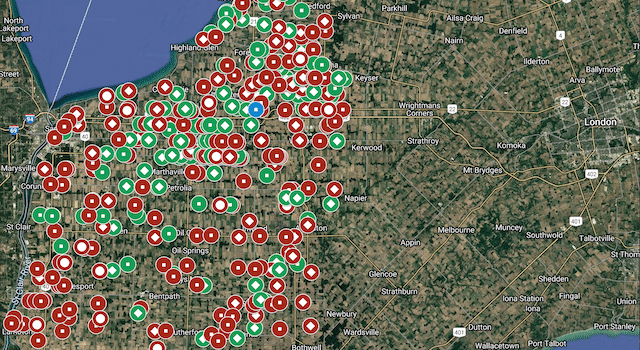
Evan, Chair of the Sarnia Heritage Committee and a leading voice in documenting Ontario’s disappearing rural heritage, shared the remarkable project he has built mapping historic farmhouses across Lambton County. Working from the observation that many homes featured in an old article on Warwick Township had since vanished, Evan’s small tracking project grew into a county-wide documentation effort. He has now catalogued 2500 historic farmhouses built in 1921 or earlier, recording their architectural styles and histories.
Among the many artifacts at the Glencoe and District Historical Society Archives are some personal items of Archibald William (A.W.) Campbell, who was born on May 14, 1863 in Wardsville.
His father had immigrated to western Upper Canada from Caithness, Scotland and his mother had been brought up on the family farm in Ekfrid Twp. The Campbells moved to the farm from Wardsville in 1864. Archibald received his early education in local schools and graduated from St. Thomas High School. He apprenticed in engineering and surveying for three years to the county engineer of Middlesex and Elgin before being commissioned as a provincial land surveyor in April 1885.
In 1888, he joined the Canadian Society of Civil Engineers and formed a private partnership, specializing in waterworks, drainage systems and bridges. In 1891 Campbell became city engineer and was a founding editor of the monthly “Municipal World” (St. Thomas). He compiled its “Engineering Section.”
Campbell was particularly interested in improved roadways and soon became recognized as a progressive advocate. “A good road-bed pays,” he wrote in May 1892. “It saves power, shortens distance and time, increases speed, insures comfort and safety, and is, in whatever way you state it, a good investment.” Public attention to roads had been eclipsed by enthusiasm for railways but, in the 1890s, the bicycle craze and the formation of the Ontario Good Roads Association spurred renewed interest. Campbell’s concern was practical: the construction and maintenance of good roads, from the farm gate to the markets and the grain elevators, meant that horses could easily pull heavier loads and that transportation costs could be lightened and consumers’ prices lowered. He was also interested in improving the professional status of engineering.
Norm McGill models Campbell’s uniform at The Archives in Glencoe.
Roadwork was the responsibility of municipalities, which in earlier deys often farmed the tasks out to influential citizens who then employed statute labour, at times resulting in shoddy standards. Campbell used the publication “Municipal World” to champion the use of trained engineers. Campbell’s advocacy led to his appointment in April of 1896 as provincial instructor in roadmaking, under the Minister of Agriculture. In 1900, he became Deputy Minister.
As the agent of his excellency the Right Honourable Lord Howden, Her Majesty’s Ambassador at Madrid, I hereby certify that Mr. James Alexander has been employed as a farm manager on his Lordship’s Grimston Estate for six years.
By his own desire, he will leave this country to try his fortune in America. I have great pleasure in testifying that his conduct has always been most trustworthy, steady and exemplary in the extensive farm works carried on here.
Also, from his good education and experience in farming, I consider him well qualified to conduct and manage any agricultural operation in all its branches.
—M. Harington, Grimston Park, Tadcaster, Yorkshire.
Penned in 1853, this letter of reference launched the Alexander family legacy in Canada—and a long line of dedicated Ontario farmers. More than 170 years later, the Alexanders’ original crown settlement south of Melbourne, Ont. is still a working cattle farm, now into its sixth generation of the family.
These deep agricultural roots sprouted in rural Forfarshire, Scotland, before blossoming on a Yorkshire estate owned by a British lord and later blooming across the ocean in Southwest Middlesex. The Alexander story is a true migrant tale, showcasing the upheaval, ambition, dedication and success of newcomers to Canada.
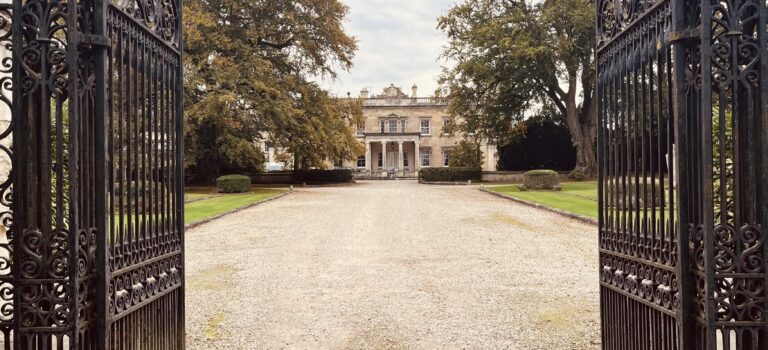
As our Uber approached the stately manor house at Grimston Park, a historic North Yorkshire estate about 25 minutes west of York, the size of the property immediately struck us. The sprawling 2,500-acre estate was a far cry from our quaint 200-acre family farm in Ekfrid Township near Melbourne, Ont.
But surprisingly, we felt right at home.
Along with my parents, Debbie and Alexander, we had travelled to this far-flung county to visit this rather impressive place because our ancestor James Alexander (1824-1895), my three-times great-grandfather, once lived, worked and worshipped here. (Though he likely arrived here via Scotland by horsedrawn coach, not electric car.)
Dec 6, 2025. The Archives, Glencoe – Donation and provenance provided by Kathleen Scott, great grand daughter, St. Thomas, Ontario. Received by Mary Simpson and Norm McGill.
This collection of items belonged to the McAlpine and Smith families of 3528 Oil Field Road, near Glencoe, Ontario. At the center of the family story is the marriage of Rebecca Smith and Alexander McAlpine, who were married on April 12, 1899. Their illustrated marriage certificate, preserved inside Alexander’s family Bible, is one of the key artifacts in this collection.
Rebecca and Alexander lived on the family farm on Oil Field Road. After Alexander’s death, the property was eventually purchased by Jim Schieman, and the McAlpine family maintained a warm friendship with the Schieman family for many years afterward. Several items in the collection reflect this long community connection.
Also included are photographs and records connected with the Zavitz, Schieman, and Peters families, who were neighbours and later stewards of the original McAlpine farm. A wedding photo of Peter Schieman’s son is part of this grouping.
Rebecca and Alexander lived on the family farm on Oil Field Road. After Alexander’s death, the property was eventually purchased by Jim Schieman, and the McAlpine family maintained a warm friendship with the Schieman family for many years afterward. Several items in the collection reflect this long community connection.
These artifacts—Bibles, hymnals, books, and photographs—together illuminate more than a century of rural family life in Southwest Middlesex, documenting marriages, migration, faith, work, and community connections passed down through generations. Thank you Heather for entrusting these treasures to the Glencoe & District Historical Society.
Tracing a Journey of Faith: Author Maria Moore shares the migration history of Old Colony Mennonites and her own family’s story during a presentation hosted by the Glencoe Historical Society.
The Old Colony Mennonite story stretches across continents and centuries—a journey shaped by faith, identity, and the ongoing search for a place where religious convictions can be lived without interference. This history, and its enduring impact, was the focus of a recent presentation by author Maria Moore at the Glencoe Presbyterian Church, hosted by the Glencoe & District Historical Society.
Over 60 history buffs gathered, in person and online, to listen to Doug Ferguson as he described his “Ancestral Odyssey” at the Glencoe and District Historical Society Archives on Wednesday evening, January 17, 2024. His Ferguson ancestors had left Craignish, Argyleshire for Aldborough Twp. in 1818 and then moved to northern Mosa Twp. in 1827. The McDonalds left Inverness for Quebec in 1830, before settling in Ekfrid Twp. in 1835.
Ellwyne Ballantyne’s twenty-two years of brief, bright life are summed up on a simple plaque attached to a majestic buttonwood tree in Carruthers Corners. When local author CJ Frederick first saw the memorial tree in the rural area just outside of Glencoe, ON, she experienced a keen reverence. “It’s just a dot on a map. I was not prepared for how beautiful the tree was. It looked like it was wearing a cloak; as my mother says, ‘wrapped in a queen’s robe’. Knowing that this tree was dedicated to the life of someone who had given that life in a faraway, long-ago conflict really made me stop and think about remembrance and the enduring nature of love.” Ballantyne’s story had to be told; Frederick was eager to record it.
Great evening with James Carruthers, the story keeper; CJ Frederick, the story teller and author; and Patrick, the story champion. We packed the Archives and hosted a few people via zoom as well.
Stories ripple all around us, if only we’re willing to hear them. In 2012, CJ first learned of Ellwyne Ballantyne and the astonishing relationship he forged with two strangers after reading a short newspaper article about the dedication of an unusual tree to a long-dead soldier from World War One. With obligations to work and family filling her time, she wasn’t yet ready to hear his story. It took a global pandemic, with the prospect of lockdowns and unexpected forced time at home, to open her ears, mind, and heart and be ready to explore the roots of Ellwyne’s story that took place more than a century before.
Yoshio Shimuzu: “You have to remember that we had been driven from our homes by racial prejudice in British Columbia, reviled and despised by the bulk of the population, and here in the farmlands of southwestern Ontario, we were welcomed as equals and saviours by the farming population.” Read more →
Presented to the Appin Memorial Day gathering August 1, 2000 by Jim May, whose family had a long association with Appin Cemetery. Jim’s first recollection of the cemetery was a phone call in the early 1950s: “Could my Dad come with his truck to help collect up stones for the cemetery gates?” This presentation tells the history of the Appin Cemetery, Appin, Ontario, Canada
By Bob Gentleman and Kathy Evans. Review printed with kind permission from the Middlesex Banner.
In July of this year, family and friends gathered at Arrowwood Farm, a beautiful property in Riverside, just south of Melbourne, to celebrate the publishing of a book written by my uncle, Bob Gentleman. The farm that is now called Arrowwood Farm (6460 Riverside Drive) has sentimental value to our family, as it was once owned by the Gentlemans, purchased in 1870.
Bob’s book, titled “They Settled in Riverside,” is largely a family history, documenting the arrival of our ancestors in the Riverside area and describing their family branches. But Bob also captures an era now decades past as he shares stories of early Riverside neighbours and of growing up in Melbourne in the 1930s. He recalls his paper route, the school, town merchants and businesses, the railroad, and the neighbours and friends who were important in his life.
Marie Williams, Glencoe: The huge crowd that packed into the Glencoe and District Historical Society Archives on February 22 proved that the “Sage of Ekfrid” is as popular today as he was over 100 years ago. In addition to 30 viewing online, over 50 turned up in person.
Lorne Munro – I became interested in historical events in the 1970s. My interest grew after attending the 25th Anniversary banquet of the Glencoe & District Historical Society at the Glencoe Legion in 2003. We presently have eight family genealogy books in our home that I manage and update. Ancestry.ca has been a great help and I correspond with family members to gather information.
During my tenure as President in 2018, the Society’s collection moved from our rooms on Main Street to the old library at 178 McKellar Street, Glencoe. I have served as secretary, first vice president, president (a couple of times). I’m slowing down now, just working on Wednesday afternoons in The Archives and enjoying any other projects that come along.
Peacefully at Strathroy Middlesex General Hospital , Strathroy on Monday, March 18, 2024 William “Lorne” Munro passed away in his 91st year. Predeceased by his wife Phyllis (2023). Dear father to Janice and Tom McCallum, Susan Sinclair and Steve Schneider and Cheryl and Roy Neves. Cherished Grandpa to Matt and Becky, Kimberly and Paul, Adam and Kirissa, Andrew and Reilly, John and Stacey, Scott and Mandy, Jacob, Emily and Brandon. Great-Grandpa to Isabelle, Josephine and Elliott. Lorne will be missed by many nieces and nephews. Predeceased by his parents Neil and Florence Munro, his sister Anna and his brother Keith. Link to Photos reel
This history was written by Lelah Bell Lumley in 1975 about her neighbourhood S.S. No. 3 School District, Mosa Township, Middlesex County, Province of Ontario, Canada.
Glenn Stott tells about 33 years of troubles that took place in Biddulph Township and Lucan Ontario region in Upper Canada from 1847 to 1880 and ended with the murder of five members of the Donnelly family.
Wonderful event held at the Appin Park. Forty people enjoyed the new community garden, congratulating the local team who have built the raised beds, set up a watering system, and nurtured the plants. Many thanks to our elected municipal leaders for taking the time to attend.
The highlight of the evening was listening to the stories regaled by Bonnie Sitter and Shirleyan English about the farmerettes, the teenagers that harvested Ontario crops from about 1942 – 1952.
Thank you Bonnie and Shirleyann. You have documented a wonderful part of agricultural history that otherwise would have been lost.
And here’s some links to the buzz created by the release of Onion Skins and Peach Fuzz: Memories of Ontario Farmerettes. (2019). by Shirleyan English and Bonnie Sitter
Bonnie Sitter, “Farmerettes: Get Out on the Farm” in The Rural Voice. June, 2018.
Local photographer and Glencoe Native, Andrew McGill hosted a Portfolio Review of his work to the core membership of the Glencoe & District Historical Society. The review took place at The Archives on February 18th, 2023.
Andrew recently moved back to the Glencoe area after living in Toronto, and New York, for over a decade. Throughout that time he has focused his lens on the farming community which he grew up in, photographing his family farm, and local community events in the region.
Andrew shared with us his 11×14″ and 8×10″ archival pigment print portfolios as well as photo books and zines he’s produced over the years. He also showed documentation from various exhibitions including his large scale public installation of 9’x9′ square banners hung at the St. Lawrence Market in downtown Toronto. Some of which have been on display at the Glencoe Curling Arena and the Glencoe Hockey Arena.
He is interested in working with the Historical Society on future projects to document our history and community.
Andrew McGill (b. 1988, Glencoe, Canada) holds a B.F.A. from The School of Image Arts, Toronto. McGill is a multi-disciplinary artist whose work is primarily photo-based. He has sharpened his own visual style through working with his peers on high profile editorial, fashion, and art photography projects in Toronto, New York, Paris, and throughout the Eastern United States. McGill has recently moved from New York City, to his hometown of Glencoe, a farming community in the heart of Southwestern Ontario, where he has begun incorporating his artistic practice into daily life, making work inspired by the local community of lifelong friends, family, and neighbours, and the pastoral landscape from which he hails.
Andrew is an American Photography Selected Winner and a Magenta Foundation Flash-Forward Emerging Photographer. A public installation of his ongoing series titled, Two Half- Hitches Could Hold the Devil Himself, was shown as part of the 2017 Scotiabank CONTACT Photography Festival, at St. Lawrence Market in Toronto. The resulting 9ft square banners have been loaned to the village of Glencoe, have been on display at the Glencoe Curling Arena, as well as, the Southwest Middlesex Hockey Arena. His work has also been shown at Harbourfront Centre in Toronto.
Andrew is currently working on personal book and portrait projects, as well as commission and editorial work. Andrew has had his work featured in the Editorial Magazine (Montreal), Fisheye Magazine (Paris), published in photobooks by Booooooom! (Vancouver), and is a contributor to The Globe and Mail (Toronto), and Topic Magazine ( New York).
My name is Andrew McGill, I’m a young farmer and a photographer. I grew up on a farm 6 kilometres north of Glencoe, Ontario. In mid 1940 my great grandfather Fred McGill purchased a farm building which was to be moved from the site of the No. 4 Bombing and Gunnery School at Fingal Ontario. The building was dismantled and moved 45 kilometres north of Fingal to its final resting place on the McGill farm at Taits rd. Glencoe where it has sat to this day. My father and I think the building was then reassembled with a new roof sometime in 1941. The site of No. 4 B&G school sat on a swath of 724 acres of land that was returned to the crown for the purpose of building the training facility. One can imagine the numerous agricultural buildings on the land that would have had to be dismantled and moved in short order to make way for the multiple airplane hangers and triangle runway of the Fingal school.
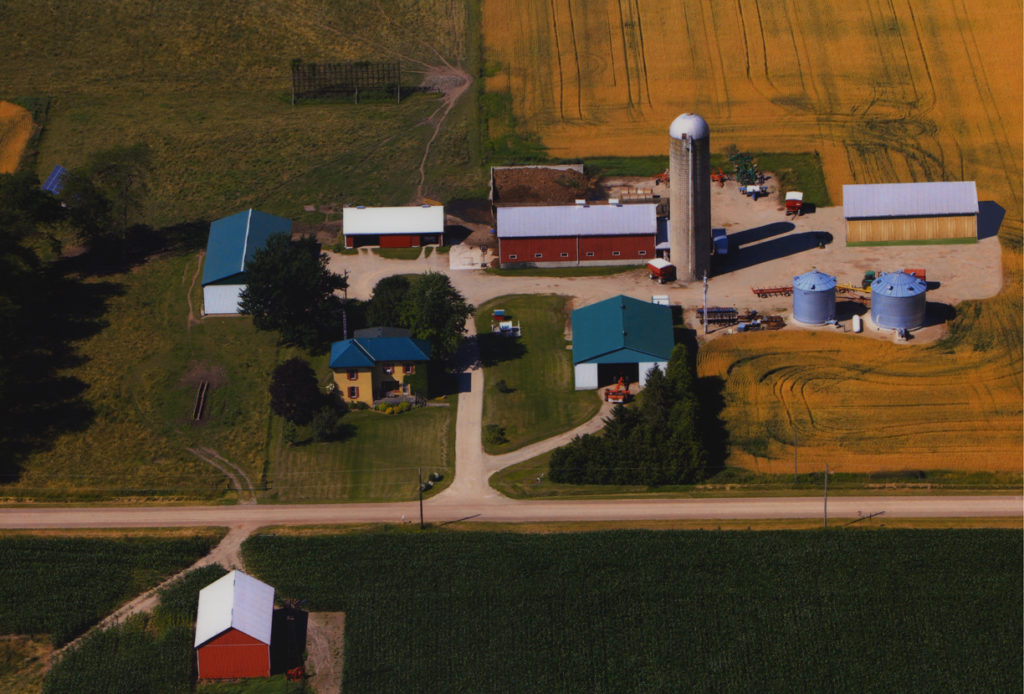
Aerial photo of the McGill farm circa 1977. The building in question can be seen directly to the left of the barn. (Photo care of McGill family Archive, 1977.)
McGill farm building moved from Fingal Bombing And Gunnery School site in 1940. (Photo: Andrew McGill. September, 2022.)
Aerial photo of the site of the Fingal Bombing and Gunnery School. (Photo: Commonwealth Air Training Plan Museum.)
Route from Fingal B&G school site to the McGill farm. (Photo: Google Maps)
Interior detail of the McGill farm building which continues to house tools and horse equipment which would have been used by the late Fred McGill circa 1940’s. (Photo: Andrew McGill, 2016.)
A restored 1942 Minneapolis Moline “Waterloo” tractor stored in the building on the McGill farms site. (Photo: Andrew McGill, 2022.)
Winifred (Eddie), Fred, and Blake McGill using their 1942 Minneapolis Moline Tractor to plant sugar beets for seed to aid the allied forces war effort. (Photo care of McGill family Archive, 1942.)
Alternate angle of Winifred (Eddie), Fred, and Blake McGill using their 1942 Minneapolis Moline Tractor to plant sugar beets for seed to aid the allied forces war effort. (Photo care of McGill family Archive, 1942.)
Clare McGill and Dorothy Brown in front of the McGill homestead with the 1942 Minneapolis Moline “Waterloo” tractor. (Photo care of McGill family Archive, 1942.)
Clare, Winifred (Eddie), and Blake McGill in front of the McGill homestead to mark the moment King George VI announced enlistment of eligible men into the military in Canada. (Photo care of McGill family Archive, 1941.)
Blake McGill standing with his newly restored 1942 Minneapolis Moline tractor on the McGill farm in 1993. (Photo care of McGill family Archive, 1993.)
Aerial photo of the McGill farm taken the year of its 100th anniversary in 2016. The relocated building can be seen clearly to the left of the barn. (Photo care of McGill family Archive, 2016.)
Dorothy (Knapp), Doug, and Ron McRae in Ilderton Ontario, 1955. During WWII, as a 13 year old, my grandmother Dorothy along with her schoolmates were tasked with finding a plant called Alder Buckthorn, which because of its consistent burn time was used to create fuses for depth charges used to sink German navy vessels. It is told that Dorothy found enough of the valuable plant for her father to pay off the mortgage of their farm. (Photo care of the McRae family Archive, 1955.)