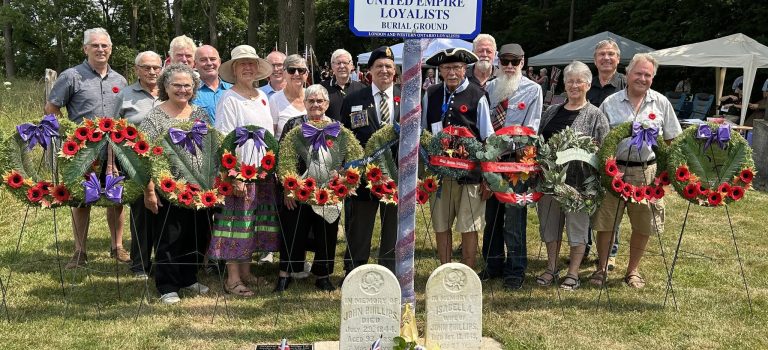
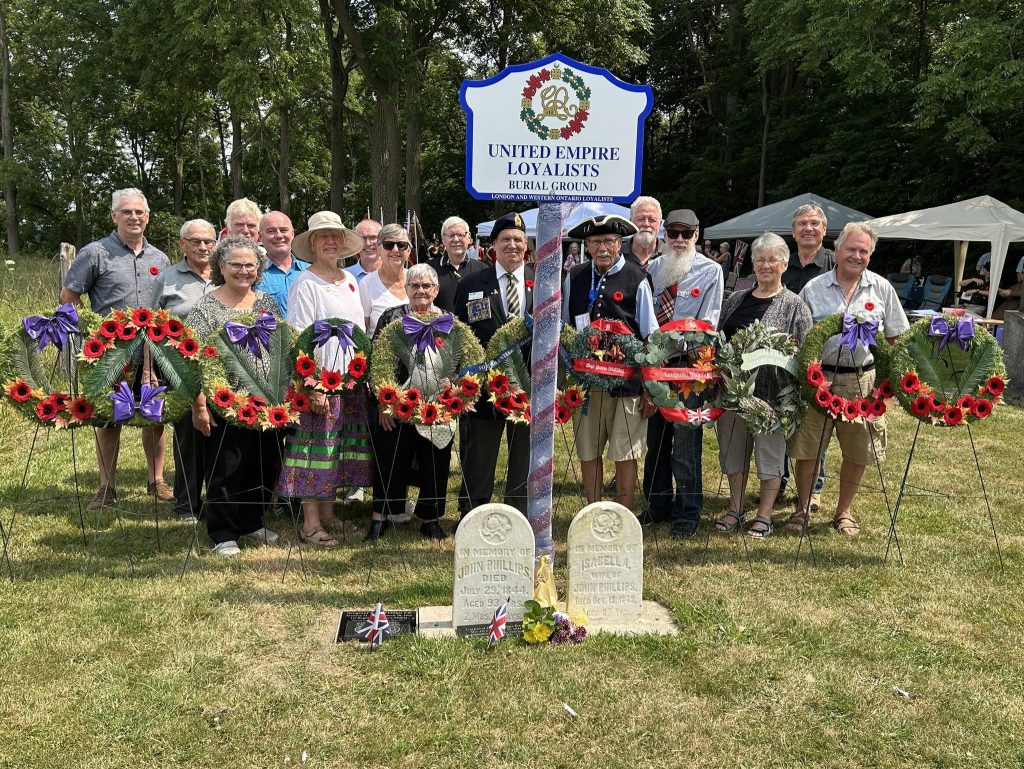
By Jennifer Grainger – On July 26, I attended the Willey Cemetery memorial service. This quiet graveyard at 5267 Gentleman Drive, just off Thames Road in the former Ekfrid Township, was busier that day than it had been in years, as it was officially dedicated as a United Empire Loyalist (UEL) Burial Ground. A War of 1812 veteran buried here was honoured at the same time. The event, sponsored by UELAC Western Ontario Branch and Glencoe & District Historical Society, reminds “Old Stock” Canadians who we are and why we’re here.
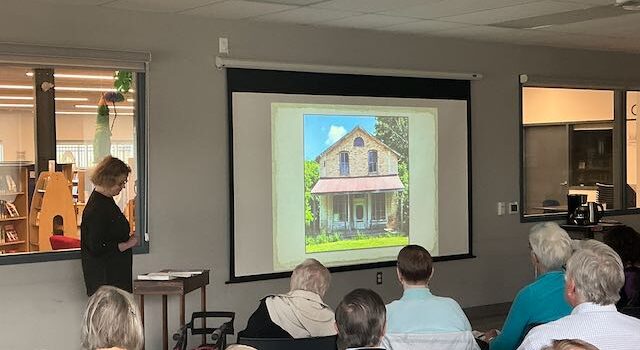
June 20, 2026 at The Archives, Glencoe: The Glencoe & District Historical Society welcomed twenty attendees for a wonderful Saturday morning session featuring guest presenter Evan Abma. The workshop was organized by Denise Corneil, Secretary of the G&DHS, who is a passionate advocate for documenting our region’s historical structures before they’re lost.
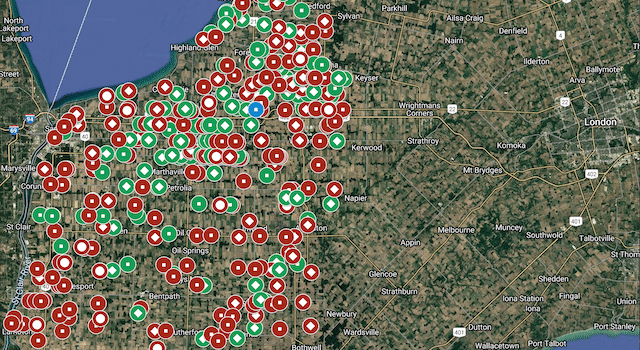
Evan, Chair of the Sarnia Heritage Committee and a leading voice in documenting Ontario’s disappearing rural heritage, shared the remarkable project he has built mapping historic farmhouses across Lambton County. Working from the observation that many homes featured in an old article on Warwick Township had since vanished, Evan’s small tracking project grew into a county-wide documentation effort. He has now catalogued 2500 historic farmhouses built in 1921 or earlier, recording their architectural styles and histories.
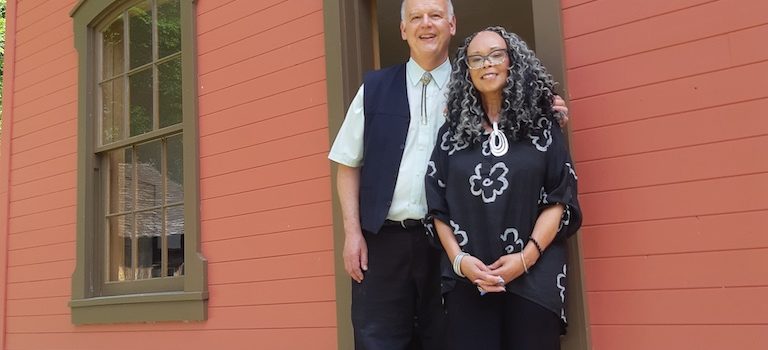
I was privileged to be in the historic African Methodist Episcopal Church at Fanshawe Pioneer Village recently, listening to two accomplished artists bring two remarkable Black Canadian lives into the light. Denise Pelley, accompanied by Stephen Holowitz, held the fifth event in the Fanshawe Village series—and what an extraordinary homecoming it was.
Not long ago, the AME Church stood on Thames Street in London, largely forgotten. Built around 1848, it had served London’s Black community as a place of worship, gathering, and resistance—a sanctuary for people who had escaped slavery and found freedom in Canada West. The plaque that marks its history tells of John Brown’s rumored visit in 1858, when the church became a space where conversations about abolition and freedom took form. For over a century after the congregation moved to a larger brick church on Grey Street, the building was someone’s home. Its original purpose faded from public memory, buried under layers of wallpaper and time.
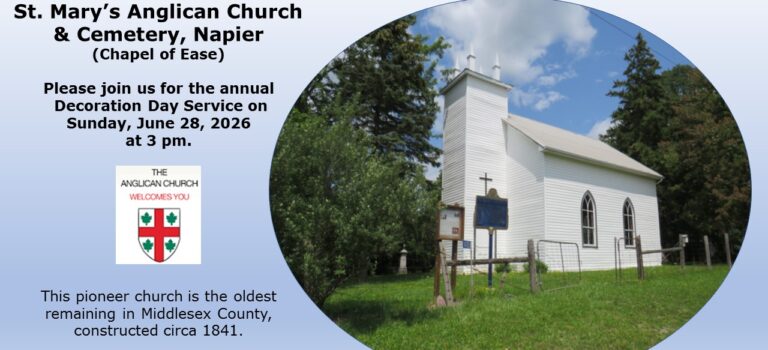
Napier: One of the first public buildings constructed in Napier was St. Mary’s Anglican Church. The land for the church, on a hill north of the village, was donated by Charles Preston. The exact construction date varies with the source, but the church was completed around 1843.
The oldest remaining church in Middlesex County, St. Mary’s Chapel of Ease holds an annual Decoration Day Service in June. It’s a day I try not to miss, since it’s an opportunity to enter a primitive pioneer building that’s usually closed.
On June 18, 2026, the Glencoe Public Library was filled to capacity as 45 community members gathered to hear local historian Jennifer Grainger explore the rise and fall of Middlesex County’s vanished villages. The event was presented in partnership between the Glencoe & District Historical Society and the Glencoe Public Library.
Drawing on maps, photographs, land records, and archaeological clues, Grainger traced where these once-thriving communities were located, how historians and genealogists research them today, and what—if anything—remains visible on the landscape now.
The G&DHS thanks the Glencoe Public Library and Courtney Joris for their partnership in bringing this event to the community, and extends its appreciation to Jennifer Grainger for sharing her research. Here is the piece Jenny wrote for the Middlesex Banner featuring Cashmere, Napier, and Kilmartin.
Ekfrid Mills, Aug 1910. Travelling East on Longwoods Rd, 1/4 mile East of Strathburn. Glencoe & District Historical Society Archives.
Ekfrid Mills circa 1910
Built in 1834 by Paten Atwood, the first flour mill in the Strathburn area was located just east of the Mosa-Ekfrid town line on the north side of Longwoods Road. The original flour mill was destroyed by fire and replaced in 1874 with a brick structure. The mill had several operators over the next twenty years including G.J. & J.B. Coulthard and Andrew Fleming. The mill ceased operations in 1920 and was dismantled in 1924.
Background: Prior to the establishment of sawmills the early settlers built dwellings out of hewn logs. These buildings were typically limited in size but effective in providing a shelter for family and livestock until better accommodations could be built. Prior to the 1830’s and well into the 1840’s buildings in Ekfrid and Mosa Townships were log structures; including houses, barns, schools, and inns.
In 1820 Anselm Foster petitioned for a grant for establishing a mill on Lot 23, however no further action was recorded. Adam Burwell had also expressed interest in a mill at this location.
My Memories Of Ekfrid Mills
I was born in 1907, so my memories are only as a child. I counted it an outing to go with my father with bags of grain with team and wagon to be ground into chop for live stock feed.
Mr. Fleming the operator at that time, would meet us at the porch and put the bags on a four wheel conveyor and push it on a track to where he wanted it, then put through while we waited.
The custom chopping was done on the main floor. The waiting period might be half an hour or two hours depending on how many customers were ahead. However the grinding capacity was quite comparable to the present day.
The grindstone was driven by a steam stationary engine of quite good size, high horse power that is. This was in the basement so to speak, with the level close to flood water, if my memory serves me right. This being pleasant and comfortable waiting area, especially in winter beside this steam heating plant. This plant was fueled by cord wood and the water of course came from the creek. (Newbigging creek it was called). Later years soft coal was used for fuel.
Mr. Fleming looked after the customers, and he usually had a boiler man looking after the engine. During the war 1914-1918 help was hard to get and many days Mr. Fleming looked after all; go down stairs fire the boiler then run upstairs and bag the chop. This become to tell on Mr. Fleming on his ageing years.
During the summer months he operated only two or three days a week. But after September when the farmers crop was getting threshed he naturally became busier. That is if the water supply in the creek was available as the dam was now getting out of repair. I think that he was hampered on this account once, to my memory.
On the second floor of this building were the flour mills or separators so to speak, many of them 5 to ten perhaps. This flour processing was done before my time and quite extensive I have been told.
Around 1918 or ’20 Mr Flemings health failed and the mill shut down.
Approximately 1920 give a year or two: the Campbell Bros. Of Melbourne were building a garage, [and] they had returned from the forces 1914-1918.
They purchased the old mill, and wrecking it to use much of the material for their new garage as it still is in Melbourne. Much of the brick was used and the boiler was used to heat the garage as well as two adjacent stores there. The flour equipment was sold to Dutton Flour Mills who up to quite recent made themselves quite famous milling pastry flour. Trade name SWANSDOWN. Many car loads were shipped. Dutton by this time had cheap hydro power.
When the highway (no2 or the former Longwoods road) was widened, it took in most of the property, of both the residence and mill also the horse shed in between used as shelter for the customers horses.
I think that I was told that when grinding first began that it was stone grinding, and by water power. Very little remains, or do I remember of the of the old dam of being much.
In my mind of all times I could not visualize what I was told of the greatness of this site.
Geo. W. McCallum, June 1982 ; From written documents provided by Geo. W. McCallum to the Glencoe & District Historical Society.
The First Mill: Patten Atwood and his wife Hannah (Brooks) had farmed in Dunwich Township, until about 1829 they crossed the river into Ekfrid.
In 1830 Paten Atwood acquired Lot 23 and by 1834 erected both a saw and grist mill. The mill was built on the west bank of Newbiggen Creek, which powered the mill. The original mill was certainly wooden, and likely a log structure considering the absence of a functional sawmill in the area. The details regarding where the millstones were acquired from, or how they were transported to the location are unknown. (The millstones used in the Napier mill took many teams of oxen to drag from Port Stanely to Napier in 1838. The roads at this time were very crude, and the local geography is laced with swamps, steep ravines, and winding gulleys.)
The establishment of the sawmill enabled residents to begin building framed wooden structures. Many existing homesteads along Longwoods Road would upgrade there dwellings, and the surrounding villages of Wardsville, Woodgreen, Strathburn, and Taits Corners emerged. Other local sawmills were built, however it was Atwood’s first mill that was critical in the initial development of the area.
The gristmill enabled local residents to grind wheat into flour in large volumes. Without a mill this is a very labour intensive activity that can only be done in small quantities. Whether both the sawmill and gristmill were housed in the same structure is unknown. It is possible that the function of the sawmill was outdoors.
In October 1839 Paten Atwood and his family decided to move to Illinois. In 1840 the ownership of the property and mills transferred to Andrew Coulthard. The Coulthard family added to the operations a carding and fulling mill (for preparing wool into thread).
“The first schools were of the most primitive construction – of log construction, with floor, roof and other features the same as the homes of the people…
The first schoolhouse in the township [Ekfrid] was built on the east half of Lot 6, on Duncan Mclean’s farm near the north corner of the farm, about 1834. About 1840 the first school in what is now S.S. No. 4 was opened in a log dwelling house on the west corner of Lot 12. Other log schoolhouses were located on the north corner of Lot 13; at or near the present site of Riverside School; and in the westerly part of the township, Lot 21 R1S.”
From The Township of Ekfrid 1821- 1941; published by the council of the township, 1949.
Fire and Rebuilding: Ekfrid Mills continued as an important and convenient operation on Longwoods Road. It was completely destroyed by fire in January 1874. The mill was rebuilt and operating by July. The new building was a brick structure built on the East bank of Newbiggen Creek, as shown in the photographs. The Ekfrid Mills became an iconic landmark.
From the photos of the brick building it appears that the original water power was derived from an undershot system. The water wheel would have been located under the door on the west wall, and the water would have passed under the wheel in a trough, causing it to spin in a counter-clockwise fashion. Sometime later the mill was converted to a wood burning boiler and the wheel was removed. Still later the boiler was heated using soft coal.
The brick building carried the name EKFRID MILLS on the western gable (partly visible in the photographs) but was generally known by the names of the operators: Coulthard Mill, Fleming Mill.
End of An Era: Andrew Fleming purchased in the mill in 1910, but it was usually open only three times per week. The mill ceased operations in 1920 and stood vacant until 1924 when it was purchased by Robert and Stewart Campbell. The Campbell brothers dismantled the mill and used the materials to rebuild their shop in Melbourne. Years later Campbell’s Garage (located on the north side of Longwoods Rd. near the main intersection) was destroyed by fire and the garage was rebuilt again. Although the building has since been used as a fire hall, library and residence, it is still often reffered to as Campbells Garage.
Morningstar Mill
Morningstar Mill: Although there are no remains of the Ekfrid Mills that we can visit today, we are fortunate that a very similar mill from the same era was restored to a functioning state and is open to the public as a museum. The Morningstar Mill gristmill in St. Catharines was built in 1872 by Robert Chappel. Around 1892 the interior of the mill was destroyed by fire but the stone building remained intact. New equipment was installed and the Morningstar Mill continued operation until 1933.
In 1992 the volunteer group “Friends of Morningstar Mill” was established and they began to restore and then operate the mill as an operating gristmill. At the start of the restoration project, much of the machinery and stones were as they had been left in 1933.
By Ian Mason, published in the Middlesex Banner, May 2026. Plan to do the North Middlesex Day Trip June 12, 2026 – link here
Nestled in the cemetery in the hamlet of Carlisle, 6 kms east of Ailsa Craig, is the Presbyterian Church Heritage Centre (PCHC). It contains the national collection of artefacts from various congregations of The Presbyterian Church in Canada from coast to coast. We are the only historic mainline denomination in Canada that preserves a collection of its artefacts. There are a few church museums throughout Canada, but they pertain to a specific church, rather than its denomination.
A common question is, “so what does the Presbyterian Church Heritage Centre collect? Bibles and crosses?”
Bibles, “yes”; crosses “mostly no.” More about that later.
In 2018, the National Presbyterian Museum in St. John’s Presbyterian Church, Toronto closed. The Museum was obliged to leave what had been our host church since 2002 when the church was sold to a developer which will eventually convert the church into condominiums, providing a small area for the congregation to continue to meet.
Curator Ian Mason began a 5-year search for a church which would be willing to host the collection of artefacts relevant to the history of The Presbyterian Church in Canada (PCC). These items help to tell the stories of those who worshipped and served Jesus Christ within the context of the PCC. Prior to the formation of the United Church of Canada in 1925 – into which 2/3 of the Presbyterian Church amalgamated – the PCC was the largest Protestant denomination in Canada.
The Curator made a cold call to Carlisle United Church asking the congregation if they would be interested in hosting a collection of artefacts. And, he added, “if you are interested in hosting this collection, you would have to give up your sanctuary and move to the basement.”
He had his answer in 3 seconds, “yes, we would be willing to do that.”
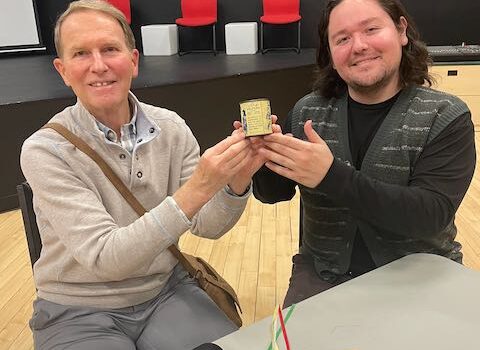
Brantford; On April 13, 2026, David Nelms and Mary Simpson travelled to Brantford, Ontario, to visit the Woodland Cultural Centre, located on the grounds of the former Mohawk Institute Residential School.
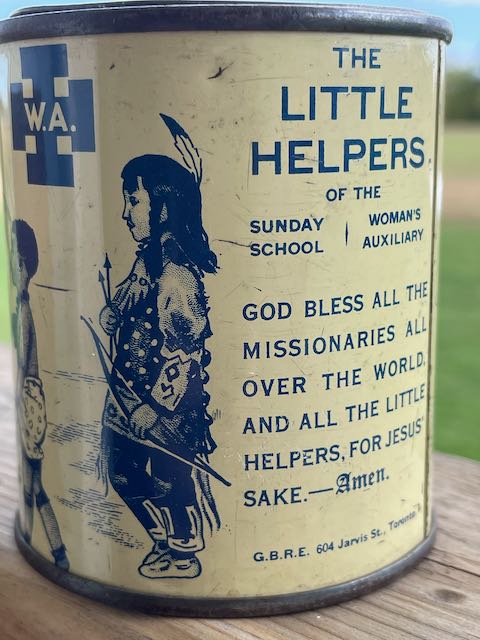
In their care was a small metal penny bank—simple in form, worn with age, and carrying with it the memory of a life.
The bank belonged to Jemima “Ina” Simpson Nelms, who passed away in the summer of 2025 at just over 100 years old. As a child growing up in rural Southwestern Ontario, Ina attended St. John’s Anglican Church in Glencoe. She received the penny tin through her Sunday School program known as “The Little Helpers.” She would save her pennies and drop them into the slot, believing—as she had been taught—that the money would help “the little Indian children.”
Printed on the surface are images of children from around the world, as they were depicted at the time, along with a short prayer: “God bless all the missionaries all over the world, and all the little helpers, for Jesus’ sake. Amen.” Strangely, the handsome North American Indigenous boy is standing aloof from the group. Jesus has his back to him and the child is not part of the group – he’s just watching.
The Little Helpers of the Sunday School. Penny bank sponsored by the Woman’s Auxiliary of the Anglican Church of Canada. The Indian child stands apart from the group of children talking to Jesus. Read more →
Tracing a Journey of Faith: Author Maria Moore shares the migration history of Old Colony Mennonites and her own family’s story during a presentation hosted by the Glencoe Historical Society.
The Old Colony Mennonite story stretches across continents and centuries—a journey shaped by faith, identity, and the ongoing search for a place where religious convictions can be lived without interference. This history, and its enduring impact, was the focus of a recent presentation by author Maria Moore at the Glencoe Presbyterian Church, hosted by the Glencoe & District Historical Society.
Normally, if you want to see the pioneer buildings constructed by our ancestors, you have to visit a museum like Fanshawe Pioneer Village. That’s because most of our early buildings were torn down and replaced with larger, grander ones as soon as it was practical to do so. If not demolished, the earliest buildings were usually modernized to include electricity, plumbing, openable windows, and insulation. Nobody likes privations.
That’s why it’s fascinating to enter one of those rare pioneer structures that’s almost completely unchanged. I’m talking about St. Mary’s, Napier...
George Ward – the founder of Wardsville and for whom the town is named – had an impressively interesting life that took him from his native Ireland and, as part of his military service, to many parts of the burgeoning British Empire. He ended up in Southwest Ontario, retired from the army and established an inn at Paint Creek (now Wardsville). He survived – just- the American invasion of 1813, and suffered, in addition to the loss of his property, the accusation of treachery due to his confused involvement in the Battle of Longwoods. Nevertheless he lived to the ripe old age of 87, and established a family that cherishes their ancestor to this day.
The connection to St John’s Anglican is through the oak altar table and reredos, seen here in the chancel under the stained glass window, and which memorialises George Ward and his immediate family:
Zooming in the altar table reveals the memorial plaque:
Windows on the past Part 3 St James Anglican Church, Wardsville by Bill Simpson
St James Wardsville was torn down in 1942 after the foundations were fatally undermined by improvements to the adjoining Hagerty Road. Sadly, there are no known pictures of the interior of the church, and we have only an image of the exterior to let us know how it looked.
The design looks very similar to that of St John’s Glencoe, with the exception that the belltower is offset to the side of the entrance rather than where the entrance porch is shown. This explains how the reredos (wooden screen in the chancel) fit so snugly into the chancel at St John’s when it was moved there. (I am writing another post about this memorial reredos and altar table.)
It was noted in an Anglican News article that St James had many beautiful ornamental and memorial windows, but we have no pictures of them.
But, remarkably, a small part of one of these windows was discovered by Wilson Bowles while renovating his house on Talbot Street and was given over in to the care of Ken Willis, the Wardsville Historian. Ken speculates that this fragment was rescued by Abraham Linden, who occupied the house previously.
It was in the year 1839 that John Strachan became the first Bishop of Toronto. When he received this appointment, his diocese covered the land area now known as Southern Ontario.
The Rev John Gunne was licensed ‘To perform the office of Travelling Missionary’ by the Bishop, for the Townships of Zone, Euphemia, Brooke, Ekfrid and Mosa on June 30, 1845. On one Sunday of each month he would ride his horse from Zone Mills (Florence) which was his headquarters, to hold services in Wardsville, likely in private homes until a church building was erected.
The first official parish to be formed was Wardsville, Glencoe and Newbury, also in 1845. About the same time, land was given to the Church of England, for the purposes of a church building, by Dr. Abraham Francis. (This land, 102 acres, was on the south Part of Lot 20, Range one North of the Longwoods Road.) A parsonage was subsequently built on this property but the year is not known.
Lots 18 and 19, south of Church Street, were obtained by the Church Society of the Diocese of Toronto by a Bargain and Sale agreement with William Hatelie, et al, on August 22, 1849. This was a year or two after a wooden framed church building had already been constructed on the lot. This is known from a letter penned by Bishop Strachan on May 8, 1848, to Hatelie and the Churchwardens of the Church of Wardsville. He wrote, gentlemen: I have the honour to acknowledge your Memorial of the 2nd instant, in which you state that you have erected a church at Wardsville, Township of Mosa at considerable expense, but that since the erection of said building, you have only had divine service in it every third Sunday. This building served a congregation of approx. 150 members until the very early 1870s when it fell into disrepair.
In part 1 of this series, I described the altar window in St John’s Anglican Church, Glencoe. There is another fine stained glass window in St John’s, which is found at the rear of the church to the left of the main door:
The image is titled “Christ Knocking on the door”.
“…The Light of the World is an allegorical painting by the English Pre-Raphaelite artist William Holman Hunt (1827–1910) representing the figure of Jesus preparing to knock on an overgrown and long-unopened door, illustrating Revelation 3:20: “Behold, I stand at the door and knock; if any man hear My voice, and open the door, I will come in to him, and will sup with him, and he with Me”….. The door in the painting has no handle, and can therefore be opened only from the inside, representing “the obstinately shut mind”.
This particular version does not show Christ holding a lamp but instead a staff.
The artist and the manufacturer are unknown to me. The style and colors of the picture suggest one of the major stained glass makers – Hobbs or McCausley.
The inscription reads:
In Memory of Thomas Strong who died 1st January 1927 aged 79 years.
He that liveth and believeth in me will never die.
Thomas Strong
From the census of 1891, Thomas Strong was a local farmer. He was married to Sarah Jane Strong. They had a son Frederick born 1881 but there is no local record for him after the 1901 census.
Thomas Strong had emigrated with Sarah from England. From below we can suppose that they both originate in the or near to Southwick, a small town in Sussex next to Brighton.
For Sarah Strong we have several peices of information from the Glencoe Transcript (thanks to Ken Willis for these):
Info from Glencoe Transcript – Wardsville News items. September 20, 1904 – Mr. and Mrs. Middlekrauff of San Francisco visited her sister Mrs. T. Strong.
September 21, 1906 – Mrs. T. Strong, who has been visiting relatives in Wiltshire England and niece Eva Frances, returned on the steamer “Empress of Britain” Sunday evening.
March 1, 1907 – Death of Sarah Jane Strong, age 57. Born in Southwick, England. Died at her home on Main Street, after a two day illness. Service at St James church by Rev. H.A. Thomas with burial in Wardsville cemetery. Cause of death : diabetes.
Info from Wardsville death records: 1 March 1907, Sarah Jane Strong, age 57 years, 3 months and 23 days, housewife. Residence – Longwoods road, Wardsville. (Main Street and Longwoods Road were one and the same). Cause of death was listed as diabetes.
Thomas became a noted benefactor of the church, loaning it $1000 to purchase the rectory building, and requiring only for interest to be paid, and the loan to be discharged at this death. In his will, he specified the stained glass window to be installed.
It is interesting therefore to speculate how his wife Sarah came to be buried in Wardsville after a funeral service at St James Church in Wardsville. There is also the disappearance of their son Frederick from all public records after 1901.
All over the world, churches are repositories of local history as well as places of worship, and Glencoe is no different. St John’s Anglican has its share of memorials and markers of personal and public history. This is the first of a series of posts about these. As a recent newcomer to Glencoe, I am likely to be unaware of facts and details about this church, window and Anna Moss which are otherwise common knowledge. Please let me know these so I can add them to this record. – Bill Simpson
There has been a St John’s Anglican Church at the corner of Main Street and Concession Drive since 1869. This building was replaced in 1893 with the current structure, depicted in the postcard shown below, with a current view beside it.
Stories about the Kilmartin community who established Burns Presbyterian Church in the hills of North Mosa.
Jennifer Grainger reporting from Mosa Township: On Sunday, March 30 at 2:00 pm I attended a rare event, an historic church celebrating an anniversary. At a time when many rural churches are closing, it’s a pleasure to see one commemorating the 190th anniversary of the congregation.
The March 30th event wasn’t an actual church service, mind you, but a celebration of the surrounding community and the role Burns Presbyterian played in it. The occasion, more historical than religious, was entitled “A Stroll Through Time.” Actors portrayed fictional, but plausible, characters from the church’s past, including an early Scottish settler, a later Dutch arrival, the last Precentor, a member of the women’s auxiliary, etc. Sometimes amusing and often poignant, the stories of former congregants were well written and allowed the modern audience to imagine life in Middlesex County, Ontario in the Good Old Days.
Reverend Enos Montour (1898-1985) was a United Church minister and writer from Six Nations of the Grand River Territory.
Over the course of his retirement, Rev. Montour wrote a collection of stories about Mount Elgin Industrial School at the time he attended (ca.1910-1915). Mount Elgin is one the earliest United Church-run Indian Residential Schools and was located on the Chippewas of the Thames First Nation. With the help of Dr. Elizabeth Graham, Montour finished and titled his book Brown Tom’s Schooldays.
With no publisher in sight, photocopies were made and distributed to family members in the early 1980s. This important book is difficult to find today, so Professor McCallum, worked with the University of Manitoba Press, Dr. Graham, and Montour’s two granddaughters Mary I. Anderson and Margaret Mackenzie, to issue a new edition.