By Mary Simpson
I was privileged to be in the historic African Methodist Episcopal Church at Fanshawe Pioneer Village recently, listening to two accomplished artists bring two remarkable Black Canadian lives into the light. Denise Pelley, accompanied by Stephen Holowitz, held the fifth event in the Fanshawe Village series—and what an extraordinary homecoming it was.
Not long ago, the AME Church stood on Thames Street in London, largely forgotten. Built around 1848, it had served London’s Black community as a place of worship, gathering, and resistance—a sanctuary for people who had escaped slavery and found freedom in Canada West. The plaque that marks its history tells of John Brown’s rumored visit in 1858, when the church became a space where conversations about abolition and freedom took form. For over a century after the congregation moved to a larger brick church on Grey Street, the building was someone’s home. Its original purpose faded from public memory, buried under layers of wallpaper and time.
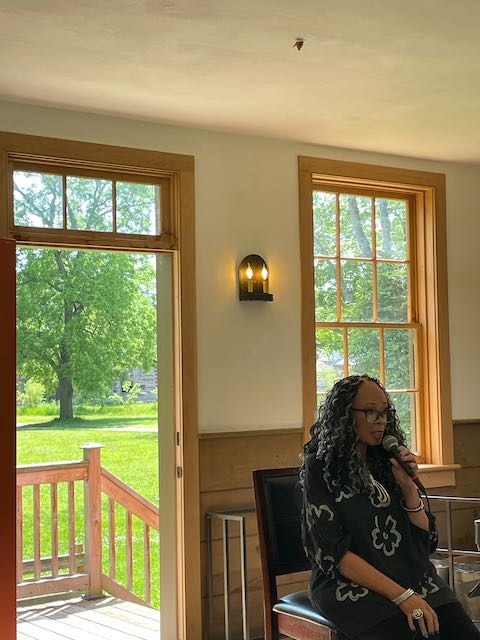
Note the butterfly on the ceiling. It was drawn in to the beauty of the music and fluttered above her for some time.
Then came the Fugitive Slave Chapel Preservation Project—a group of dedicated community members who saw what was at stake. They understood that losing this building meant losing tangible evidence of London’s connection to the Underground Railroad, to Black self-determination, to a history that many of us never learned in school. After years of work, fundraising, and careful restoration, the chapel was relocated to Fanshawe Pioneer Village in 2022, where it was fully restored by June 2023.
Walking into that building now, you can see the care that went into bringing it home. The wide-plank hand-hewn horizontal wainscoting that lines the walls speaks of an original open floor plan—a space where community could gather. The accordion lath visible in the corner near the front door tells you something about construction techniques that were common in the mid-1800s. The basement hatch door, the timber frame, the cedar siding painted in heritage colours—all of it speaks to authenticity, to respect, to refusal to let this building become a museum piece or a relic. It is a living space for gathering, learning, and listening.
Denise Pelley is a musician, educator, and storyteller of remarkable depth. She is, quite simply, one of the finest artists working in our larger community. She told the stories of Salome Bey and Lawrence Hill—two Black Canadians whose contributions to art, literature, and culture deserve to be known far more widely than they are.
Salome Bey: pioneering blues singer, songwriter, performer. “Canada’s First Lady of Blues,” they called her. Born in Newark, New Jersey, the Grammy-nominated singer, composer, and actress made Toronto her home in 1964. Bey profoundly shaped Canada’s music and theatre scenes by mentoring young artists and writing critically acclaimed cabaret shows like Indigo. Living in Toronto in the late 1970s, I knew the name well but didn’t know much about her. She was made an honorary member of the Order of Canada in 2005 and was later honoured with a commemorative stamp by Canada Post. Denise says that: “Three of the songs I sang during the Salome presentation were ones that she recorded. … I’m sure her interpretation showed the deep meaning those songs had. Actually still have.”
Then she told us about Lawrence Hill, (Dan Hill’s brother) the celebrated author of *The Book of Negroes*—a novel that brought the experience of Black Loyalists and freedom seekers into the consciousness of readers across the country. Both artists, in their own ways, carried forward the work of bearing witness, of speaking truth, of insisting that their stories and the stories of their people matter.
The acoustics in the little church are amazing. She sang, she spoke, she invited us into their worlds. And Stephen Holowitz, accompanied her. The acoustics in that church honoured the voices that had filled it nearly two hundred years ago. Beautiful gospel and blues. It was moving to experience art, music, and historical reflection in a space saved precisely because people understood that it was sacred ground.
The Glencoe & District Historical Society contributed $1,500 toward the preservation of this church. Lorne Munroe understood that heritage is not something that belongs only to the past. He made the motion and a few of us wondered why we needed to support a London project. But we passed the motion. Seeing that church in active use, full of community members engaged with story and song, made that investment feel like so much more than money.
Next event is September 27, 2026, the sixth edition focuses on Rose Fortune, Loyalist and Canada’s first female police officer, and hockey player, Herb Carnegie. Tickets to this 2:00 p.m. performance include admission to the Heritage Village, which is open from 10:00am – 4:00pm. at the Fanshawe Pioneer Village is located within Fanshawe Conservation Area. More details coming soon—check back here for updates!
Transcription from Panel in the church –
The African Methodist Episcopal Church (AME) is a Black denomination of the Methodist Church, founded during the late eighteenth century in the United States. Black Methodists faced discriminatory seating by white church leaders in some churches, and advocacy for equal treatment was unsuccessful. As a result, many Black parishioners decided to withdraw from congregations they were attending, and formed their own racially separate, Black Methodist churches. These churches led to the establishment of the African Methodist Church, also often called Bethel Methodists.
In 1840 the AME Church formed a Conference in Canada West. From 1840 until the AME Church was built, congregants likely met in members’ homes. In 1847, land was purchased at 275 Thames Street, (south of Bathurst Street) in London, Canada West (now Ontario) by the trustees of the African Methodist Episcopal (AME) Church. The indenture notes “… in trust that they shall erect, or cause to be built there on, a house or place of worship for the use of the Members of the African Methodist Episcopal Church.”
The trustees named in the property purchase included William Hamilton, Benjamin Harris, Henry James, Henry Logan, John Osburne, Thomas Wingate, and George Winemiller. They contracted the construction of a small timber-framed church which was likely completed in the early 1850s, and was the first church building to serve the Black community in London. James Harper was appointed as the first minister to lead services for the London congregation.
The area where it was built near the Forks of the Thames River, then referred to as “The Hollow,” was home to a growing Black community, which had established itself here even before London was incorporated as a city in 1855. At that time, the Black population in London was estimated to be over 350 people. In 1856, the AME Church became the British Methodist Episcopal (BME) Church, as a way of creating a distinctly Canadian Conference, separate from their American counterpart.
Canadian congregants wanted to identify themselves more closely with Britain and the British colony that granted them their freedom and equal rights. The BME Church still remains an active religious organization in a number of communities in today. Between 1848 and 1869, the AME Church served London’s Black community as a place to gather and worship. It also became a safe haven for many freedom seekers who fled enslavement in the United States, some by way of the Underground Railroad, and free Black people who came as well.
By May of 1869, the congregation had grown enough that trustees sold the Church on Thames Street, and built the more substantial brick Beth Emanuel BME Church at 430 Grey Street. The original timber-framed Church on Thames Street was then converted into a home. Used as a residence for over 100 years, the original purpose of the building was largely forgotten, but in 1986 a historic plaque was installed by the London Public Library to denote its significance.

