June 20, 2026 at The Archives, Glencoe: The Glencoe & District Historical Society welcomed twenty attendees for a wonderful Saturday morning session featuring guest presenter Evan Abma. The workshop was organized by Denise Corneil, Secretary of the G&DHS, who is a passionate advocate for documenting our region’s historical structures before they’re lost.
Evan, Chair of the Sarnia Heritage Committee and a leading voice in documenting Ontario’s disappearing rural heritage, shared the remarkable project he has built mapping historic farmhouses across Lambton County. Working from the observation that many homes featured in an old article on Warwick Township had since vanished, Evan’s small tracking project grew into a county-wide documentation effort. He has now catalogued 2500 historic farmhouses built in 1921 or earlier, recording their architectural styles and histories.
Evan chose Google MyMaps as his platform of choice because it is open-source, shareable, and free of any paywall — making the resulting map accessible to anyone, from researchers to curious homeowners. He walked the group through his entire process: the historical land registers, tax assessments, farm directories, topographic maps, census records, satellite imagery, and concession maps he draws on, as well as digital research tools like Newspapers.com, Google Books, and Ancestry.ca.
Attendees appreciated his academic rigour — Evan triple-checks sources and applies a confidence score to each entry, acknowledging that personal memory, while valuable, isn’t always as reliable as we assume.
The group was pleased to have local architectural designer Julie Field in attendance, whose work designing appropriate additions to older homes brought a practical, hands-on perspective to the discussion.
Why Are We Losing These Houses?
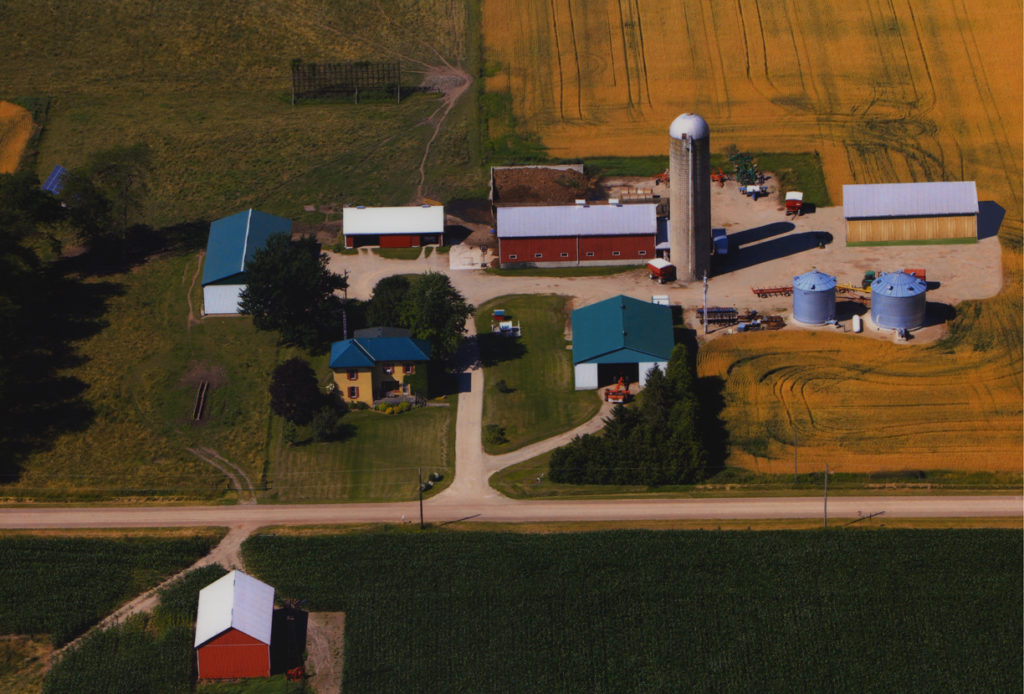
A central theme of the morning was the alarming rate at which Lambton County’s heritage homes — including its beautiful yellow brick farmhouses — are disappearing. Evan pointed to several converging causes:
- Most rural municipalities have no heritage registries, committees, or champions to advocate for at-risk barns, homes, and homesteads
- Farm consolidation and severances, which leave older farmhouses redundant
- Reluctant landlords — farmers who inherit a house but have no interest in being landlords, and opt to demolish rather than maintain
- The high cost and effort of maintaining older homes
- A general lack of appreciation for heritage value, paired with a lack of knowledge about heritage-appropriate materials and methods (Evan noted that even well-meaning repairs often use the wrong type of mortar, causing long-term damage)
- Fires — sometimes suspicious in origin — followed by estate sales
- A simple lack of preservation knowledge across the board
Evan noted that barns face an even steeper decline. The Ontario Barn Preservation organization, which is undertaking similar documentation work for barns — photographing structures and cataloguing architectural styles into a database housed at the University of Guelph — was sorry to miss the session but shares the same urgent mission.
Sources and Local Connections
Evan highlighted ONLAND, a free digital archive created when the Ontario government digitized historical deeds and survey records in the 1990s. He also credited the foresight of Harold Crothers, David McDonald, and Irene Matheson, who rescued filing cabinets full of deeds for Western Middlesex decades ago — records that now reside safely in the vault at our own Archives.
Check out The Google Map.
Link the Facebook Group Lost Lambton, Found!
What are the implications here in SW Middlesex?
The session sparked real enthusiasm for what’s possible locally. The Society’s vision is to build on work already begun by Blake McGill, starting with churches and schools, and to make that existing research accessible to the public using MyMaps and other digital tools. This presentation may help spark ideas for how we can apply similar methods locally, building on the work already underway in our community.
Call to Action: If you have an interest in historic farmhouses, rural architecture, mapping, research, or local history—and especially if you’ve already gathered notes, photos, or stories—this session is for you. Come learn, ask questions, and imagine what a shared, community-driven heritage map for Southwest Middlesex could look like. Your knowledge and curiosity are part of preserving the stories written into our landscape.
Background
Evan’s work began after he noticed that many historic homes featured in an online article about Warwick Township were no longer standing. What started as a small tracking project quickly expanded to all of Lambton County, revealing uneven patterns of preservation—some areas retaining many historic homes, while others have seen rapid decline.
These farmhouses represent more than buildings. They embody the aspirations of early rural settlers, marking a transition from log cabins to substantial homes that reflected permanence, prosperity, and connection to the land. Their loss, Evan argues, erodes not only housing stock but also our tangible link to rural history.


