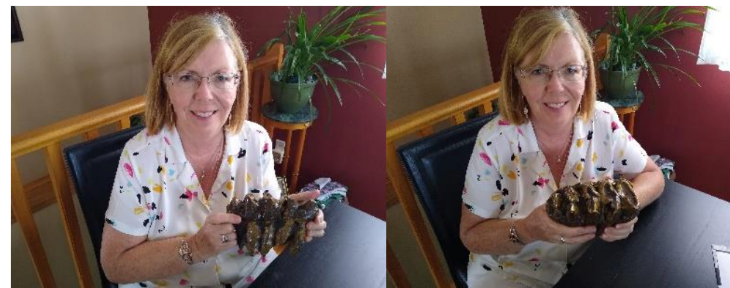
Glencoe Transcript, October 30, 1890: The bones of another Mastodon have been found on the farm of T. Jones, at. While plowing on Wednesday, the head, upper jaw, three teeth and one rib of a mastodon were ounearthed. The rib is 4 ft in length and the teeth are 3 in wide and 6 in long.. The parties are still digging, and additional discoveries are expected.
A Bit of History about the Mosa Mastodon
… by Glennda (WATSON) Dupuis, 2024
Mr. and Mrs. Andrew Watson, along with their two sons, Edward and James, came from Ompah, Ontario (in Frontenac County in eastern Ontario) in 1919. Andrew purchased a farm on the C.P.R. Road in Mosa Township (northerly half of Lot #8, Third Concession, Mosa Township) from Mr. George Innes.
Andrew and Elizabeth resided on this farm until Andrew’s death in 1947. James purchased the farm from his mother and resided there with his wife, Dora, until 1956, when they sold and moved into the town of Glencoe. Their children were Clara, Morley, and Glenn. I am Glenn’s daughter and James’ granddaughter.
In 1939, while plowing a drained bog on his farm, James unearthed two giant teeth which were later confirmed to be those of a mastodon. Each tooth weighed approximately 4.5 lbs (just over 2 kg) and measured approximately 7.5 inches by 4 inches.
Other bones were found on the site and were described by James as being “as far round as a football.” These were believed to be leg bones. Unfortunately, not being well versed in the preservation of fossils and not truly understanding what he had discovered, the process used to unearth these other bones resulted in them falling into pieces.
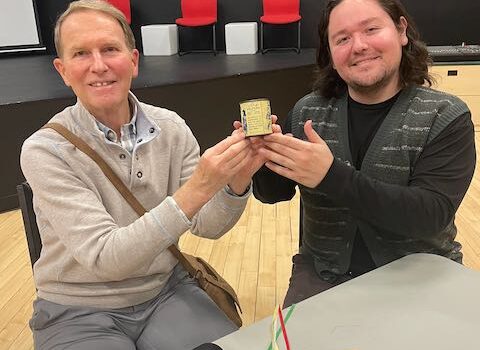
Brantford; On April 13, 2026, David Nelms and Mary Simpson travelled to Brantford, Ontario, to visit the Woodland Cultural Centre, located on the grounds of the former Mohawk Institute Residential School.
In their care was a small metal penny bank—simple in form, worn with age, and carrying with it the memory of a life.
The bank belonged to Jemima “Ina” Simpson Nelms, who passed away in the summer of 2025 at just over 100 years old. As a child growing up in rural Southwestern Ontario, Ina attended St. John’s Anglican Church in Glencoe. She received the penny tin through her Sunday School program known as “The Little Helpers.” She would save her pennies and drop them into the slot, believing—as she had been taught—that the money would help “the little Indian children.”
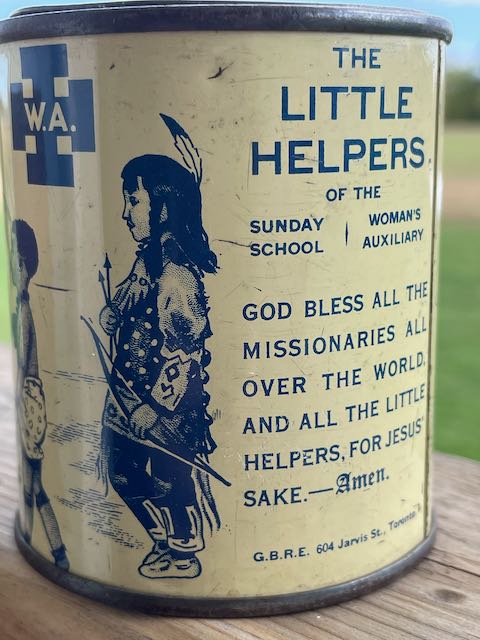
Printed on the surface are images of children from around the world, as they were depicted at the time, along with a short prayer: “God bless all the missionaries all over the world, and all the little helpers, for Jesus’ sake. Amen.” Strangely, the handsome North American Indigenous boy is standing aloof from the group. Jesus has his back to him and the child is not part of the group – he’s just watching.
The Little Helpers of the Sunday School. Penny bank sponsored by the Woman’s Auxiliary of the Anglican Church of Canada. The Indian child stands apart from the group of children talking to Jesus. Read more →
Glencoe & District Historical Society– Annual General Meeting for 2025 – 2026
President’s Report, Mary Simpson
Prepared for the AGM April 15, 2026– 7:00 p.m. Nineteen in attendance. The ARCHIVES, 178 McKellar St., Glencoe
Founded in 1978, the Glencoe & District Historical Society (G&DHS) was established to preserve and share the rich history of Southwestern Ontario, with a particular focus on the Glencoe area.
We are supported by a dedicated group of officers, directors, and managers—those remarkable volunteers who have taken on defined roles. Their commitment is the foundation of our work. General Manager Harold Carruthers and Vice President Norm McGill keep it all going, providing steady operational oversight, community presence, and mentorship to volunteers.
Mary Simpson’s report, Outgoing President
As I complete my two-year term as President, I do so with deep appreciation for the strength of this organization and the people who sustain it. I am pleased to be moving into the role of Past President, and to welcome Norm McGill as incoming President.
When I stepped into this role, I had a few simple hopes. I wanted the Historical Society to feel like a safe and welcoming place—where people could show up as themselves, and where we support each other in the work we care about. I wanted us to be inclusive, to open the door wider, and to recognize that everyone here has something valuable to contribute.
I also saw this Society as part of something bigger. Not just one organization, but part of a whole network of heritage work happening across our district—our museums, our libraries, our local historians, our community groups. Over the past couple of years, I think we’ve taken real steps toward connecting those dots, building relationships, and working more collaboratively.
At the heart of it, my goal has been to help us grow as a community-based organization—one that is rooted in the principles of community development. That means sharing leadership, supporting volunteers, encouraging initiative, and trusting people to step forward and take on meaningful roles. And we’ve seen that happen. Thank you, everyone—for your time, your energy, and your commitment to this community and its history.
This work doesn’t belong to any one person—it belongs to all of you. I’m very grateful for the chance to serve as President, and I’m looking forward to continuing in a supporting role as Past President. Norm, I know you’ll do a wonderful job, and I’m here to support you and the team however I can. – Mary Simpson
by Mary Simpson, Old River Farm, Mosa Township, Treaty 21.
Attending Mark French’s presentation at the Glencoe and District Historical Society (18 March 2026) felt like waking up to a responsibility I had never fully acknowledged. Mark, an Elder from Deshkan Ziibiing (Chippewas of the Thames First Nation) and husband of our G&DHS treasurer Diana Jedig, spoke about treaties not as dry legal relics but as living relationships.
As a farmer and settler whose family names – Simpson, Moorehouse, Pearce, McEachran, Stalker – are written into this land, his words left me moved. We begin meetings with a land acknowledgement, yet what follows? Learning about the treaties themselves, understanding how they were made in good faith, and recognizing the complex histories and losses Indigenous peoples have endured are our next steps. This piece is my attempt to articulate what I learned.
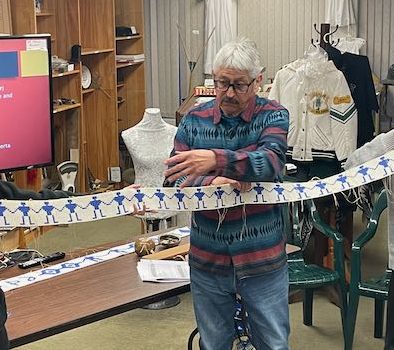
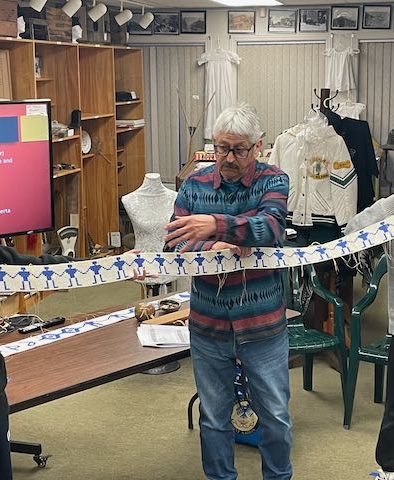
Mark French and his two grandchildren explain the significance of this wampum belt. March 19, 2026.
Treaties as Living Relationships
In Mark’s talk I learned that treaties are far more than legal documents. Indigenous peoples from this region have long understood treaties as formal agreements that create a framework for a relationship and an ongoing process for maintaining it. In Anishinaabe world views, all life is interconnected – plants, animals and other beings have spirit and agency, and humans carry reciprocal duties of care. A treaty establishes ongoing responsibilities to one another, to other beings and to the land.
Mark showed how Wampum belts (the ones shown here were crafted by his brother) are a powerful visual record of these agreements. Wampum belts are made of purple and white shell beads woven into symbolic designs that hold the words and pledges spoken in their presence. Each belt is a living presence that connects present treaty partners with generations past. When a belt is brought out, its story and obligations are renewed. These designs were not just art – they are instructions for relationship.
The originals back in the day were painstakingly crafted from small beads laboriously carved out of quahog shells. No wonder wampum, a currency, was so highly prized. No wonder the beads manufactured in Europe were welcomed along with other technological breakthroughs – iron pots, kettles, knives, and axes.
Wampum beads were crafted from purple and white quahog clam shells (Mercenaria mercenaria). They signify a sacred, living record of history, diplomacy, and spiritual beliefs for Northeast Indigenous nations. Far beyond currency, these shells symbolize peace, authority, and the interconnectedness of life, used to bind treaties, honor leaders, and preserve ancestral wisdom.
Local Treaties in Southwestern Ontario
Middlesex County rests on multiple treaties. Locally, we acknowledge that we are on the traditional lands of the Anishinaabek, Haudenosaunee, Lūnaapéewak and Attawandaron and that the area is covered by several treaties: the Two Row Wampum/Silver Covenant Chain, the Beaver Hunting Grounds (Nanfan) Treaty of 1701, the McKee Treaty of 1790, the London Township Treaty of 1796, the Huron Tract Treaty of 1827, and the Dish with One Spoon Covenant.
Responsibilities of Settlers
Settlers are treaty people. I had always thought treaty rights were something only Indigenous peoples had, but treaties are agreements that bestow rights and obligations upon both parties. Historic treaties established an ongoing relationship between settlers and First Nations where each group asserted rights and responsibilities in relation to the other. These agreements were meant to last “as long as the sun shines, the grass grows, and the river flows”, a phrase that emphasises permanence.
Being a settler treaty person means recognising both the rights granted to us and the responsibilities that accompany them.
Settler rights under treaties included freedom of religion, the right to share the land, the right to pursue agriculture and economic activities, the right to political self‑determination and the right to peace and goodwill.
These rights came with obligations: to respect Indigenous spiritual traditions, to recognise Indigenous control over reserves and resources, to honour Indigenous sovereignty and to maintain peace and goodwill.
Non‑Indigenous Canadians have a responsibility to know the treaties they are part of and the rights and responsibilities they have through them. The Indigenous Foundation notes that to honour treaty responsibilities, we must hold the Canadian government accountable when it violates treaty obligations. This means educating ourselves, insisting that governments respect treaties, and supporting Indigenous communities when they assert their rights.
Mark also spoke about how Indigenous peoples have endured broken promises, land theft, residential schools and other systemic violations despite upholding their treaty responsibilities. Settlers often colluded in these injustices by refusing to understand their own history. Recognising our own ancestors’ complicity does not condemn them but calls us to do better.
Mark explains the design and significance of the wampum – a sacred, living record of history, and diplomacy.
Being a Treaty Person: Learning and Action
KAIROS Canada summarises what it means to be a treaty person: everyone living in North America – Turtle Island – is a treaty person, and treaties are living relationships meant to guide how we live together based on mutual respect, peace and sharing. Being a treaty person brings responsibilities:
Learn the truth about the land we live on. Start by discovering whose traditional and treaty territory we reside on. Tools like Native-Land.ca can help.
Uphold the spirit and intent of the treaties. Treaties were agreements to share the land, not to surrender it. We must honour sharing and reciprocity.
Listen to and follow the leadership of First Nations. Indigenous peoples continue to uphold their side of treaty responsibilities despite systemic injustices. Our role is to support and not override their leadership.
Reject erasure, stereotypes and colonial myths. This includes challenging narratives that depict treaties as mere land sales or Indigenous peoples as obstacles to progress.
Take action towards justice and reconciliation. This might include supporting Indigenous land claims, participating in treaty education and engaging in land stewardship initiatives.
As farmers, we can also take concrete steps. In Saskatchewan, there is an interesting program called the Treaty Land Sharing Network which encourages non‑Indigenous landholders to voluntarily open their privately owned land to Indigenous peoples for cultural practices, ceremony, harvesting and gathering. This grassroots initiative recognises that treaties were meant to share land, not to exclude. By building relationships through land-sharing, the network renews treaty responsibilities and helps Indigenous land users reconnect with their traditional territories.
Reflection from a Settler Farmer
I know that the land is not something owned outright but loaned to us by previous generations and entrusted to us for future ones. I love the matriarchal reverence for ancestors, respect for elders and for the earth that nurtures us.
Coming from a long line of settlers, the McEachrans, the Pearces, Stalkers… I take pride in the hard work of my ancestors – particularly my many great grandmothers and their daughters. The grinding labour to clear fields, plant, harvest, grind grain, feed and cloth their families. But the truth is: my clans’ prosperity would not have been possible without treaties that opened land to settlement and the dispossession of Indigenous peoples. -Mary
Mark spoke about how Indigenous communities view ancestors not as distant memories but as active participants in community life, guiding decisions and reminding us of responsibilities.
I also learned that acknowledging the land is only the beginning. Many land acknowledgements emphasise gratitude and respect for the natural world, but they conclude by stressing that awareness means nothing without action and encouraging everyone to take steps toward decolonising practices. Mark challenged us to move beyond reciting acknowledgements and to engage with treaty education. Treaties involve complex histories; some include fair negotiations, while others involved coercion or misunderstanding. Many treaties were not honoured, leading to the erosion of culture, language and land.
The injustices that plagued Indigenous communities – broken treaties, residential schools, dispossession – are mirrored in today’s world where economic deals often harm those without power. As settlers’ descendants, we must see the patterns: the same disregard for human dignity continues when corporations put profit over people. When we understand that the exploitation of Indigenous peoples is part of a larger pattern of injustice, we can better align ourselves with those fighting for justice today.
Moving Forward: Commitments from the Heart
Writing this piece has prompted me to articulate personal commitments that flow from my treaty responsibilities:
Educate myself and others. I will learn about the treaties that cover the land where I live and farm. I will seek out Indigenous perspectives on these treaties, recognising that official documents often omit Indigenous voices.
Support Indigenous leadership and initiatives. When Indigenous communities call for action – whether it is opposing harmful development projects, asserting land rights or protecting water – I will listen, amplify and support them. This includes holding governments accountable for treaty obligations.
Participate in land sharing. Maybe we can create a Treaty Land Sharing Network in Ontario and open parts of our farm for Indigenous cultural practices and harvesting. Sharing the land honours the spirit of treaties and builds relationships based on reciprocity, and sounds like fun.
Challenge colonial narratives. When conversations around me diminish Indigenous rights or depict treaties as outdated, I will challenge those views. I will share what I have learned about treaties as living agreements and about our shared responsibilities.
Teach future generations. As a parent and community member, I will ensure that next gen farmers understand that they are treaty people, too. They need to know whose land they farm and the obligations that come with that privilege.
Writing from the heart means acknowledging both the pain and the hope. The pain lies in the injustices inflicted on Indigenous peoples and the realisation that my own prosperity is tied to that history. The hope lies in the possibility of renewed relationships based on honesty, respect and shared stewardship. Treaties are not relics; they are living promises.