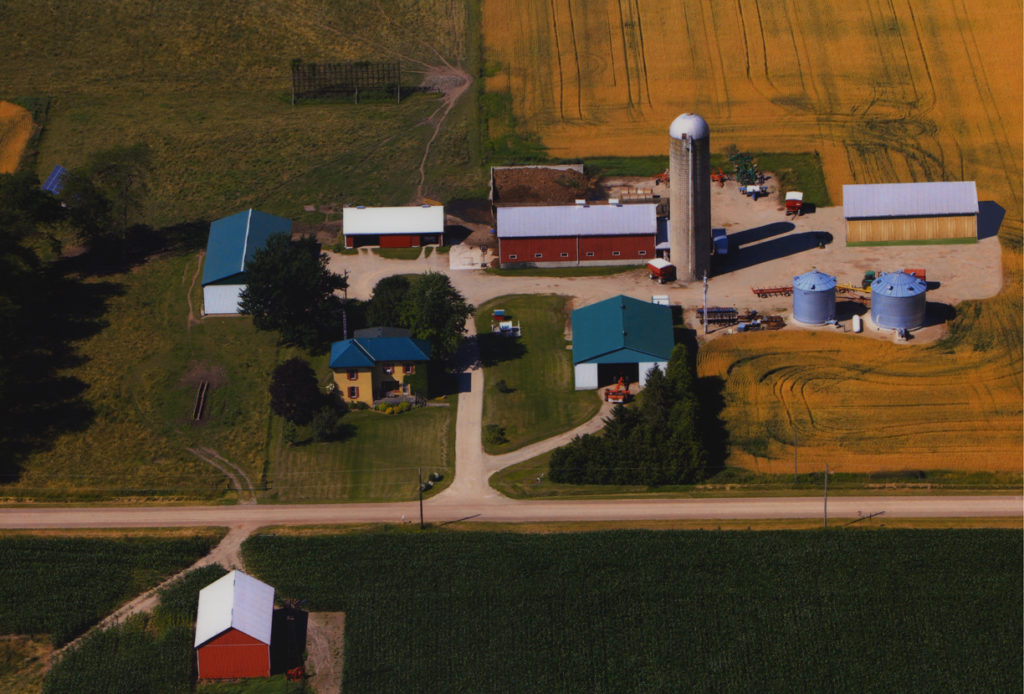
McGill Farm History & the Gunnery School

My name is Andrew McGill, I’m a young farmer and a photographer. I grew up on a farm 6 kilometres north of Glencoe, Ontario. In mid 1940 my great grandfather Fred McGill purchased a farm building which was to be moved from the site of the No. 4 Bombing and Gunnery School at Fingal Ontario. The building was dismantled and moved 45 kilometres north of Fingal to its final resting place on the McGill farm at Taits rd. Glencoe where it has sat to this day. My father and I think the building was then reassembled with a new roof sometime in 1941. The site of No. 4 B&G school sat on a swath of 724 acres of land that was returned to the crown for the purpose of building the training facility. One can imagine the numerous agricultural buildings on the land that would have had to be dismantled and moved in short order to make way for the multiple airplane hangers and triangle runway of the Fingal school. 

Aerial photo of the McGill farm circa 1977. The building in question can be seen directly to the left of the barn. (Photo care of McGill family Archive, 1977.)

McGill farm building moved from Fingal Bombing And Gunnery School site in 1940. (Photo: Andrew McGill. September, 2022.)
Aerial photo of the site of the Fingal Bombing and Gunnery School. (Photo: Commonwealth Air Training Plan Museum.)
Route from Fingal B&G school site to the McGill farm. (Photo: Google Maps)
Interior detail of the McGill farm building which continues to house tools and horse equipment which would have been used by the late Fred McGill circa 1940’s. (Photo: Andrew McGill, 2016.)
A restored 1942 Minneapolis Moline “Waterloo” tractor stored in the building on the McGill farms site. (Photo: Andrew McGill, 2022.)
Winifred (Eddie), Fred, and Blake McGill using their 1942 Minneapolis Moline Tractor to plant sugar beets for seed to aid the allied forces war effort. (Photo care of McGill family Archive, 1942.)
Alternate angle of Winifred (Eddie), Fred, and Blake McGill using their 1942 Minneapolis Moline Tractor to plant sugar beets for seed to aid the allied forces war effort. (Photo care of McGill family Archive, 1942.)
Clare McGill and Dorothy Brown in front of the McGill homestead with the 1942 Minneapolis Moline “Waterloo” tractor. (Photo care of McGill family Archive, 1942.)
Clare, Winifred (Eddie), and Blake McGill in front of the McGill homestead to mark the moment King George VI announced enlistment of eligible men into the military in Canada. (Photo care of McGill family Archive, 1941.)


Blake McGill standing with his newly restored 1942 Minneapolis Moline tractor on the McGill farm in 1993. (Photo care of McGill family Archive, 1993.)
McGill Farm
Aerial photo of the McGill farm taken the year of its 100th anniversary in 2016. The relocated building can be seen clearly to the left of the barn. (Photo care of McGill family Archive, 2016.)
Dorothy (Knapp), Doug, and Ron McRae in Ilderton Ontario, 1955
Dorothy (Knapp), Doug, and Ron McRae in Ilderton Ontario, 1955. During WWII, as a 13 year old, my grandmother Dorothy along with her schoolmates were tasked with finding a plant called Alder Buckthorn, which because of its consistent burn time was used to create fuses for depth charges used to sink German navy vessels. It is told that Dorothy found enough of the valuable plant for her father to pay off the mortgage of their farm. (Photo care of the McRae family Archive, 1955.)

The #4 Bombing and Gunnery School

Three perspectives on the local  #4 Bombing and Gunnery School during WWII were presented at the Archives, 178 McKellar St, Glencoe October 12, 2022 from 7 p.m. to 9 p.m.  

Blair Ferguson, local author of Southwold Remembers: The #4 Bombing and Gunnery School brought some great artifacts. Blair is an authority on the local training facility which is located at the Fingal Wildlife Management Area. His book is filled with stories about the people who worked there.

Andrew McGill is a local photographer and farmer. Andrew presented his family’s personal connection to the Gunnery School.   

Paul Anderson, author of Eric Stirling – The Missing Son – A Recollection of His Life, (published privately) joined us from his home in New Zealand via Zoom. Young Eric Stirling joined the airforce and like so many young guys from the Commonwealth, he was trained in Canada at the #4 B&G School. He never made it home.

The young men were SO young. The movies cast actors in their 30s so we forget that WWII was the first adventure off the farm for many young soldiers. Eric was 24. Many were not even 18.

Salvaged from the Ruins: book launch Al McGregor

Al McGregor has launched his new book: Salvaged from the Ruins – A Novel of 1945. As One War Ends Another Begins.  Al’s novels serve up history with drama, great characters, and several intersecting storylines to keep things exciting. It’s hot off the press. Let’s help our local writer sell lots of copies.  http://almcgregor.com/

Salvaged from the Ruins is a story about the end of WWII when millions of refugees flood Europe – a time when compassion is another casualty of war. The story is set against the events of 1945 in Europe, Canada and the United States.

Local author Al McGregor specializes in historical fiction. His books are based on the Canadian experience with an emphasis on Southwestern Ontario.

G&DHS was happy that their first ‘hybrid event’ went off without a hitch Wednesday, September 28th at the Archives in Glencoe.  Al also signed books at Glencoe Fair a few days prior.  

Here is a link to Al sharing his personal story as part of the Senior’s Life in the Talbot Settlement Series: Al McGregor

Conflict doesn’t end with surrender. The evidence is in the Ruins.

Al McGregor's Website: http://almcgregor.com/
Al McGregor tells his audience about the historical backstory to his new novel.
Al McGregor's Oral History 15 minute tale told to the Seniors Oral History Project, telling about growing up in West Elgin, how he got into broadcasting, and his love for writing historical fiction!