Willey Cemetery, 5267 Gentleman Drive, Ekfrid Township, Southwest Middlesex
Willey Cemetery Commemoration Ceremony
Sunday, July 26, 2026
2:00 p.m.
Willey Cemetery Ceremony Honours Two Centuries of Loyalist and Militia Service
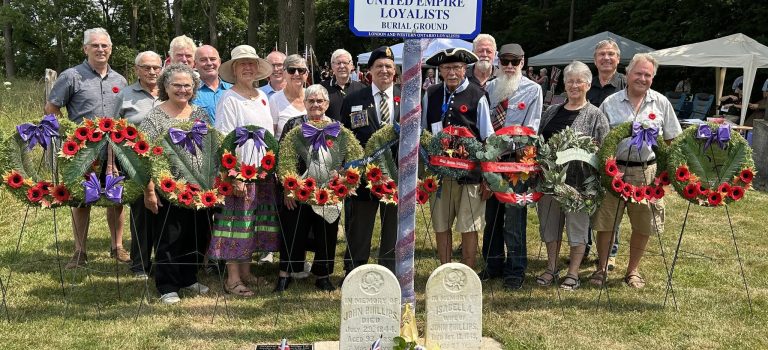
On Sunday, July 26, the Glencoe & District Historical Society joined the Municipality of Southwest Middlesex, the United Empire Loyalists’ Association of Canada, and over 60 guests at Willey Cemetery to formally designate the site as a United Empire Loyalist Burial Ground and to unveil commemorative plaques honouring Corporal John Phillips, UEL, and his son, Sergeant Peter Phillips, UE.
The afternoon opened with piper Rob Easton’s prelude and the singing of “O Canada,” followed by an Indigenous land acknowledgement from GDHS President Norm McGill and welcomes from Southwest Middlesex Mayor Allan Mayhew, Middlesex County Warden Susan Clark, and UELAC London Branch President Carol Childs, who brought greetings on behalf of the national Association and formally recognized Willey Cemetery as a Loyalist Burial Site.
A Sweep Through Two Wars
The heart of the afternoon was a history presentation delivered by Master of Ceremonies, Retired Major Greg Childs, tracing the military service that brought both Phillips men to Ekfrid Township.
Childs began well before the American Revolution, with the French and Indian War — the North American front of the global Seven Years’ War between Britain and France. He walked guests through the chain of consequence that followed: France’s push into the Ohio Territory, Britain’s costly victory (including the 1760 battle on the Plains of Abraham), and the war debt that led King George III to tax Britain’s thirteen colonies. That taxation, Childs explained, was a principal spark of the Revolution — a war many colonists refused to support, instead forming militia regiments loyal to the Crown. Corporal John Phillips served in one of these, the New Jersey Volunteers, seeing action at Staten Island, Charleston, King’s Mountain, and numerous smaller engagements.
Childs placed the Phillips family’s story inside the larger Loyalist migration: some 50,000 refugees, of Indigenous, Black, white, and mixed backgrounds, driven from the thirteen colonies for their loyalty to the Crown during the nine years of the Revolutionary War, many suffering incarceration and the loss of land and wealth. Those who resettled in what became Canada were granted 200 acres of uncleared land, often in strategically sensitive areas, and Lord Dorchester’s grant of the hereditary “U.E.” designation to their descendants — Canada’s only hereditary post-nominal honour — marked their commitment to the “Unity of the Empire.”
From there, Childs turned to the War of 1812, describing how Britain’s blockade of Napoleonic France, and the Royal Navy’s practice of seizing sailors from American ships, prompted President Madison to invade Canada with three armies — forces that, on paper, outnumbered the British and Canadian militia eightfold. He credited the discipline of commanders like General Brock, and the effectiveness of First Nations allies such as Tecumseh, with a defence that held. Sergeant Peter Phillips, serving with the Oxford Militia, fought at the Siege of Detroit, the Battle of Frenchman’s Creek, the Battle of Nanticoke Creek, the Battle of Lundy’s Lane, and the Battle of Malcolm’s Mills. Childs noted, too, the war’s cost to Canada’s First Nations allies, whose promised territory in Michigan and points west was abandoned by British negotiators at the Treaty of Ghent.
Harold Carruthers, UE, and his daughter Natasha Carruthers Kalita followed with a closer look at the combat service of both Phillips men, grounding Childs’ broader history in the specific record of the two soldiers being honoured that day.
Remembrance and Recognition
The ceremony moved into its most solemn portion with the Act of Remembrance: the Last Post, two minutes of silence, a piper’s lament of “The Flowers of the Forest,” the Rouse, and a three-volley salute fired by re-enactors from the Royal Scots. A moment of silence was also held for the late GDHS member Ken Willis.
Wreaths were laid on behalf of Middlesex County, the Municipality of Southwest Middlesex, the Royal Canadian Regiment (which holds the Right of Perpetuation for both the 1812 Oxford Militia and the Middlesex Militia), Chippewa of the Thames First Nation, three Royal Canadian Legion branches (Reg Lovell #219, Melbourne #510, and Newbury #583), the Phillips family itself, the UELAC, the Historical Society, and the Royal Scots re-enactors. The ceremony closed with “God Save the King” and an invitation to fellowship at the Reg Lovell Legion Branch in Glencoe.
Special recognition was given to Harold Carruthers for his research and physical preparation work at the cemetery, to genealogist Vanessa Warner, UE, for establishing the martial record of both Phillips men, to Piper Rob Easton, to the Royal Scots re-enactors, and to the War of 1812 Gravesite Project, which funded the granite plaques placed at the site.
The ceremony fulfills the goal set out in the Society’s original call to attend the event: securing Willey Cemetery’s designation and beginning the work of stabilizing a site whose concrete surround has cracked and shifted with age. The Society continues to steward Willey Cemetery on behalf of families whose descendants are no longer able to maintain it directly.


