A Remarkable Revival of Scots Gaelic Heritage at Tait’s Corners
Written by Trevor Aitkens | Directed by Antje Giles Performed November 15–16, 2025
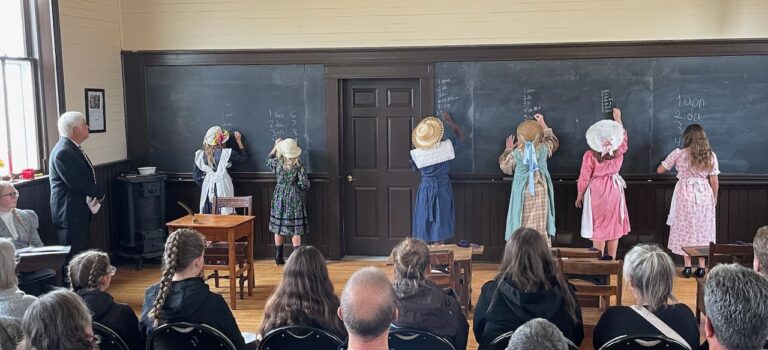
The Glencoe & District Historical Society was honoured to sponsor and support June Journey / Turas an Ògmhìos, a beautifully crafted Gaelic play written by Trevor Aitkens and hosted at the historic Tait’s Corners Schoolhouse. Over three sold-out performances on November 15–16, 2025, audiences filled the lovingly restored 1910 one-room school to experience a deeply moving, often humorous, always heartfelt return to the early school days of our region.
A Cast of 18 Bringing 1910 Back to Life
The production featured a remarkable cast of 18 local actors, intergenerational in age and representing families from across Southwest Middlesex and Strathroy-Caradoc. Their portrayals of teachers, students, elders, and neighbours transported audiences directly into a 1910 classroom at the very moment when Scots Gaelic—the language of their parents and grandparents—was slipping out of daily use.
The cast brought warmth, laughter, tenderness, and occasional heartbreak to the stage. Audience members noted that the play felt “like watching our great-grandparents speak again.”
The cast takes a bow. the students earned a certificate for their commitment to learning Gaelic and their lines.
The Glencoe area was settled predominately by Scottish immigrants many of whom spoke Gaelic.
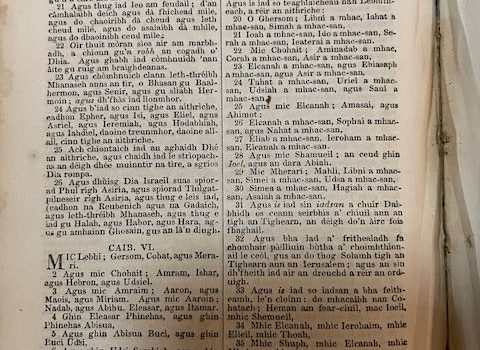
Duncan Mitchell (1838-unknown) from Metcalfe Township lived on the South 1/2 of Lot 18, Conc 13. He had this book of 41 Gaelic poems published localy in Rodney, Ontario in 1887. This book was generously donated to the Historical Society from the McAlpine family in 1986, and several poems were translated by Donald Campbell in 1999.
D. Campbell included notes with the translation explaining that most Gaelic speakers did not learn to read and write from formal education, and that to a modern reader his spelling is very poor. He surmises that Duncan was likely quite a fluent speaker who wrote in Gaelic using what he had learned from personal study and practice. Campbell also states that he clearly used a regional dialect of Gaelic and that he was writing according to his accent, which was common.
Druchd Na Beinne (Original Gaelic Text) Druchd na beinne, druchd na beinne, Druchd na beinne, o anail Chriosd, Druchd na beinnes’s Dia bhi lienne ‘N am na gainne’s gus a chtioch.
Druchd na beinne, gu ar comhdach, Air an lon anar bhios sin sgith; druchd na beinne bheiradh beos dhuinn Air an rod san tsaoghal shios.
Druchd na beinne ann’s an fhasach, Gu ar sasachadh gu sior: Leis an dochas chaoidh nach basaich; Ach gu brath a mhareas fior.
Druchd na beinne ‘n am an earraich, Gu ar tarruinn dhionnsuidh Chriosd Druchd na beinne tha toirt barrachd: Bheir nach fannaich sin gu sior.
Druchd na beinne tha cho beodhach, Air na rosaibh sruthadh sios; ‘S leam bu tatneach e bhi dortadh; Air gach neonnan buidhe blion.
Druchd na beinne ‘n am an t’samhraidh, ‘S e a b’ansuidh lainn gu fior; Gu ar cumail dlu r’ar n’annsachd: ‘S tiormachd samhraidh orn’ a crion.
Druchd na beinne ‘n am an fhaoghair, Gu ar cumail dlu ri Criosd; Gu ar neartacha ‘S g’ar cobhair: Ann’s gach obair gus a chrioch.
Druchd na beinne’n am a gheamhraidh, ‘N nar bhios teanndtachd air tir; Druchd na beinne chum na cranndachd: Chuir a dh’ anntaobh chaoidh gu sior.
Druchd na beinne ann’s an t’siorruitrheachd, ‘S mi nach iarradh uaith gu fior; Ach bhi’m shuidhe’n sgail na diadhachd: ‘N glachdadh Chriosd gu suthinn sior.
The Dew of the Mountain (English Translation) The dew of the mount, the dew of the mount, The dew of the mount from the breath of Christ, The dew of the mount God being with us In the time of famine, to the end.
The dew of the mount, to cover us, on the morass when we are tired; dew of the mount that would enliven us on the road in the earth below.
Dew of the mount in the wilderness, To give us satisfaction never ending: with the hope that will never die; But forever will last true.
Dew of the mount in the spring time, Drawing us toward Christ Dew of the mountain that surpasses: Enabling that we shall not faint ever.
Dew of the mount that is so enlivening, On the roses dripping down; With me would be desirable to be pouring; On each small wilted yellow flower.
Dew of the mount during summer time, It would be preferable to us; to keep us close to our attachment: while drought of summer withers us.
Dew of the mount in time of autumn, To keep us close to Christ; Strengthening us, relieving us: in every toil to the end.
Dew of the mount in time of winter, When the land is paralyzed; Dew of the mount to put anger: To one side always and forever.
Dew of the mount in eternity truly, I would not desire to be without; But that I’d be sitting in the shadow of God: in the everlasting embrace of Christ.
Known locally as the “Mush Hole,” the Mohawk Institute in Brantford, Ont. was Canada’s oldest and longest-running residential school. But on September 30, 2025, it officially became an interpretive historic site. On that solemn day, what was once a place of suffering, erasure and intergenerational trauma was reborn as a museum, teaching site—and a space for truth-telling, remembrance and hope.
The transformation was decades in the making, built on persistent activism, deep community engagement, archival research, restoration efforts and, above all, the resolve of survivors and Indigenous leadership that this history not be buried.
Behind the Bricks: A New Chapter
At the London Museum on September 25, Mary Simpson attended the launch of Behind the Bricks: The Life and Times of the Mohawk Institute. Edited by Richard W. “Rick” Hill Sr., Alison Norman, Thomas Peace and Jennifer Pettit, Behind the Bricks draws together Indigenous and settler historians, community voices, archival researchers, archaeologists and survivors to reconstruct the layered history behind the walls of the institute. Another launch event was held by the Ontario Historical Society a couple nights later.
The book begins by tracing the school’s founding and historical context, before delving into the its architecture and physical spaces, the curriculum and daily regimes imposed on children, religious and governmental oversight, student resistance, and the long process of commemoration and preservation. To close, Behind the Bricks allows survivor voices to speak directly, offering their unique perspectives of lived experience.
The editors have emphasized that the Mohawk Institute was not an isolated institution—it was in many ways a model or prototype for national residential school policy. The takeaway: What can this case teach us about the wider system of Indigenous schooling and control in Canada? How did notions of “civilization,” assimilation and authority operate in this place? How do we reckon with the spaces—the bricks, corridors and dormitories—that bore witness to so much pain? Behind the Bricks does not offer easy answers, but rather invites readers into the difficult task of listening, digging and reflecting.
There is never a doubt that a soldier marching obediently into a volley of musket fire is a hero. An army surgeon, his white apron stained with blood, working countless hours in the heat to save whomever he can, is also a hero. What of Generals, Lieutenants, and Captains who give orders, strategize, and feel the weight of entire armies on their shoulders as they command men to give everything to a cause? Surely, they are heroes as well. Historically, it seems easy to list the heroes of war, but it is rare that ordinary women and children are included on these lists. Today, I invite you to consider those left behind. They are not left behind by choice or lack of courage. Not because they didn’t feel the pull of the cause as deeply and passionately as their male counterparts. They were left behind, in the shadows, to do what women have always done: endure the hardships and try and prosper, all while maintaining their family’s wellbeing.
“Soldiers on a March.” The Army Children Archive (TACA), 14 Jan. 1884, www.archhistory.co.uk/taca/move.html. Accessed 14 Aug. 2025.
Contributions by Brian Huis and Gregory Childs. Edited by Mary Simpson.
On Sunday, July 27, 2025, the Simpson Cemetery in Southwest Middlesex came alive with memory, history, and community spirit. Over 50 descendants, neighbours, and friends gathered under the shade of the massive White Oak “heritage tree” for the annual cemetery memorial hosted by the Glencoe & District Historical Society (GDHS). This year a group of Simpson descendants, Micheline Champagne-Johnston, Wanda Simpson, Wendy Bestward, Jan Simpson, Dennis Simpson, Mary Simpson, and Brian Huis, joined in to give the event an interesting twist.
Cemeteries, particularly in rural Ontario, have long been places of both remembrance and reflection. Their park-like settings provide green space, cultural continuity, and a sense of belonging. This year’s memorial carried on the tradition of visiting and honouring one local cemetery each year.
Cemeteries are not only about the past; they are living classrooms and gathering spaces that remind us of who we are and the legacies we carry forward. – Brian Huis
Honouring Nicholas Bodine, War of 1812 Veteran
The central feature of the 2025 memorial was the recognition of Private Nicholas Bodine (1788–1885), a War of 1812 veteran buried in Simpson Cemetery. Bodine served in the 2nd Company, 1st Regiment of the Norfolk Militia and fought at the Battle of Lundy’s Lane on July 25, 1814—one of the war’s bloodiest encounters.
Nicholas’ service with the Norfolk Militia is perpetuated by the current Reserve Army Regiment, The 56th Field Artillery Regiment of the Royal Canadian Regiment of Artillery (56 FD), headquartered in Brantford. The Government of Canada awarded several War 1812-15 battle honours: ‘Detroit’, ‘Niagara’, ‘Queenston Heights’, ‘Defence of Canada 1812-15’, some of which, if not all were likely fought by Nicholas. The Norfolk Militia was also involved with the skirmish at the McCrae House near Chatham.
Born in Pennsylvania, Bodine came to Upper Canada in 1811, married Charlotte Sovereign, and farmed 50 acres in Mosa Township. His long life of 97 years was remembered in the Glencoe Transcript obituary of 1885, which praised his loyalty, faith, and wide respect in the community.
Glenn Stott and son, Brad Stott, stand attention to honour Nicholas Bodine, September 27, 2025Read more →
The UTMRS— the Royal Scots —are more than skilled re-enactors; they are devoted stewards of local memory and dedicated community builders. Under the leadership of committed champions like Glenn Stott, they have brought the history of the Battle of the Longwoods to life for countless residents and visitors alike.
The Longwoods Memorial Service, held each March, is a vivid example of their impact. For decades, the story of the March 4th, 1814 skirmish was largely forgotten. In the 1980s, when my mother, Betty Simpson, noticed a solitary wreath placed at the federal monument near our family home, she discovered it was the Royal Scots who had revived this commemoration. Their dedication inspired local neighbours and organizations—including our Historical Society—to get involved and ensure the memory of those who fought and fell is never lost again.
The Royal Scots’ efforts extend beyond a single memorial service. They have taken on the ambitious Longwoods Heritage Weekend, an undertaking that draws families, students, and history enthusiasts from far and wide. Through authentic re-enactments, educational demonstrations, and engaging storytelling, they make our shared past accessible and meaningful for new generations.
Moreover, the UTMRS’s leadership and volunteer spirit have rippled outward. Champions like Glenn Stott were early supporters of the Canada Barn Quilt Trails project—encouraging community heritage work far beyond the battlefield. Their members give countless hours in costume and behind the scenes, sharing history with honesty, passion, and respect for the land and peoples connected to these stories.
Their work has even inspired film. The 2017 documentary by Barbara Urbach and Crocodile Productions is a testament to how the UTMRS bring history alive in both intimate, human ways and grand, dramatic moments on our historic landscapes.
In every sense, the Upper Thames Military Re-enactment Society are true keepers of our community memory. Their dedication ensures that stories like Lieutenant Patrick Graeme’s sacrifice—and the broader heritage of the War of 1812 in our region—continue to inspire reflection and understanding.
For these reasons, the Glencoe & District Historical Society wholeheartedly endorses the Upper Thames Military Re-enactment Society for the Governor General’s History Award. They richly deserve this recognition for their outstanding contribution to community history and heritage education.
There is so much more we could add. Please do not hesitate to reach out to us to learn more about their wonderful community work. It’s so much fun to work with them – they never say ‘no’ when we ask for a re-enactor to attend an event – no matter how small or modest the event is.
Stories about the Kilmartin community who established Burns Presbyterian Church in the hills of North Mosa.
Jennifer Grainger reporting from Mosa Township: On Sunday, March 30 at 2:00 pm I attended a rare event, an historic church celebrating an anniversary. At a time when many rural churches are closing, it’s a pleasure to see one commemorating the 190th anniversary of the congregation.
The March 30th event wasn’t an actual church service, mind you, but a celebration of the surrounding community and the role Burns Presbyterian played in it. The occasion, more historical than religious, was entitled “A Stroll Through Time.” Actors portrayed fictional, but plausible, characters from the church’s past, including an early Scottish settler, a later Dutch arrival, the last Precentor, a member of the women’s auxiliary, etc. Sometimes amusing and often poignant, the stories of former congregants were well written and allowed the modern audience to imagine life in Middlesex County, Ontario in the Good Old Days.
The Canadian Government created the Public Archives of Canada in 1872. In Europe, archives retained government records only with personal papers going to libraries as manuscripts. The Dominion Archivist of Canada determined that all personal records of historical and cultural value should be collected as well as government records, with both being stored in the Public Archives. This Total Archives approach was a departure from other countries and is known as a Canadian contribution to archival theory and practice. Over time, multi-media records were added to collections in addition to traditional paper records. Many other national, regional archival programmes, as well as those in municipalities or universities, have adapted the total archives concept. The area municipal and university archives adopt this strategy as does the Provincial Archives of Ontario.
The benefit of this approach is that archives hold records for researchers about family history such as searching houses, land or any other item of interest. The government records also provide some of the information required in these searches. Having municipal records available – if they are open to the public – are advantageous to researchers and also to Municipal Clerks or staff, who sometimes are contacted by genealogists with family history requests. Municipal staff benefit by being able to transfer those questions to properly-trained staff who have access to, not only government records, but also personal papers and other resources. This removes the need for municipal staff to answer questions in an already busy day and provides researchers with a one-stop location. Genealogists account for over 40% of archives’ users who travel to areas specifically to visit Archives. While there, their tourist dollars support restaurants, hotels, local merchants and other local amenities.
An Archives is a program, not a project. Continued funding and municipal support are required to ensure the success of the Middlesex County Archives.
Written by the Committee to Establish a Middlesex County Archives, July 2021
CBC Radio ‘Ideas’: Until the past few years, the story of the Chatham Coloured All-Stars was not widely known outside their hometown. But thanks to the Chatham-Kent Black Historical Society and the University of Windsor’s Centre for Digital Scholarship, with the help of the Harding family, the legacy of the Chatham Coloured All-Stars lives on. They reconstructed the 1934 season, and the team’s history through newspaper clippings, scrapbooks and interviews with the players and their descendants.
Everyone’s efforts led to the Chatham Coloured All-Stars being inducted into the Canadian Sports Hall of Fame in 2022 — 88 years after their 1934 season opener.
Listen to this hourlong podcast by CBC Ideas. Link here.
Everybody knew, in the neighborhood, all the men playing on the team…. And they played a really competitive, athletic, exciting kind of baseball.
Five months after their opener in October 1934, the Chatham Coloured All-Stars became the first all-Black team to win the Ontario Baseball Association championships, then known as the Ontario Baseball Amateur Association.
Over 60 history buffs gathered, in person and online, to listen to Doug Ferguson as he described his “Ancestral Odyssey” at the Glencoe and District Historical Society Archives on Wednesday evening, January 17, 2024. His Ferguson ancestors had left Craignish, Argyleshire for Aldborough Twp. in 1818 and then moved to northern Mosa Twp. in 1827. The McDonalds left Inverness for Quebec in 1830, before settling in Ekfrid Twp. in 1835.
Near the house there is a sturdy oak tree that I always think of as one of the oldest of my friends. I grew up with it. Of course that is not exactly true, for I stopped growing many years ago, while it kept on growing, and it may keep on growing for centuries to come. But when I was a growing boy it was just the right kind of a tree for me to chum with. It was not too big to climb, and yet it was big enough to take me on its back and carry me into all the dreamlands of childhood.
What happens when the story gets twisted? The story keeper and the storyteller got their wires crossed. Bunny, the story keeper, decided to tell a different story about her son. And the extended family all colluded. Eventually the son found out his true story – ‘the last man standing’. Tom Wilson discovered he is a descendant of mohawk warriors, hunters and chiefs …but he was denied the truth until he was in his 50s. You can see his artwork at the TAP Centre of Creativity until December 21st. Now he gets to tell his story – his story can be viewed here on film.
Everyone has a story. And all our stories are compelling and amazing. Why not write yours down for your descendants? Our children want to know about their ancestors and our ancestors want us to tell their stories. Truth preferred – the truth as we know it and have experienced it. Story keepers and story tellers. – Mary Simpson
Art by Tom Wilson
TAP Centre for Creativity presented Mohawk Warriors, Hunters and Chiefs, a solo exhibition of the artwork of Tom Wilson tehohåhake (two roads). Tom is a musician, writer and visual artist based in Hamilton, Ontario. Tom’s art exhibition ended December 21, 2024
Reverend Enos Montour (1898-1985) was a United Church minister and writer from Six Nations of the Grand River Territory.
Over the course of his retirement, Rev. Montour wrote a collection of stories about Mount Elgin Industrial School at the time he attended (ca.1910-1915). Mount Elgin is one the earliest United Church-run Indian Residential Schools and was located on the Chippewas of the Thames First Nation. With the help of Dr. Elizabeth Graham, Montour finished and titled his book Brown Tom’s Schooldays.
With no publisher in sight, photocopies were made and distributed to family members in the early 1980s. This important book is difficult to find today, so Professor McCallum, worked with the University of Manitoba Press, Dr. Graham, and Montour’s two granddaughters Mary I. Anderson and Margaret Mackenzie, to issue a new edition.
Ellwyne Ballantyne’s twenty-two years of brief, bright life are summed up on a simple plaque attached to a majestic buttonwood tree in Carruthers Corners. When local author CJ Frederick first saw the memorial tree in the rural area just outside of Glencoe, ON, she experienced a keen reverence. “It’s just a dot on a map. I was not prepared for how beautiful the tree was. It looked like it was wearing a cloak; as my mother says, ‘wrapped in a queen’s robe’. Knowing that this tree was dedicated to the life of someone who had given that life in a faraway, long-ago conflict really made me stop and think about remembrance and the enduring nature of love.” Ballantyne’s story had to be told; Frederick was eager to record it.
Great evening with James Carruthers, the story keeper; CJ Frederick, the story teller and author; and Patrick, the story champion. We packed the Archives and hosted a few people via zoom as well.
Stories ripple all around us, if only we’re willing to hear them. In 2012, CJ first learned of Ellwyne Ballantyne and the astonishing relationship he forged with two strangers after reading a short newspaper article about the dedication of an unusual tree to a long-dead soldier from World War One. With obligations to work and family filling her time, she wasn’t yet ready to hear his story. It took a global pandemic, with the prospect of lockdowns and unexpected forced time at home, to open her ears, mind, and heart and be ready to explore the roots of Ellwyne’s story that took place more than a century before.
Yoshio Shimuzu: “You have to remember that we had been driven from our homes by racial prejudice in British Columbia, reviled and despised by the bulk of the population, and here in the farmlands of southwestern Ontario, we were welcomed as equals and saviours by the farming population.” Read more →
By Mary Simpson and Denise Corneil. Featured in the Middlesex Banner.
The Barn Quilt Trail Movement, which started in Ohio, USA, has blossomed into a colorful journey across North America, thanks to the vision and dedication of individuals like Donna Sue Groves, now deceased. Inspired by her love for quilts and barns, Groves initiated the movement in 2001 when she painted the first quilt square on her family’s barn in Adams County, Ohio.
In Canada, the movement found roots in Temiskaming, Ontario, in 2007. Bev Maille, Marg Villneff, and Eleanor Katana spearheaded a project to paint 200 quilt squares, adorning barns and historic landmarks across the region in time for the International Plowing Match 2009. This initiative not only added vibrant colors to the landscape but also attracted tourists and boosted economic development.
Wardsville, Middlesex County, Ontario, joined the trail in 2009 when Denise Corneil’s mother, Eileen, returned from the U.S. with a barn quilt brochure. Denise, along with a team of volunteers, stitched a story quilt commemorating Wardsville’s founders, Mr. and Mrs. George Ward, for the village’s 2010 Bicentennial celebration. This project revitalized the community and became a testament to the power of preserving local heritage.
The movement continued to flourish in Ontario. With support from the Sand Plains Community Development Fund, over 100 quilts were created, each telling stories of settlement, community building, and rural life. Barn quilt trails spread up and down the roads of Middlesex, Elgin, Oxford, Norfolk, and Brant Counties in 2011.
Here in Middlesex, women living along Longwoods Road and the community of Chippewa of the Thames, worked side by side to plan two trails explaining how the War of 1812-1814 affected the lives of women, children, and families. The winter of 1813 was particularly bad.
Trail of Tears- Family. Located in the community of Chippewa of the Thames
The result was the Trail of Tears Barn Quilt Trail, a collection showcased on Chippewa of the Thames locations, and a trail stretching along Longwoods Road from Delaware to Thameville – plus two beautiful quilts and many new and enduring friendships. These trails and many more trails across Canada are curated at barnquilttrails.ca.
In 2013, all major barn quilt trails in Ontario were curated on one website, barnquilttrails.ca, supported by the Ontario Trillium Foundation. This initiative aimed to provide guidance and encouragement to communities starting their own barn quilt projects, ensuring the movement’s sustainability and growth. This website continues to be curated by volunteers and now showcases barn quilts across Canada.
As barn quilt trails spread across Canada, the United States, and around the world, they became more than just colorful displays; they became a way for communities to share their stories and preserve their heritage.
Today, as new projects like those in South Bruce and Osgoode Township emerge, the legacy of the Barn Quilt Trail Movement lives on. Denise Corneil, Wardsville, along with a dedicated team, remains committed to supporting and promoting these initiatives, ensuring that the colorful journey across North America continues to thrive for generations to come.
Some community barn quilt projects start the planning process with a theme and a story quilt. In 2009, Wardsville started up with the War of 1812 theme. Eleanor Blain and Sue Ellis, seasoned quilt makers, devised a plan to engage people of all skill levels in the quilt-making process.
With the assistance of local historian Ken Willis, who provided valuable insights into the Wards’ history, the quilt committee traced the Wards’ journey from establishing a settlement along Longwoods Road to enduring the trials of the Battle of the Longwoods and the ensuing accusations of treason. Thirty quilt blocks were meticulously selected to depict key moments in the Wards’ lives, ensuring that Mrs. Margaret Ward’s contributions were honored too.
The quilt-making process was a labor of love, with countless hours spent selecting fabrics, cutting shapes, and stitching together each block. Ellis and Blain invited community members, both experienced quilters and novices, to lend their hands to the project. The quilt frame at Beattie Haven Retirement Home became a hub of activity as individuals gathered to contribute stitches to the communal creation.
The quilt telling the story of George and Margaret Ward being stitched at Beattie Manor retirement home.
When the George Ward Commemorative Quilt was unveiled at Wardsville United Church in May 2010, it elicited gasps of awe from the crowd. The quilt’s was entered into the Group category at the 2010 International Plowing Match Quilting Competition in Shedden,where it claimed second prize.
Barn quilts are eight-foot square (and larger) painted replicas of actual fabric quilt blocks installed on barns. Barn quilts draw attention to Canada’s disappearing rural landscapes, timber frame barns, and the family farm. Each barn quilt tells a story and draws attention to unmarked historical places.
They can be scattered through the county mounted on beautiful barns (like Huron County), or they can create a themed route, leading visitors from one site to the next.
Tourists are Interested in our local history
With the aging baby boomer cohort, there is a lot of interest in nostalgia and history. There is a growing recognition that tourists are interested in our local history too.
The Canadian federal government is investing in rural and remote tourism. The tourism industry is realizing what barn quilt enthusiasts always knew. Statistics Canada shows that tourism provides billions of dollars in revenue and accounts for 10% of local jobs in rural (non-metro) areas. A federal spokesperson said that “Tourism can diversify and strengthen the economic base and viability as well as safeguard local culture, language and heritage. Businesses benefit from increased income from direct sales of homegrown and locally made products. Visitors want to participate in authentic Indigenous experiences, and 62% of Indigenous tourism businesses are in rural and remote areas.”
Louise Long applies masking tape prior to painting. Three coats. (Photo by Dave Chidley)
And so the barn quilt movement continues to spread. Go to barnquilttrails.ca to find the trails in Middlesex County and southwestern Ontario. Embark on a journey through time and space. This isn’t just tourism; it’s a love letter to the land, a celebration of heritage, and a testament to the power of community.
Presented to the Appin Memorial Day gathering August 1, 2000 by Jim May, whose family had a long association with Appin Cemetery. Jim’s first recollection of the cemetery was a phone call in the early 1950s: “Could my Dad come with his truck to help collect up stones for the cemetery gates?” This presentation tells the history of the Appin Cemetery, Appin, Ontario, Canada
By Bob Gentleman and Kathy Evans. Review printed with kind permission from the Middlesex Banner.
In July of this year, family and friends gathered at Arrowwood Farm, a beautiful property in Riverside, just south of Melbourne, to celebrate the publishing of a book written by my uncle, Bob Gentleman. The farm that is now called Arrowwood Farm (6460 Riverside Drive) has sentimental value to our family, as it was once owned by the Gentlemans, purchased in 1870.
Bob’s book, titled “They Settled in Riverside,” is largely a family history, documenting the arrival of our ancestors in the Riverside area and describing their family branches. But Bob also captures an era now decades past as he shares stories of early Riverside neighbours and of growing up in Melbourne in the 1930s. He recalls his paper route, the school, town merchants and businesses, the railroad, and the neighbours and friends who were important in his life.
Film industry pros sweat the possibility that many digital files will eventually become unusable — an archival tragedy reminiscent of the celluloid era.
Martin Scorsese: “The preservation of every art form is fundamental.”
For the movie business, these are valuable studio assets — to use one example, the MGM Library (roughly 4,000 film titles including the James Bond franchise and 17,000 series episodes) is worth an estimated $3.4 billion to Amazon — but there’s a misconception that digital files are safe forever. In fact, files end up corrupted, data is improperly transferred, hard drives fail, formats change, work simply vanishes. “It’s a silent fire,” says Linda Tadic, CEO of Digital Bedrock, an archiving servicer that works with studios and indie producers. “We find issues with every single show or film that we try to preserve.” So, what exactly has gone missing? “I could tell you stories — but I can’t, because of confidentiality.”
Specialists across the space don’t publicly speak about specific lost works, citing confidentiality issues. So, only disquieting rumors circulate — along with rare, heart-stopping lore that breaches public consciousness. One infamous example: In 1998, a Pixar employee accidentally typed a fatal command function, instructing the computer system to delete Toy Story 2, which was then almost complete. Luckily, a supervising technical director who’d been working from home (she’d just had a baby) had a 2-week-old backup file.
Experts note that indie filmmakers, operating under constrained financial circumstances, are most at risk of seeing their art disappear. “You have an entire era of cinema that’s in severe danger of being lost,” contends screenwriter Larry Karaszewski, a board member of the National Film Preservation Foundation. His cohort on the board, historian Leonard Maltin, notes that this era could suffer the same fate as has befallen so many silent pictures and midcentury B movies. “Those films were not attended to at the time — not archived properly because they weren’t the products of major studios,” he says.
Can you imagine digitising the Mona Lisa painting and destroying the original? The Magna Carta? The British North America Act? 1798 Act of Parliament to create London District? The answer to maintaining records is not paper or digital – it is both!
Committee To Establish a Middlesex County Archives