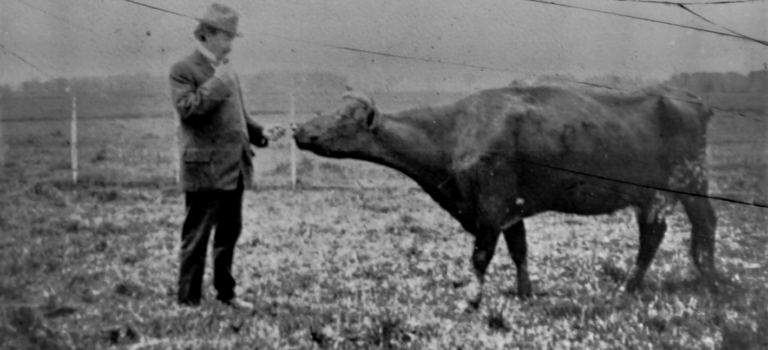
Peter McArthur died October 28, 1924 ……..and we will plant and dedicate a “scarlet maple” in his honour near his grave at the Eddie Cemetery October 27, 2024 at 2:00 p.m. Exactly 100 years later…. We plan to celebrate with selected readings on site.
For your comfort, please bring a lawnchair….. Also, walk with care as the ground is uneven. Take time afterwards to roam around and listen to the stones at Eddie Cemetery.
Park across the road in Mark McGill’s farm laneway. We have his permission. Do not park along the highway. It’s a dangerous knoll.
If the weather is poor, please come to the Archives instead, 178 McKellar St., Glencoe, ONtario.
“Although I have lived in far countries and great cities, no place ever was my home except this farm.” – Peter McArthur
When I strive to fathom the secret of this love I find that it is due to the fact that I learned history, not from books, but from the lips of the men and women who made Canada—that I learned the history, not of the government, but of the people. The spirit that broods over me to-day is the same that danced among the shadows beside an open fireplace while I listened to endless crooning tales of the sufferings and hopes of the pioneers.
THE SOUL OF CANADA – CHAPTER XXI
Book Title: The Affable Stranger
Date of First Publication: 1920
Author: Peter McArthur
It is all very well for men like William Lloyd Garrison to exclaim, “My country is the world.” I cannot lay claim to so broad a humanitarianism. Though I do not see the need of hating any other man’s country, there is one country that means more than any other to me. How could I reprove the people of the United States for loving their own country—for being jingos, if you will—when I know that their home love cannot exceed mine?
Let me confess. Often and often I have thought of writing something about the love of my native land, but was restrained by the feeling that it was too intimate and personal to be exposed for the entertainment of the public. Goodness knows I have gossiped about almost everything in the most shameless way, but there was something about love of the land that seemed too sacred to reveal even to intimate friends. But now I am emboldened to hang my heart on my sleeve and talk to those of my readers both in Canada and the United States who have felt the love of the land and know what it means. I have the good fortune to be living on the farm on which I was born—the farm which my father cleared. Although I was born too late to take a hand in the work of clearing,
I learned the history of every acre before an open fireplace many years ago. The history of the clearing of the land, the first crops, the names and characters of the horses and cows on the place, are so interwoven with my youthful recollections that I seem to remember them all as if I had taken part in the battle with the wilderness myself, and had shared in all its triumphs and sorrows. Something of this farm struck a tendril into my heart which neither time nor distance could break. It is the only spot on earth that ever gave me the feeling of home. Even after being away for years I have sat down in New York or London, England, and have been as homesick for this farm as a little boy who makes his first journey away from his mother’s side. At any time I could close my eyes and see the quiet fields, and I would wonder what crops they were sown to. At all times it was my place of refuge, and, when I finally returned to it, it was with a feeling that my wanderings had ended, and that I could settle down and enjoy life where I belonged.
At the present time this love of the land appeals to me as being especially significant. The turmoil in the world to-day recalls to me the great purpose which moved my father and mother to undertake the task of making a home for themselves in the wilderness. They wanted to establish a home where their children and their children’s children could be free. I know the oppression and hardship from which they escaped in the old world, and the toil and hardship they endured in the new before their dream was realized. It is high time that we who are native-born realized the price that our parents paid for the freedom and liberty we have enjoyed. The freedom that they won by their toil and sacrifice is a heritage worthy of our sons who did battle so that it may endure.
There have been times when I thought that the men of my own generation were escaping too lightly in the work of establishing a Canadian nation, but I think so no longer. This new nation was founded by our freedom-loving and infinitely patient fathers, and defended by our freeborn and heroic sons. It is true that we came too late to take part in the pioneer work, and were too old to take our place in the trenches. But on us there rests a heavy responsibility. It is for us to pierce through the confusions and selfishness of political strategy and establish the truth and justice that alone can make a nation endure. We must be true to the great purpose of our fathers and the splendid courage of our sons. Here is something that strikes deeper than party politics, that demands the best that is in us of wisdom and sanity. If we fail to do our part nobly the whole fabric of nationhood will fall. Love of the land carries with it a responsibility that may try us as sorely as the wilderness tried our fathers or as the battlefront tried our sons. And for us there is no escape. The future of Canada is in our keeping.
Whenever I read history, even the history of Canada, I feel like the American soldier who was wallowing through the mud after the battle of Spottsylvania Court-house. Saluting his officer, he exclaimed bitterly: “If ever I love another country, damn me!”
History, as written, is largely a record of crimes and blunders that are exposed or whitewashed according to the political bias of the man who is writing the history. Historians, as a rule, are more given to the use of whitewash than a political investigating committee. Fired by a patriotic desire to picture for us a country worth loving, they suppress much, glorify everything that seems worth glorifying, and give us something that is no nearer the truth than the crayon portraits you see in many country parlors. If historians told the simple truth, every nation with a scrap of decency would be trying to live down its history, just as a convict tries to live down his past. And yet—and yet I confess to a love of Canada that is not simply a patriotic emotion, but a passion to which my whole being vibrates. To me Canada is a living soul—a Presence that companions me in the fields—a mighty mother that nourished my youth and inspires my manhood.
Whenever I think of Canada I remember Carman’s (Bliss) wonderful lines:
“When I have lifted up my heart to thee,
Then hast thou ever hearkened and drawn near,
And bowed thy shining face close over me,
Till I could hear thee as the hill-flowers hear.”
When I strive to fathom the secret of this love I find that it is due to the fact that I learned history, not from books, but from the lips of the men and women who made Canada—that I learned the history, not of the government, but of the people. The spirit that broods over me to-day is the same that danced among the shadows beside an open fireplace while I listened to endless crooning tales of the sufferings and hopes of the pioneers. The Spirit of Freedom that led them into the wilderness became my spirit, and their dream of a free Canada became a living spirit that danced about me in the flickering light of the flaming back-logs.
By some trick of the imagination I have always thought of Canada as the blithe spirit that haunted my childhood. But in my childhood she did not always come in the same guise. Sometimes she would come gliding out of the depths of the forest, a shy and dusky sprite that would take me by the hand and teach me the love of flowers and birds and the infinite mysteries of Nature. Again she would come as a country maid, glowing with the joy of life, who would lead me through the fields where she reaped the harvest and bound the sheaves. Always she walked in the sunlight and though her moods were full of song and care-free laughter
“She had the lonely calm and poise
Of life that waits and wills.”
As the years passed and the burdens of life began to press, I lost the intimate touch with the spirit of my country. But always I was conscious that back of the turmoil she was working her will and shaping the destiny of a free people. Though I might be stunned and disheartened by the greed of commerce and the clamor of politics, I could still see dimly that the spirit that companioned my youth was at work wherever men and women labored. And her love was not only for those who could claim it as a birthright, but to all who came to Canada in quest of freedom. Creeds and nationalities and old hatreds were nothing to her. No matter what wrongs or abuse of power there might be in high places, the spirit of Canada was nourishing the weak, teaching them the lesson of freedom, and moving to her place among the nations.
Then came the day when the war trumpets sounded and the soul of Canada flamed to her full stature. She heard the call of the oppressed and hurled her legions against the oppressor. Not hers
“To mix with Kings in the low lust for sway,
Yell in the hunt, and share the murderous prey.”
Nourished in freedom she gave battle for freedom. To-day I see her, as I saw her in the time of war, roused but unafraid, and watching with questioning eyes the sacrifice of her sons. Standing heroic on the soil that gave her birth she marks with glooming brows the madness of the nations. This is the hour of her decision. Woe alike to those who would stay her hand and to those who would hurry her to destruction! Born of the dreams of humble people who toiled and served for the freedom on which she was nourished, Canada must be forever free! As a free nation within the Empire she has given lavishly of her best, and as a free nation she must endure!
-30-