Southwestern Ontario is a diverse region of communities, farms, waterways, and historic landscapes. This tag connects stories, people, places, and events that help place our local history within the broader context of the region.
There is never a doubt that a soldier marching obediently into a volley of musket fire is a hero. An army surgeon, his white apron stained with blood, working countless hours in the heat to save whomever he can, is also a hero. What of Generals, Lieutenants, and Captains who give orders, strategize, and feel the weight of entire armies on their shoulders as they command men to give everything to a cause? Surely, they are heroes as well. Historically, it seems easy to list the heroes of war, but it is rare that ordinary women and children are included on these lists. Today, I invite you to consider those left behind. They are not left behind by choice or lack of courage. Not because they didn’t feel the pull of the cause as deeply and passionately as their male counterparts. They were left behind, in the shadows, to do what women have always done: endure the hardships and try and prosper, all while maintaining their family’s wellbeing.
“Soldiers on a March.” The Army Children Archive (TACA), 14 Jan. 1884, www.archhistory.co.uk/taca/move.html. Accessed 14 Aug. 2025.
Windows on the past Part 3 St James Anglican Church, Wardsville by Bill Simpson
St James Wardsville was torn down in 1942 after the foundations were fatally undermined by improvements to the adjoining Hagerty Road. Sadly, there are no known pictures of the interior of the church, and we have only an image of the exterior to let us know how it looked.
The design looks very similar to that of St John’s Glencoe, with the exception that the belltower is offset to the side of the entrance rather than where the entrance porch is shown. This explains how the reredos (wooden screen in the chancel) fit so snugly into the chancel at St John’s when it was moved there. (I am writing another post about this memorial reredos and altar table.)
It was noted in an Anglican News article that St James had many beautiful ornamental and memorial windows, but we have no pictures of them.
But, remarkably, a small part of one of these windows was discovered by Wilson Bowles while renovating his house on Talbot Street and was given over in to the care of Ken Willis, the Wardsville Historian. Ken speculates that this fragment was rescued by Abraham Linden, who occupied the house previously.
Published in the April 2025 issue of the Middlesex Banner.
Orval Shaw, a name that once echoed through over 40 cities, towns and countryside of Ontario, was more than just a petty criminal. He was a symbol of defiance, a master of evasion, and a figure who captured the public’s imagination. I have drawn his story from historical accounts and newspaper reports, revealing the life of the man known as the “Skunk’s Misery Bandit.”
I first found out about Orval while researching other local history topics in the area of Hespeler, Ontario where I lived. During my research Orval’s name turned up several times as he was in Guelph, Hespeler, Idylwild and Puslinch during his escapades.
I was amazed that nobody had researched his life previously. One of the main challenges was finding out more about Orval’s private life and the lack of photos of him. I was lucky to find a distant relative of Orval’s’ who supported my work.
Eventually I decided to do comprehensive research of Orval, and I am very pleased with the book that came out of that research.
In part 1 of this series, I described the altar window in St John’s Anglican Church, Glencoe. There is another fine stained glass window in St John’s, which is found at the rear of the church to the left of the main door:
The image is titled “Christ Knocking on the door”.
“…The Light of the World is an allegorical painting by the English Pre-Raphaelite artist William Holman Hunt (1827–1910) representing the figure of Jesus preparing to knock on an overgrown and long-unopened door, illustrating Revelation 3:20: “Behold, I stand at the door and knock; if any man hear My voice, and open the door, I will come in to him, and will sup with him, and he with Me”….. The door in the painting has no handle, and can therefore be opened only from the inside, representing “the obstinately shut mind”.
This particular version does not show Christ holding a lamp but instead a staff.
The artist and the manufacturer are unknown to me. The style and colors of the picture suggest one of the major stained glass makers – Hobbs or McCausley.
The inscription reads:
In Memory of Thomas Strong who died 1st January 1927 aged 79 years.
He that liveth and believeth in me will never die.
Thomas Strong
From the census of 1891, Thomas Strong was a local farmer. He was married to Sarah Jane Strong. They had a son Frederick born 1881 but there is no local record for him after the 1901 census.
Thomas Strong had emigrated with Sarah from England. From below we can suppose that they both originate in the or near to Southwick, a small town in Sussex next to Brighton.
For Sarah Strong we have several peices of information from the Glencoe Transcript (thanks to Ken Willis for these):
Info from Glencoe Transcript – Wardsville News items. September 20, 1904 – Mr. and Mrs. Middlekrauff of San Francisco visited her sister Mrs. T. Strong.
September 21, 1906 – Mrs. T. Strong, who has been visiting relatives in Wiltshire England and niece Eva Frances, returned on the steamer “Empress of Britain” Sunday evening.
March 1, 1907 – Death of Sarah Jane Strong, age 57. Born in Southwick, England. Died at her home on Main Street, after a two day illness. Service at St James church by Rev. H.A. Thomas with burial in Wardsville cemetery. Cause of death : diabetes.
Info from Wardsville death records: 1 March 1907, Sarah Jane Strong, age 57 years, 3 months and 23 days, housewife. Residence – Longwoods road, Wardsville. (Main Street and Longwoods Road were one and the same). Cause of death was listed as diabetes.
Thomas became a noted benefactor of the church, loaning it $1000 to purchase the rectory building, and requiring only for interest to be paid, and the loan to be discharged at this death. In his will, he specified the stained glass window to be installed.
It is interesting therefore to speculate how his wife Sarah came to be buried in Wardsville after a funeral service at St James Church in Wardsville. There is also the disappearance of their son Frederick from all public records after 1901.
Prepared by the Executive members for the members of G&DHS. For the AGM April 16, 2025.
Preserving Our Family Histories for Future Generations
Our ancestors—whether Indigenous, settler descendants, newer generations, or recent Canadians—have all contributed to the rich history of our communities. Each of us carries important stories that deserve to be told. Historians seek the truth, striving to understand what really happened and how people have worked together over time. We share a common past, woven together through generations. Consider this: each of us has two grandmothers, four great-grandmothers, eight great-great-grandmothers, and so on—each with their own unique stories waiting to be remembered.
Every family needs both storytellers and story keepers. The Glencoe & District Historical Society encourages families to record their histories—write down stories, label the backs of photographs, and document the details that future generations will cherish.
Some families are fortunate to collaborate with authors like CJ Frederick, who transform family histories into engaging historical novels. Others use platforms like Remento or StoryWorth to compile family memories into beautifully bound books that can be passed down for generations. Online genealogy tools such as Ancestry.ca have also made it easier than ever to trace our roots.
Many families bring their archives and precious artifacts to the Historical Society for safekeeping. In today’s digital world, we recognize what a treasure trove these collections are. While digitization allows for easy sharing, it does not guarantee long-term preservation. Whether in digital or physical form, historical records are always at risk. By working together to protect and document our shared past, we ensure that future generations will have access to the rich stories that shape our community.
These are our aims for 2024/2026:
Connect with membership and build close, working relationships with all our local groups, our regional heritage groups, and the elected reps and staff people of Southwest Middlesex and County of Middlesex.
Ramp up our outreach and channels. Mobilize an IT circle to support improved communication and decision-making.
Digitize and record our stories, curate, preserve, upload, and share. Figure out better platforms for working together. Facebook groups don’t cut it.
Learn the tools offered by dynamic governance, and the flourishing business canvas
Bring our elders and youth together. Tell all the stories. 10,000 years of local history. Place making.
Build a cultural network to link history with tourism. Nurture and support the arts in heritage and cultural communities.
Lead the interactive Barn Quilt Trail project, which features an alliance of four organizations plus FedDev Government of Canada, the funder. Link our cultural assets to local tourism strategies and investments. Work with Middlesex county tourism.
Advocate for county archives. Interpret history along the Thames river Watershed arts corridor
Invite skilled local people and support their history passions. Build teams around peoples’ interest. Assign domains. Delegate authority.
Update and revise our bylaws. Build a closer working relationship with the Ontario Historical Society.
Build out our organizational structure. We have a great foundation in our bylaws featuring managers. Build a circular hierarchy to support workers, facilitators, leaders, and admin support.
Engage the branding dream team to do an agile branding process for G&DHS, the interactive Barn Quilt Trail, and our various groups and projects that need a brand
Figure out how to tell our amazing stories, make sure they are preserved and interpret the amazing history of Ontario Southwest, that we want to share with family, friends, community, travelers, guests, youth, new, Canadians, refugees, children, all of the people that make up our Rural society people.
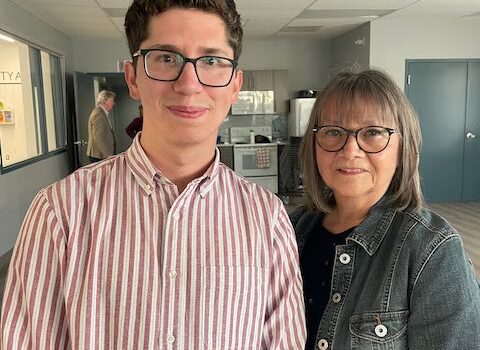
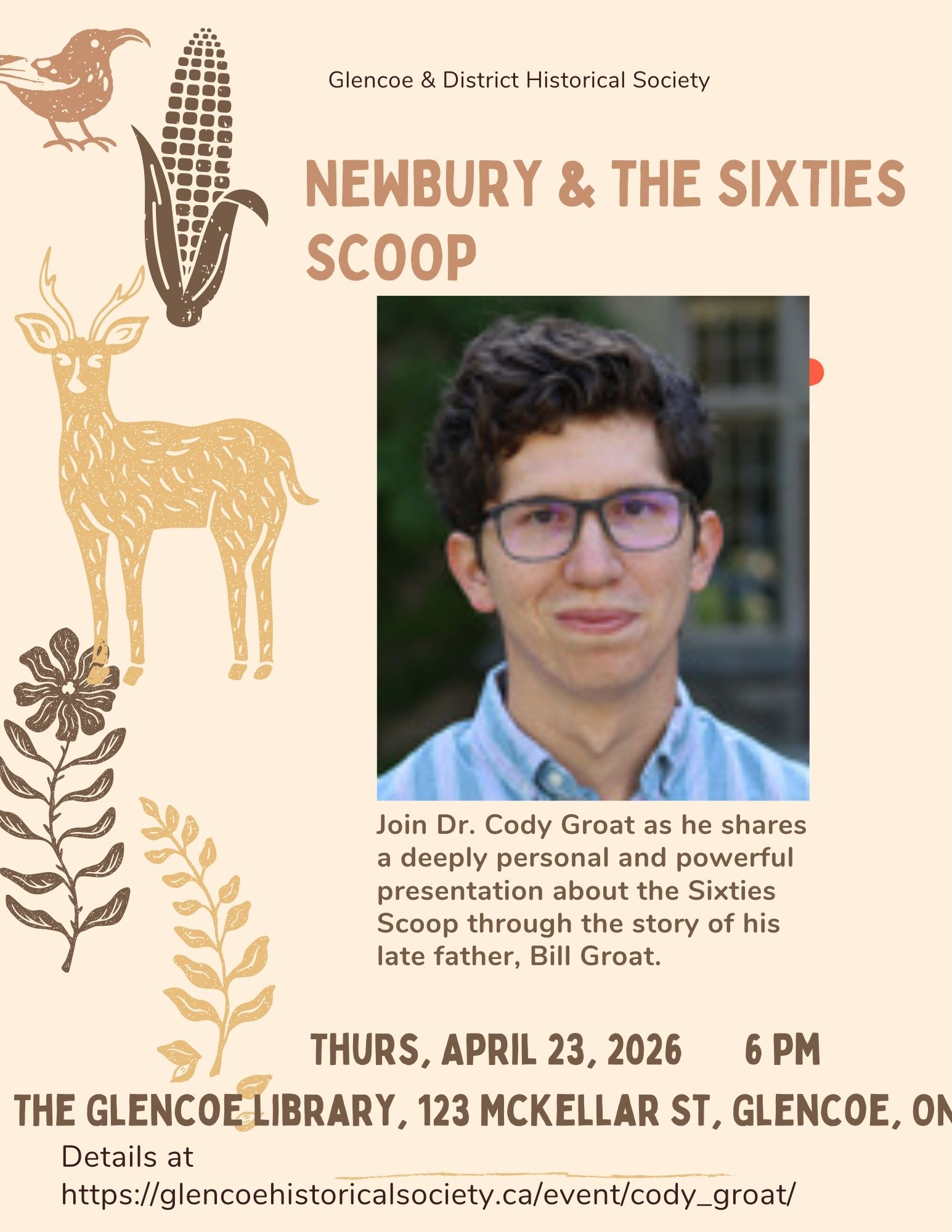
Dr. Cody Groat shared a deeply personal and powerful presentation about the Sixties Scoop through the story of his late father, Bill Groat. About 45 people attended this moving presentation. Thank you staff of Glencoe Library for working with the historical society to build a wonderful partnership.
A survivor of this dark chapter in Canadian history, Bill was a Kanyen’kehaka (Mohawk) child raised in a foster home in Newbury, Ontario, before returning to his biological parents—survivors of the Indian Residential School System—in London, Ontario.
Patrick Johnston, a researcher for the Canadian Council on Social Development, first used the term “Sixties Scoop” in his 1983 report on Indigenous children in the child welfare system, entitled Native Children and the Child Welfare System. In the report, Johnston describes the large-scale apprehension of Indigenous children in the 1960s from their homes, communities and families of birth — often without their parents’ or band’s consent — and their subsequent adoption into predominantly non-Indigenous families across the United States and Canada. The Sixties Scoop was not an isolated event propelled by inferior Indigenous parenting, but rather an extension of paternalistic policies in Canada that sought the assimilation of Indigenous cultures and communities. Ref: The Canadian Encyclopedia
Dr. Groat is an Assistant Professor in the Department of History and Indigenous Studies at Western University, and a citizen of the Kanyen’kehaka nation and Six Nations of the Grand River Reserve. In 2025, he received the King Charles III Coronation Medal for his work promoting Canadian heritage.
Check out Dr. Groat commenting on the return of items from the Vatican: https://youtu.be/MBx30UPx2jM?si=yb779M12tfELPxil. He talks with APTN’s Creeson Agecoutay about the Indigenous artifacts coming into Canada from the Vatican.
All over the world, churches are repositories of local history as well as places of worship, and Glencoe is no different. St John’s Anglican has its share of memorials and markers of personal and public history. This is the first of a series of posts about these. As a recent newcomer to Glencoe, I am likely to be unaware of facts and details about this church, window and Anna Moss which are otherwise common knowledge. Please let me know these so I can add them to this record. – Bill Simpson
There has been a St John’s Anglican Church at the corner of Main Street and Concession Drive since 1869. This building was replaced in 1893 with the current structure, depicted in the postcard shown below, with a current view beside it.
Stories about the Kilmartin community who established Burns Presbyterian Church in the hills of North Mosa.
Jennifer Grainger reporting from Mosa Township: On Sunday, March 30 at 2:00 pm I attended a rare event, an historic church celebrating an anniversary. At a time when many rural churches are closing, it’s a pleasure to see one commemorating the 190th anniversary of the congregation.
The March 30th event wasn’t an actual church service, mind you, but a celebration of the surrounding community and the role Burns Presbyterian played in it. The occasion, more historical than religious, was entitled “A Stroll Through Time.” Actors portrayed fictional, but plausible, characters from the church’s past, including an early Scottish settler, a later Dutch arrival, the last Precentor, a member of the women’s auxiliary, etc. Sometimes amusing and often poignant, the stories of former congregants were well written and allowed the modern audience to imagine life in Middlesex County, Ontario in the Good Old Days.
Marie Williams: A large crowd packed into the Glencoe and District Historical Society Archives on Wednesday evening, March 12, 2025. Following announcements, a brief membership report and some unfortunate technical difficulties, Society president Mary Simpson introduced the evening’s guest speaker, Glencoe native and author Daniel Perry.
Perry spoke about his newest work, a non-fiction memoir focussed on his own research into the life of Thomas Gardiner and Gardiner’s connection to the hamlet of Cashmere in the former Township of Mosa.
Born in 1774 in Ireland, Singleton Gardiner sailed for New York State in 1804. He moved to the Talbot Settlement in 1816 and to Mosa Township in 1825. He built a mill in 1834 on the site of what became Cashmere.
His brother Thomas Gardiner, born in Ireland in 1767, sailed for New York in 1804 and arrived in Upper Canada in 1807. Perry outlined charges laid against Thomas Gardiner which were subsequently dismissed, the connections between Thomas Gardiner and John Parker Jr., tales from the War of 1812, his years serving as a teacher, disputes over land, family friction and his pleas for help as an aging man.
Singleton Gardiner was the first person buried at the Cashmere Cemetery in 1834 but there is no stone marking what could be the grave of Thomas Gardiner.
CBC Radio ‘Ideas’: Until the past few years, the story of the Chatham Coloured All-Stars was not widely known outside their hometown. But thanks to the Chatham-Kent Black Historical Society and the University of Windsor’s Centre for Digital Scholarship, with the help of the Harding family, the legacy of the Chatham Coloured All-Stars lives on. They reconstructed the 1934 season, and the team’s history through newspaper clippings, scrapbooks and interviews with the players and their descendants.
Everyone’s efforts led to the Chatham Coloured All-Stars being inducted into the Canadian Sports Hall of Fame in 2022 — 88 years after their 1934 season opener.
Listen to this hourlong podcast by CBC Ideas. Link here.
Everybody knew, in the neighborhood, all the men playing on the team…. And they played a really competitive, athletic, exciting kind of baseball.
Five months after their opener in October 1934, the Chatham Coloured All-Stars became the first all-Black team to win the Ontario Baseball Association championships, then known as the Ontario Baseball Amateur Association.
The story I am about to write happened in 1954 at the humble beginning of Hollandia Bakery, Wm. Bruinink & Sons, the start of what is now known as Hollandia Bakeries Ltd. The village of Mt. Brydges had a population of approximately 1200 souls, at least that is my recollection. Fire hydrants were a square hole of 24” x 24” approx. 6 feet deep. The water supply to homes was a piston pump pounding happily when it was encouraged to supply water.
The first Hollandia was located in what is now Sunshine Bakery. If one were to take down the brick wall, on the exposed wooden wall one would find the words Hollandia Bakery painted by John Kolstein. It was John who we kept busy painting our delivery vans which were later observed in the surrounding communities. The original Hollandia was known as Robinson Bakery until it was purchased by brother Henry in 1953.
Henry did the baking and I did the selling house to house in Mt. Brydges and Strathroy. Some of my customers were Northcotts, Lucas, Daucetts, Orrs and many more whose names have slipped my memory. In Strathroy one of my customers was Pastor Buursma of the CRC. It was he who put me in touch with Bill Jervis who owned the IGA store on Front Street. This store became the stepping stone to wholesale selling.
Hollandia Bakery & Sons was to be established in what was known as Gold Seal Dairy on the main street in Mt. Brydges, between Young and Regent streets. My parents Bill and Dorothy Bruinink, my brother Bill and I took up residence in the front of the dairy bar which, by the way, had gone bankrupt and we bought at a good price. In 1955 we added 75 feet to the back of the building which was to be the “enlarged” bakery. This expansion became an annual event until we reached Emerson Street. In 1961 an addition of approximately 300 feet was added to the north side of the building. In 1970 the bakery was destroyed by fire and rebuilt south of Mt. Brydges. It is difficult to imagine that 60 years have passed since Hollandia had it’s humble beginning. In 2014, Hollandia celebrated its 60th anniversary!
Going back to 1955, I was in charge of the sales organization while brother Henry and my father ran the bakery and its ever growing staff. In 1956, my brother-in-law, Joop de Voest, joined our now Hollandia Bakeries Ltd. and took on the job of Secretary-Treasurer and administrator.
I recently had a “flash back” regarding the thriftiness of being Dutch.
The Grandmothers Sugar Cookie by Hollandia Bakery & Sons, Strathroy, ON
Cookie with the Hole:
One of our most popular cookies was the sugar cookie. We were selling this item at .39 cents retail for a 13 oz. package and they “walked off the shelf”. This caught the attention of father William. He called us together and read the riot act pertaining to this cookie.
“Boys” he said, “We have to make a fundamental change to the weight of the sugar cookies. The package is simply too heavy for what we get in return. I propose that we reduce the count to 20 cookies in the roll from 24.”
My reaction was prompt – “But Dad, this would make this package a lot smaller and our sales would go down. Why not increase the selling price?” This was not a bad idea, but it would take this item out of the occasional 3/$1.00 special category. Suddenly Henry said “how about if we put a hole in each cookie? This will bring down the weight.”
Voilá – The Grandmothers Sugar Cookie was born and became our biggest seller. ‘The cookie with the hole’ was now a favourite with children and adults. Children enjoyed putting their finger in the hole. A contest was born – Who could keep the cookie from falling apart while eating it with their finger in the hole?!
It is amazing how the thriftiness of the Dutch could produce such an incredibly popular cookie.
As the remaining survivor of the founders of Hollandia Bakeries Ltd. and now retired and no longer involved, I am pleased to submit this brief history.
Over 60 history buffs gathered, in person and online, to listen to Doug Ferguson as he described his “Ancestral Odyssey” at the Glencoe and District Historical Society Archives on Wednesday evening, January 17, 2024. His Ferguson ancestors had left Craignish, Argyleshire for Aldborough Twp. in 1818 and then moved to northern Mosa Twp. in 1827. The McDonalds left Inverness for Quebec in 1830, before settling in Ekfrid Twp. in 1835.
A great new contemporary play. Eight members attended the June 7th Strathroy performance at the developing Wright Centre. We were pleased to meet members of the Board of Directors. Let’s support this wonderful project to bring a performing arts centre to downtown Strathroy. – Mary Simpson, Pres, G&DHS.
Mary Simpson: We love Len’s plays – he writes plays about us. Plays about southwestern Ontario. Plays about our people and culture. Len Cuthbert wrote 2023’s Lawrence Station & 2024’s Snapshots)
This is a play for all those who love flying…. For those who love looking down at the earth from a few meters or thousands of metres above the earth’s surface. Let’s meet the four characters. There are six performances to choose from.
Did you know that there are between 12,000 and 14,000 aircraft in the air at one time?
I was on one of them at the end of March break, in the very back seat, waiting to land at Toronto Pearson during very turbulent weather. It was so rough, that as we were on the final approach, (in the same type of aircraft as the Delta flight that rolled over in a crash at Pearson recently), I had a strong feeling that the pilot would choose to abort the landing. Sure enough, the engines spooled up and the pilot conducted a missed approach, and off we went. When this happens, it’s a busy scene in the cockpit with cleaning the aircraft up (flaps, spoilers, gear, and anything else that’s sticking out) changing charts, frequencies and plans to head into a new approach pattern. It’s hard to tell all that’s going on in the back seat, so after we arrived home, I went to a website where you can watch all active flights all over the world. There, you can look up your most recent flight and see the route with all flight details like speed and altitude. I found our flight and discovered that the pilot opted to change runways in the process which resulted in a perfect landing. Go here and watch some serious live aircraft activity. https://www.flightradar24.com/
Come take flight with these four unique characters as they surprise you with the unexpected experiences of life that make it hard to keep the blue side up.
Mick, a young pilot/aircraft mechanic of a small airport in Welland also acts as the airport manager in exchange for living space above the hangar, where he is guardian of his 13 year old sister left in his care by his deceased parents. He understands aircraft, but not so much raising a teen sister.
Dee-J just turned 13 and is growing up in an apartment above an airport hangar while her classmates have normal lives in normal homes. But what is normal? She’s an adventurous teen who loves to fly.
Jade was abandoned by her mother as a child and grew up in the foster system. She is friends with Mick and Dee-J and occasionally helps Mick with raising Dee-J. But Mick and Jade operate completely differently making their relationship interesting. She also works part time for Mick while taking classes at college.
Delilah is everyone’s friend and Jade’s college roommate. She’s compassionate and caring and wouldn’t have experienced half the adventures if it weren’t for her controlling and needy friend Jade.
James Reaney Memorial Lecture: Snapshots of Jamie with Jeff Culbert – 19 October 2024
Hosted by Words Artistic Director Josh Lambier.
In conversation with Jeff Culbert and Josh Lambier of Words Fest
This Lecture celebrates the legacy of London poet and playwright James Crerar (Jamie) Reaney (1926-2008) and his late wife, the poet Colleen Thibaudeau. Jamie Reaney was friends with Jeff Culbert, a connection that began in the 1980s.
With Josh as tour guide, Jeff recalls his roles in the Reaney creative process and will be performing selected readings and songs on this journey.
Part 1: Peter McArthur, the hardest question and the “horrible, horrible” war
By Stephanie McDonald, December 2024
It’s a question from a child no parent is equipped to answer: Should I go to war? It was what Daniel, eldest son of Mabel and Peter McArthur, asked of his father in the early years of the First World War.
Even as prolific a writer as Peter McArthur was, one can imagine how the man dubbed the “Sage of Ekfrid” struggled to find the right words to share with his son. His response reveals both his wish for his child to come to his own decision as well as the urge to protect and keep him safe.
Peter penned his answer to Dan’s question in a letter on January 25, 1916, a year and a half into the war:
Near the house there is a sturdy oak tree that I always think of as one of the oldest of my friends. I grew up with it. Of course that is not exactly true, for I stopped growing many years ago, while it kept on growing, and it may keep on growing for centuries to come. But when I was a growing boy it was just the right kind of a tree for me to chum with. It was not too big to climb, and yet it was big enough to take me on its back and carry me into all the dreamlands of childhood.
On December 5, 2024, the Mary Webb Centre in Highgate organized an Afternoon With Authors book sale as a fundraiser to restore the beautiful stained glass dome.
The Mary Webb Centre came to life in 2010 when a group of people in the Highgate area saw an opportunity where the wrecking ball threatened to demolish the 100 year old United Church. The vision was to create community centre, art gallery and concert hall and now in 2024, 14 years later, the 250 seat venue is a “must-play” address for renowned as well as up-and-coming musicians from across Canada and for local performers too.
Artice by Paul Langan about Orval Shaw – click here.
Paul Langan is going to tell us about the legend of Orval Shaw—The Bandit of Skunk’s Misery. We often hear fragments of stories and myths. Paul has done the research. He is going to talk about the process of collecting information for historical books and about how this booklet came together.
Orval Shaw never killed anyone or committed any major crime, yet from 1921 to 1934, Orval’s life of petty crimes led to some of the most sensational police hunts to try and capture him.
Book is also available from Amazon. The Bandit of Skunk’s Misery is only paperback; no e-book options available .
On April 3, 1929, in Hespeler, Ontario, the greatest force of police anywhere in Canada was assembled to search for the “mystery man of Skunk’s Misery.” For the first time ever, historian and author Paul Langan has collected all the known published information on Orval into one book. Local connection: Paul’s mother’s family, the Doyle’s, are from 9th Concession of Raleigh Township.
Book released- 11/13/2024 – ISBN 978-1998829408
We will have books for sale at this book signing event.
In the meantime, to order his book(s):
WORDSWORTH BOOKS in Waterloo, Ontario carries all Paul Langan books in print.
Booklet is also available from Amazon. The Bandit of Skunk’s Misery is only paperback; no e-book options available .
For over two decades, Ken Willis has dedicated himself to preserving Wardsville’s history, curating a collection donated by residents that tells the story of Wardsville and its people. The Wardsville Museum is a cherished part of our community that houses a collection of artifacts and stories that showcase Wardsville and Mosa’s rich history. The museum depends on community support to preserve its treasures.
Ken Willis, the long-time curator of the Wardsville Museum, shares his personal story and an appeal for support.
Please denote your donation to benefit the Wardsville Museum and a tax receipt will be issued. Every dollar helps preserve Wardsville’s heritage for future generations.
Your support means the world to Ken and the entire Wardsville community. Thank you for helping us keep our history alive!
What happens when the story gets twisted? The story keeper and the storyteller got their wires crossed. Bunny, the story keeper, decided to tell a different story about her son. And the extended family all colluded. Eventually the son found out his true story – ‘the last man standing’. Tom Wilson discovered he is a descendant of mohawk warriors, hunters and chiefs …but he was denied the truth until he was in his 50s. You can see his artwork at the TAP Centre of Creativity until December 21st. Now he gets to tell his story – his story can be viewed here on film.
Everyone has a story. And all our stories are compelling and amazing. Why not write yours down for your descendants? Our children want to know about their ancestors and our ancestors want us to tell their stories. Truth preferred – the truth as we know it and have experienced it. Story keepers and story tellers. – Mary Simpson
Art by Tom Wilson
TAP Centre for Creativity presented Mohawk Warriors, Hunters and Chiefs, a solo exhibition of the artwork of Tom Wilson tehohåhake (two roads). Tom is a musician, writer and visual artist based in Hamilton, Ontario. Tom’s art exhibition ended December 21, 2024