Barn Quilt Trail Movement: A Journey Across North America

By Mary Simpson and Denise Corneil. Featured in the Middlesex Banner.

The Barn Quilt Trail Movement, which started in Ohio, USA, has blossomed into a colorful journey across North America, thanks to the vision and dedication of individuals like Donna Sue Groves, now deceased. Inspired by her love for quilts and barns, Groves initiated the movement in 2001 when she painted the first quilt square on her family’s barn in Adams County, Ohio.

In Canada, the movement found roots in Temiskaming, Ontario, in 2007. Bev Maille, Marg Villneff, and Eleanor Katana spearheaded a project to paint 200 quilt squares, adorning barns and historic landmarks across the region in time for the International Plowing Match 2009. This initiative not only added vibrant colors to the landscape but also attracted tourists and boosted economic development.

Wardsville, Middlesex County, Ontario, joined the trail in 2009 when Denise Corneil’s mother, Eileen, returned from the U.S. with a barn quilt brochure. Denise, along with a team of volunteers, stitched a story quilt commemorating Wardsville’s founders, Mr. and Mrs. George Ward, for the village’s 2010 Bicentennial celebration. This project revitalized the community and became a testament to the power of preserving local heritage.

The movement continued to flourish in Ontario. With support from the Sand Plains Community Development Fund, over 100 quilts were created, each telling stories of settlement, community building, and rural life. Barn quilt trails spread up and down the roads of Middlesex, Elgin, Oxford, Norfolk, and Brant Counties in 2011. 

Here in Middlesex, women living along Longwoods Road and the community of Chippewa of the Thames, worked side by side to plan two trails explaining how the War of 1812-1814 affected the lives of women, children, and families.  The winter of 1813 was particularly bad.  

Trail of Tears- Family. Located in the community of Chippewa of the Thames

The result was the Trail of Tears Barn Quilt Trail, a collection showcased on Chippewa of the Thames locations, and a trail stretching along Longwoods Road from Delaware to Thameville – plus two beautiful quilts and many new and enduring friendships.  These trails and many more trails across Canada are curated at barnquilttrails.ca.  

In 2013, all major barn quilt trails in Ontario were curated on one website, barnquilttrails.ca, supported by the Ontario Trillium Foundation. This initiative aimed to provide guidance and encouragement to communities starting their own barn quilt projects, ensuring the movement’s sustainability and growth.  This website continues to be curated by volunteers and now showcases barn quilts across Canada.

As barn quilt trails spread across Canada, the United States, and around the world, they became more than just colorful displays; they became a way for communities to share their stories and preserve their heritage. 

Today, as new projects like those in South Bruce and Osgoode Township emerge, the legacy of the Barn Quilt Trail Movement lives on. Denise Corneil, Wardsville, along with a dedicated team, remains committed to supporting and promoting these initiatives, ensuring that the colorful journey across North America continues to thrive for generations to come.

The Fabric Quilt: Honoring Mr. & Mrs. George Ward

Some community barn quilt projects start the planning process with a theme and a story quilt.  In 2009, Wardsville started up with the War of 1812 theme.  Eleanor Blain and Sue Ellis, seasoned quilt makers, devised a plan to engage people of all skill levels in the quilt-making process. 

With the assistance of local historian Ken Willis, who provided valuable insights into the Wards’ history, the quilt committee traced the Wards’ journey from establishing a settlement along Longwoods Road to enduring the trials of the Battle of the Longwoods and the ensuing accusations of treason. Thirty quilt blocks were meticulously selected to depict key moments in the Wards’ lives, ensuring that Mrs. Margaret Ward’s contributions were honored too. 

The quilt-making process was a labor of love, with countless hours spent selecting fabrics, cutting shapes, and stitching together each block. Ellis and Blain invited community members, both experienced quilters and novices, to lend their hands to the project. The quilt frame at Beattie Haven Retirement Home became a hub of activity as individuals gathered to contribute stitches to the communal creation.

The quilt telling the story of George and Margaret Ward being stitched at Beattie Manor retirement home.

When the George Ward Commemorative Quilt was unveiled at Wardsville United Church in May 2010, it elicited gasps of awe from the crowd. The quilt’s was entered into the Group category at the 2010 International Plowing Match Quilting Competition in Shedden,where it claimed second prize.

What is a Barn Quilt?

Barn quilts are eight-foot square (and larger) painted replicas of actual fabric quilt blocks installed on barns. Barn quilts draw attention to Canada’s disappearing rural landscapes, timber frame barns, and the family farm. Each barn quilt tells a story and draws attention to unmarked historical places.

They can be scattered through the county mounted on beautiful barns (like Huron County), or they can create a themed route, leading visitors from one site to the next.

Tourists are Interested in our local history

With the aging baby boomer cohort, there is a lot of interest in nostalgia and history.  There is a growing recognition that tourists are interested in our local history too.

The Canadian federal government is investing in rural and remote tourism.  The tourism industry is realizing what barn quilt enthusiasts always knew.  Statistics Canada shows that tourism provides billions of dollars in revenue and accounts for 10% of local jobs in rural (non-metro) areas.  A federal spokesperson said that “Tourism can diversify and strengthen the economic base and viability as well as safeguard local culture, language and heritage. Businesses benefit from increased income from direct sales of homegrown and locally made products.  Visitors want to participate in authentic Indigenous experiences, and 62% of Indigenous tourism businesses are in rural and remote areas.” 

Louise Long applies masking tape prior to painting. Three coats. (Photo by Dave Chidley)

And so the barn quilt movement continues to spread.  Go to barnquilttrails.ca to find the trails in Middlesex County and southwestern Ontario.  Embark on a journey through time and space. This isn’t just tourism; it’s a love letter to the land, a celebration of heritage, and a testament to the power of community. 

History of The Appin Cemetery

By Jim May

Presented to the Appin Memorial Day gathering August 1, 2000 by Jim May, whose family had a long association with Appin Cemetery. Jim’s first recollection of the cemetery was a phone call in the early 1950s: “Could my Dad come with his truck to help collect up stones for the cemetery gates?” This presentation tells the history of the Appin Cemetery, Appin, Ontario, Canada

Read more
They Settled in Riverside – family history book

They Settled in Riverside – family history book

By Bob Gentleman and Kathy Evans. Review printed with kind permission from the Middlesex Banner.

In July of this year, family and friends gathered at Arrowwood Farm, a beautiful property in Riverside, just south of Melbourne, to celebrate the publishing of a book written by my uncle, Bob Gentleman. The farm that is now called Arrowwood Farm (6460 Riverside Drive) has sentimental value to our family, as it was once owned by the Gentlemans, purchased in 1870. 

Bob’s book, titled “They Settled in Riverside,” is largely a family history, documenting the arrival of our ancestors in the Riverside area and describing their family branches. But Bob also captures an era now decades past as he shares stories of early Riverside neighbours and of growing up in Melbourne in the 1930s. He recalls his paper route, the school, town merchants and businesses, the railroad, and the neighbours and friends who were important in his life.

Read more
The Appin Cemetery Commemoration

The Appin Cemetery Commemoration

Appin Cemetery Commemoration   July 28, 2024

As part of an annual commemoration of area cemeteries, Glencoe & District Historical Society (G&DHS) organized a presentation and community walk at the Appin Cemetery. Prayers, dedications, singing, and community conversation were key parts of the afternoon.

Read more
Peter McArthur’s beloved farm, his grave, and back to the Archives in Glencoe.  

Peter McArthur’s beloved farm, his grave, and back to the Archives in Glencoe.  

Marie Williams: An impressive crowd gathered for the “Haunts of Peter McArthur” road trip Sunday afternoon, June 16, starting out at what was the McArthur homestead on McArthur Rd. before moving onto the Eddie Cemetery on Glendon Dr. and finally back to the Archives in Glencoe. Two plaques were unveiled along the way as McArthur trivia and memories were shared. Both young and more established fans of the works of the “Sage of Ekfrid,” family members and historians enjoyed the afternoon which was organized by the Glencoe and District Historical Society. The Society is marking the 100th anniversary of the death of Peter McArthur in 2024. See photos on Facebook Post.

Read more
Peter McArthur: Our Famous Canadian – 1866 – 1924

Peter McArthur: Our Famous Canadian – 1866 – 1924

Marie Williams, Glencoe: The huge crowd that packed into the Glencoe and District Historical Society Archives on February 22 proved that the “Sage of Ekfrid” is as popular today as he was over 100 years ago. In addition to 30 viewing online, over 50 turned up in person.

Read more

April 1, 2023 to March 31, 2024 in review

Report for the Glencoe & District Historical Society

Date & Venue: Wednesday, April 17th, 2024, at the Archives, 178 McKellar Street, Glencoe.

Attendance: A solid turnout of 30 members, with all executives present except President Ken Beecroft.

Opening: Vice President Mary Simpson initiated the meeting at 7:00 PM, welcoming members old and new.

Remembrance: A moment of silence was observed for the late Lorne Munro, a member for 20 years.

Business as Usual: The minutes from the previous year’s AGM were approved without issue, and discussions moved smoothly to current matters.

Financial Health: Treasurer Marilyn McCallum presented a detailed financial report and budget for the upcoming year, which were both accepted unanimously.

Membership Milestone: Harold Carruthers announced a record membership count, (over 80 members) reflecting the society’s ongoing relevance.

Engaging Programs: Program Director Mary Simpson introduced upcoming events, including a talk by local author C.J. Fredericks.

Election Excitement: Nominations for the new executive team were made and approved smoothly.

Dynamic Presentations: Members shared updates on various projects, showcasing the society’s diverse activities.

Wendy Simms Bestward reported on the Simpson Descendants genealogy work. 

Denise Corneil reported on the alliance formed by Glencoe & District Historical Society, Creative Communities, barnquilttrails.ca, the Chippewa of the Thames cultural group, and EXAR Studios to build a story telling app to enhance the Barn Quilt Trails, a grassroots arts movement.

Harold Carruthers noted the 100th anniversary of  the death of “The Sage of Ekfrid” Peter McArthur.  There will be an interesting event on Father’s Day, June 16th at 1:00 p.m.  

Norm McGill conducted a Show and Tell in which 8 people participated. 

Closing: The meeting concluded at 8:50 PM, setting the stage for the incoming executive team.

Looking Ahead: With new leadership in place, the society is poised for another productive year.

Read more
Lorne Munro, Past President

Lorne Munro, Past President

Lorne Munro in the early yers
Lorne Munro in the early years


Lorne Munro – I became interested in historical events in the 1970s. My interest grew after attending the 25th Anniversary banquet of the Glencoe & District Historical Society at the Glencoe Legion in 2003. We presently have eight family genealogy books in our home that I manage and update. Ancestry.ca has been a great help and I correspond with family members to gather information.

During my tenure as President in 2018, the Society’s collection moved from our rooms on Main Street to the old library at 178 McKellar Street, Glencoe. I have served as secretary, first vice president, president (a couple of times). I’m slowing down now, just working on Wednesday afternoons in The Archives and enjoying any other projects that come along.

Peacefully at Strathroy Middlesex General Hospital , Strathroy on Monday, March 18, 2024 William “Lorne” Munro passed away in his 91st year. Predeceased by his wife Phyllis (2023). Dear father to Janice and Tom McCallum, Susan Sinclair and Steve Schneider and Cheryl and Roy Neves. Cherished Grandpa to Matt and Becky, Kimberly and Paul, Adam and Kirissa, Andrew and Reilly, John and Stacey, Scott and Mandy, Jacob, Emily and Brandon. Great-Grandpa to Isabelle, Josephine and Elliott. Lorne will be missed by many nieces and nephews. Predeceased by his parents Neil and Florence Munro, his sister Anna and his brother Keith.   Link to Photos reel 

Read more

The Appin Community Garden Project

By Dylan Grubb, Appin, ON

The sense of community is one of the best aspects of living in a small town. Amongst these many things that gives Appin this feeling is the community gardens. Inspired by the World War II victory gardens used to help provide produce to towns and cities in Canada, the project started early in the spring of 2023.

Read more

Early Days of Mosa Township

The most southwest of Middlesex County’s townships, Mosa Township was initially part of a much larger parcel of land including parts of Kent and Lambton Counties. Surveyor Mahlon Burwell indicated that there was some confusion regarding the naming of the township, first designated as township D and then briefly as Aragon. Finally, the name Mosa, a derivative of the Spanish word Musa (muse). However the Lieutenant Governor Sir Peregrine Maitland decided to name the township Mosa, after the Maas river.

Read more
Blood on the Snow – lecture about the Donnellys

Blood on the Snow – lecture about the Donnellys

Glenn’s talk on YouTube – give it a listen

Glenn Stott tells about 33 years of troubles that took place in Biddulph Township and Lucan Ontario region in Upper Canada from 1847 to 1880 and ended with the murder of five members of the Donnelly family.

Read more

Mass Destruction of Cultural Heritage is Unfathomable

December 4, 2023

Archivists Respond to Conflict in Israel and Gaza

The Board of Directors of the Archives Association of Ontario (AAO) is heartbroken at the violence in Israel and Gaza. We are deeply saddened by the loss of life in the region over recent months and express our immense grief for any of our members who are affected or have lost family members or friends. 

Read more

Arnold Warren Nethercott 1928 – 2020

The Loyalist Gazette. Spring 2021

Obituary

On December 21, 2020, Arnold Nethercott passed away at Country Terrace Nursing Home, Komoka, Ontario. Arnold was the beloved husband of 32 years of Barbara (Balch) Nethercott nee: Dadswell. He was a dear stepfather of Ruth Truesdale (Brian), Kathy Bedford (Larry), Greg Balch (Kim), Mark Balch (Linda), Bruce Balch (Kim) and Chris Balch (Yvonne). Loving grandfather of 14 and great-grandfather of 15.

Arnold is also survived by his brothers Marv Nethercott (Mary) and Bill Nethercott (Roxann) and by his sisters Lois McLean and Phyllis Munro (Lorne). He was the loving uncle of 13 nieces and nephews and many great-nieces and great-nephews. Predeceased by his parents James Percy Nethercott and Mary Louise (Warren) Nethercott, his sister Eleanor Wells and his brothers-in-law Vin Wells and Jack McLean.

Arnold achieved the rank of Captain as a Forward Air Controller in fixed-wing aircraft and as a helicopter pilot while in the Canadian Armed Forces. He served in peacekeeping duties in various locations around the world including Cyprus. He was also a respected Past President of the Ontario Genealogical Society (www.ogs.on.ca) and the United Empire Loyalists Society of Canada. (www.uelac.org)

Glencoe has changed over the decades.

Rural challenges

by Marie Williams-Gagnon, Hayter Publications Inc., Sept 2019

Spending a few hours involved in a municipal economic development strategy session this past week proved both enlightening and frightening, as would be the case in any rural community across Canada.

It’s no secret that rural communities face their own advantages, along with their own unique challenges. The reasons rural communities both suffer and thrive  have changed over the years, as have their demographics. 

In 1851, nearly nine in 10 Canadians lived in rural areas. The early census’ of this nation contained questions about the number of acres of land attached to a dwelling, the number and type of animals owned as well as the horsepower of equipment used on the property. During that time period, the Canadian economy was based on the primary sector more than today, led by agriculture and natural resources like wood or coal.

The proportion of those living in rural areas has steadily declined, eventually falling below 50 per cent between 1921 and 1931, due mainly to shifts within the Canadian economy.

Between 2006 and 2011, Canada’s rural population did increase by 1.1 per cent, compared to the nation’s overall growth rate of 5.9 per cent. However, in the same period, the rural proportion of the population declined. Ontario is one of four provinces that have the proportion of their population living in rural regions near to or lower than the national average. In fact, Ontario sits second lowest at 14.1 per cent. In a nutshell, today fewer than one in five live in a rural area.

The 2019 demographics indicate that rural communities overall are still facing a declining population, although many from cities are heading out of the urban centres for more reasonable housing prices. While the shift in search of housing is welcome news, it also comes with its own challenges as urbanites learn to cope without round-the-clock store openings, the anonymity of city living, internet options and, at times, even the scents of rural life.

Some opt to simply use their rural homes as residences, putting any involvement within their new communities on the back burner. They have continued to shop, dine and seek entertainment in the cities, places  that they commute to everyday for work, instead of seeing what their local communities have to offer. 

As many who live in rural areas are aware, there is a lot to offer and many opportunities beyond the farm life although agriculture may have the main economic impact, often followed by motor vehicle parts manufacturing and construction. 

While rural Ontario is not attracting the major immigrant population that cities are, it is changing in other ways. No longer are children automatically expected to take over the family farms. As a result, some have opted to sell to neighbours who have often severed the rural homes off and amalgamated the land to create larger farm parcels. 

Businesses, which no longer need a storefront thanks to the internet, are growing in rural areas but empty storefronts create unease among potential residents. The challenges small rural businesses face are multiple, ranging from attracting customers who are apt to drive to the city for perceived deals to simply getting the financing to even open their doors. Community businesses, which can be ignored by both newcomers and long-time residents, inevitably remain a target for fundraisers of all types which ultimately cuts into profits.

Rural municipal governments face their own challenges with the need to attract and retain both residents and businesses, to find funding for downloaded services while handling both application bottlenecks and increased regulations for everything from wastewater treatment to building permits. These communities face hurdles attracting and retaining health care professionals and keeping the doors of schools, arenas and churches open. 

On the horizon are even more challenges as baby boomers become retired seniors, needing support and housing. Without suitable housing to accommodate an aging population, rural communities may lose even more residents. That is something that census figures are already demonstrating with the number of seniors living in rural Canada being lower (15 per cent) than those living in small and medium centres. Rural Canada is also unique with a small proportion of young adults aged 15 to 29. In 2011, 17 per cent of people living in rural areas were aged 15 to 29, a proportion lower than the national average of 20. Many leave their rural homes in search of higher education and employment, never to return.

There are no magic answers. What must happen closest to home is getting involved in rural communities, buying local and supporting the businesses that in turn support local events and teams. The success or failure of the local economy hinges on the support of the community.

“A successful economic development strategy must focus on improving the skills of the area’s workforce, reducing the cost of doing business and making available the resources business needs to compete and thrive in today’s global economy.” –Rod Blagojevich

-30-

Marie Williams-Gagnon, Hayter Publications

Harold’s Photos of Glencoe

Harold’s Photos of Glencoe

On Wednesday evening April 17, 2019, the Glencoe & District Historical Society hosted the Annual Meeting at the new ARCHIVE facilities. President Lorne Munro welcomed those attending and introduced the guest speaker, our own historian Harold Carruthers. Fifty people attended this event, the first program to be presented at 178 McKellar Street, Glencoe.

Although President Lorne introduced Harold, no introduction was needed. Harold mentioned that the presentation is a continuation of one that he did last April 2018 at Glencoe’s Historic Train Station.

Harold showed 300 images spanning the period between the 1880’s and the 1960’s, focussing on the street scenes of Glencoe Ontario. Harold also focused on the human perspective, highlighting parades and social events. Many people, long gone, were recognized by members of the audience.

Upon conclusion of the display at 8:15 p.m., President Lorne Munro thanked Harold for his interesting narrative. A time of fellowship followed the presentation and audience members enjoyed exploring the new facility. The Annual Meeting and Election of Executive Officers led by President Lorne Monroe followed.

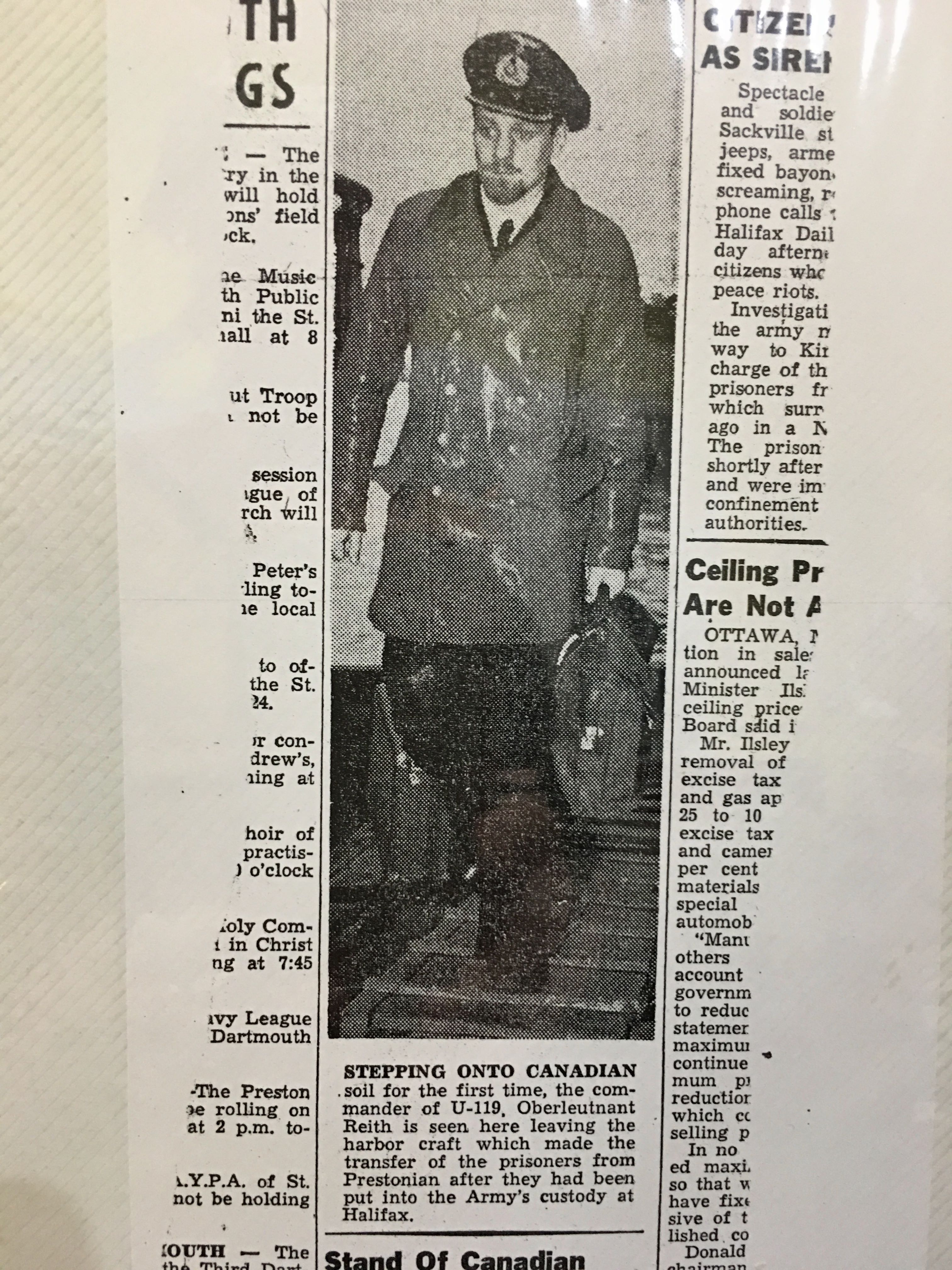
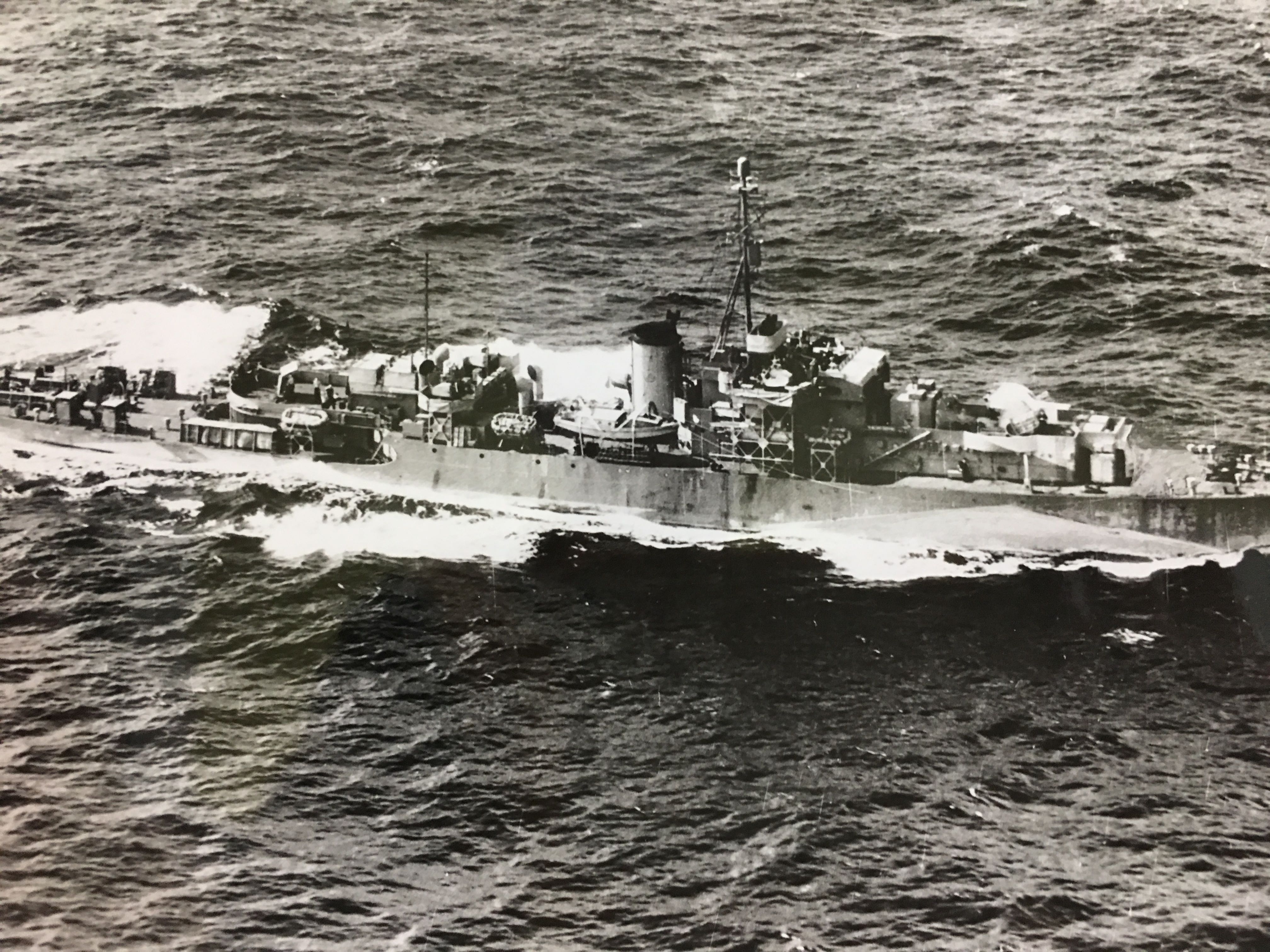
Stuart W. “Skip” Patterson, HMCS Prestonian, WWII


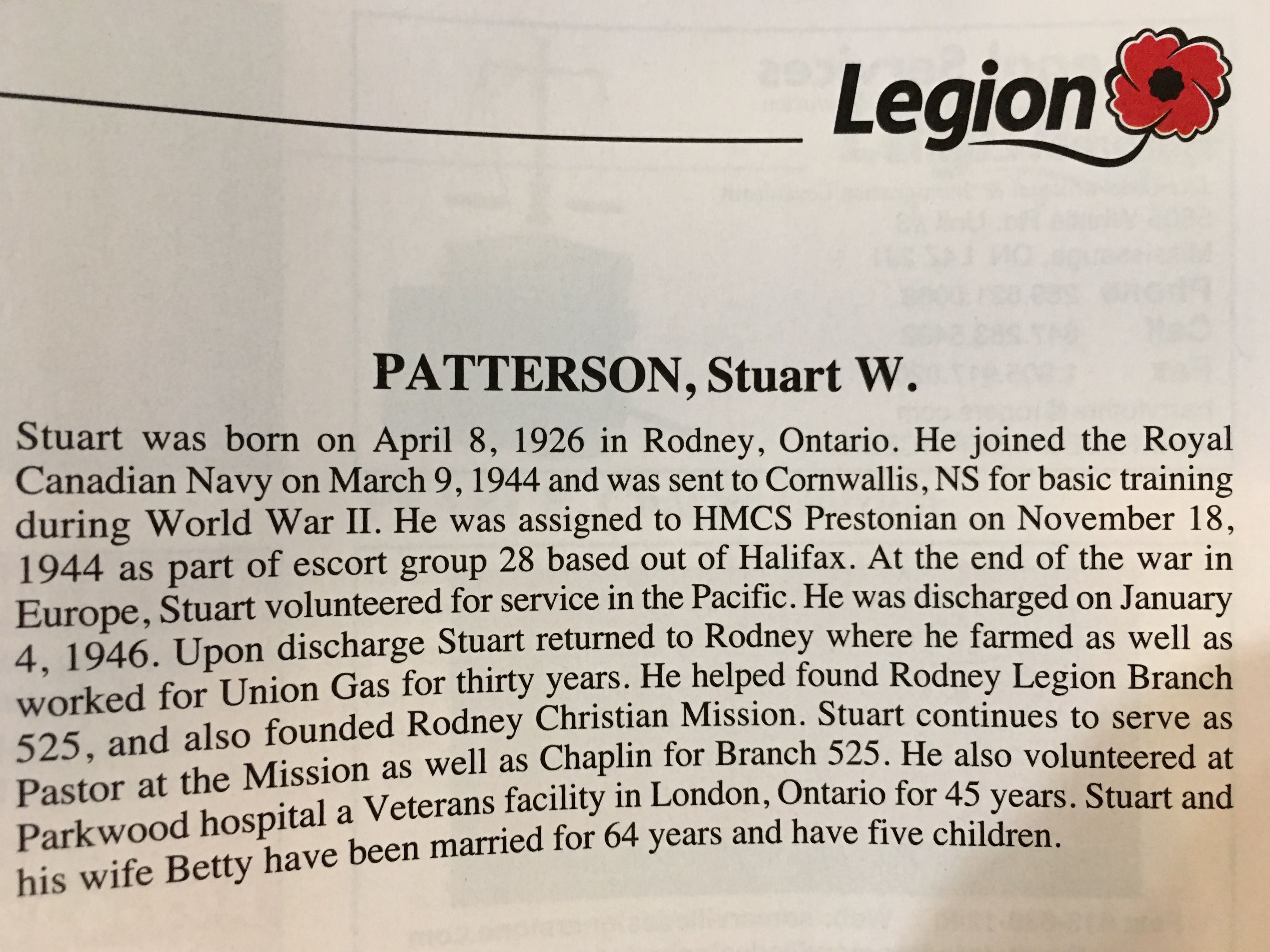
Excerpt from Royal Canadian Legion Yearbook:

Stuart Patterson was born 6 April 1928, in Rodney, Ontario.  He joined the Royal Canadian Navy on March 9, 1944 and was sent to Cornwallis, Nova Scotia for basic training in WWII.  He was assigned to HMCS Prestonian 18 November 1946 as part of escort group 28 out of Halifax.  At the end of the war, Stuart volunteered to serve in the Pacific.  He was is discharged 4 Jan 1946.

Stuart returned to Rodney where he farmed as well as worked for Union Gas for 30 years.  He helped found Rodney Legion Branch and he also founded Rodney Christian Mission and served as its pastor . He volunteered at the Parkwood Hospital in London, a veterans’ hospital.  Stuart and his wife Betty have 5 children.

“Flagship Erie” Plaque Unveiling near Lawrence Station

“Flagship Erie” Plaque Unveiling near Lawrence Station

Article written by Ken Beecroft:

Lawrence Station, ON: On Sunday September 9th at 2 p.m. there was an unveiling of a commemorative plaque at the site of the area’s most serious air disaster. Although a cold, windy and blustery day, at least 200 people were on hand for this solemn occasion.

On October 30, 1941, while on route across southwestern Ontario from Buffalo to Detroit, American Airline’s DC-3 “Flagship Erie” suddenly fell from the skies just east of the rural Elgin County hamlet of Lawrence Station, on the Southwold Township farm of Thompson and Viola Howe. In all, twenty American citizens on board perished. Local citizens along with fire, police, military, and media respondents along with many more were remembered for their efforts. Inquiries by Canadian and American officials never determined the cause of the crash. In 1941, there was a designated landing strip in nearby Mosa Township at the corner of Longwood’s Road and Old Airport Road, southwest of Glencoe, that could have provided refuge. They never made it there. This awful disaster lead to the development of flight data recording technology.
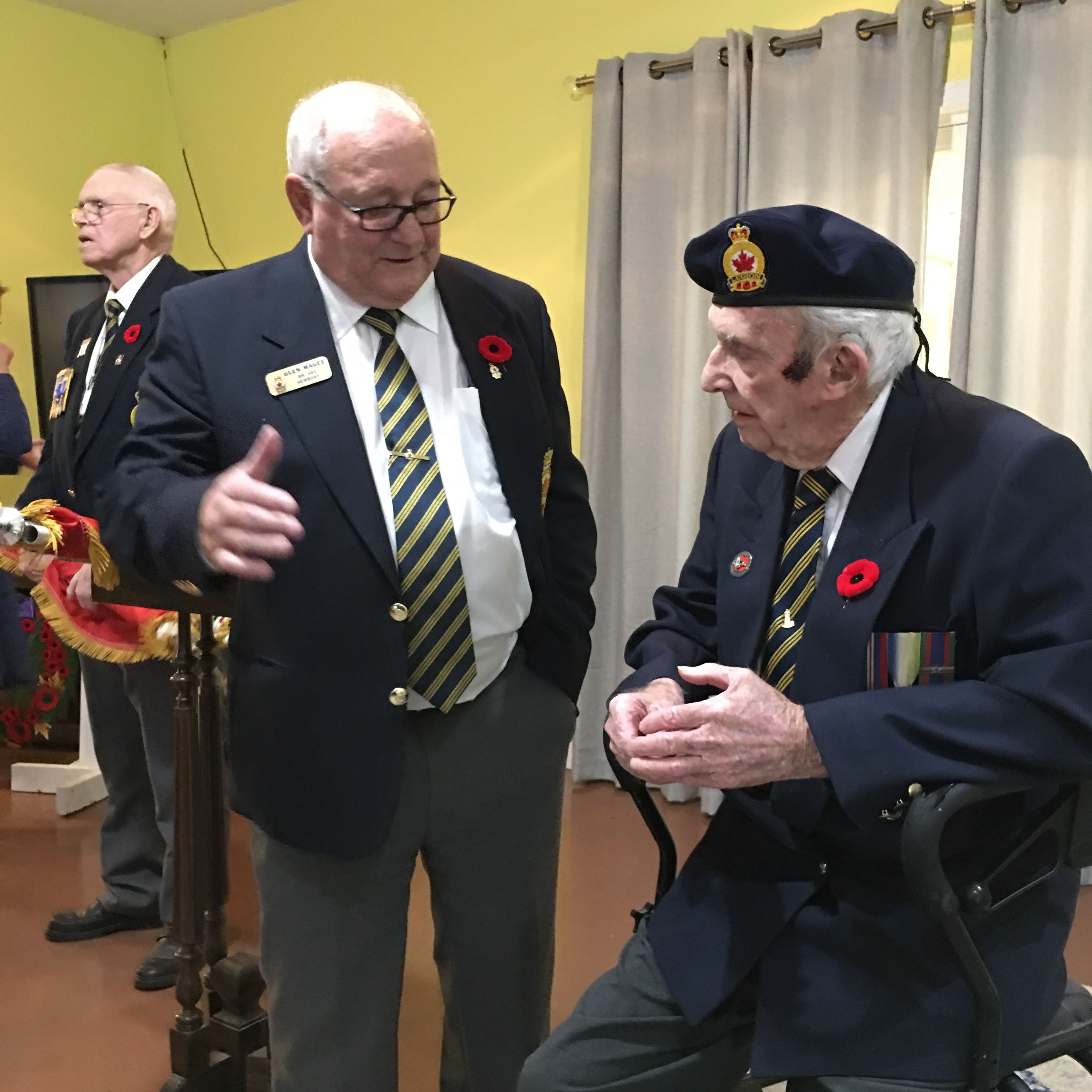
To most people passing by, this has always been another farmer’s field, as time has eroded memories. We can now acknowledge that this place holds a significant place in Southwold Township history. The plaque recognition Project is a combined venture by Greenlane Community Trust, Southwold Township History Committee, S.S. #12 Southwold School Alumni, along with many others…..Well done Southwold !!!