WWII Civilians and Resistance

Fall 2022 Lecture Series G&DHS

This fall’s program is about the resistance movements in Europe and the Canadian Home Front. These are inspiring stories for the generations who have never had to rise up together to fight a war.  (Our COVID experiences gave us an inkling.)  Only years later do we learn about what went on behind the scenes, thanks to historians.  Our speakers are going to address this civilian engagement angle as well as their research and stories. 

Sep 24, 2022.  Let’s help launch Al McGregor’s new book at the Glencoe Fair. Salvaged from the Ruins – A Novel of 1945.  As One War Ends Another Begins.   1- 4 p.m. in the Curling Arena at the historical society’s table. https://glencoehistoricalsociety.ca/events/ 

Sept 28, 2022.  Presentation and book launch at the Archives, 178 McKellar St, Glencoe. Al McGregor’s new book, Salvaged from the Ruins – A Novel of 1945.  https://glencoehistoricalsociety.ca/events/ 

Oct 12, 2022.  Two historians will regale us with stories from our local  #4 Bombing and Gunnery School during WWII.   The Archives, 178 McKellar St, Glencoe from 7 p.m. to 9 p.m.  https://glencoehistoricalsociety.ca/events/  

Nov 8, 2022.  The role of Allied military chaplains and the stories of those who died in the Battle of Normandy from June 6, 1944 to August 25, 1944.   Featuring Rev. Tom Wilson from the French Riviera.  2:00 p.m. at The Archives, 178 McKellar St, Glencoe https://glencoehistoricalsociety.ca/events/  Nov 23, 2022.  Red Noble will tell us about the daring WWII Operation Jericho to bust out Resistance members and political prisoners.  Hybrid in-person and broadcast event starts at 7:00 p.m. at The Archives, 178 McKellar St,  https://glencoehistoricalsociety.ca/events/

Nov 23, 2022.  Red Noble will tell us about the daring WWII Operation Jericho to bust out Resistance members and political prisoners.  Hybrid in-person and broadcast event starts at 7:00 p.m. at The Archives, 178 McKellar St, 

See facebook Events and https://glencoehistoricalsociety.ca/events/ for details 

Oakland Cemetery, Mosa Township

“Beyond the gates of the cemetery lives an historical account of our past, a rich heritage populated by friends and relatives.  Loved ones who can no longer be with us, but whose memories live on.” 

– Josh Kekosz

Each year the Historical Society honours those who came before us.  On July 24, 2022, the   Cemetery Memorial Service was held at Oakland Cemetery, which was opened May 1894 by a group of ten men who formed a Board of Directors.  

Five acres was purchased from a local farmer in Mosa Township and surveyed into plots of 16 feet X 16 feet.  These plots were purchased by families.  One plot had room for 8 burials.  The first burial was Thomas Hopkins in May 1894.     

The area was previously served by small family plots and St. Andrew’s (Graham) Cemetery at 112 Main Street Glencoe (Concession 1, Lot 1). St. Andrew’s Cemetery eventually contained approximately 500 burials between 1841 – 1931.  It still exists and is classified as ‘abandoned’.  

After the new Oakland Cemetery opened and families started purchasing plots, new stones were installed and the names of beloved previously-deceased family members were commemorated.  This could explain why there are 175 inscriptions whose dates of death are prior to May 1894.

Records are poor but we surmise that sometimes stones were moved to the new Oakland and sometimes the stones might have been buried or lost from their original  family plot locations.  And what of the bodies?  We guess that bodies probably remain in their original resting places.  It seems doubtful if they would have  been disinterred and moved. May they continue to rest in peace.

Link to interactive G&DHS Cemetery Map.   

Written by Harold Carruthers and Mary Simpson, 2022.

Oakland Cemetery Memorial
Poster for July 24, 2022 memorial event.

What’s on the Horizon for G & DHS?

K.W. Beecroft, President, G & DHS. Dated April 20, 2022

Our April 20th Members Meeting represents G&DHS’s 44th anniversary. A wonderful achievement for our organization.

With Covid 19 hopefully on the decline, we hope to move ahead with Program ideas and initiatives that will be informative and educational for our members and the public. We plan to have at least four or five member’s meetings and several events, which has been mentioned that we normally attend or sponsor annually. Hopefully, we can also present an “Open House” event where we can invite people in, and see what we’re about.

We also intend to broaden our relationships with other area historical organizations, and participate and promote events of common interests. Just recently, on April 2nd G & DHS was featured in a presentation sponsored by the London/ Middlesex Genealogical Society. We are also pleased to be involved with Backus Page House. Certainly, the Wardsville Museum and Ekfrid Museum are also close partners. 

During this past year, we have reached out to the Lower Thames Conservation area, in order to promote preservation of historic buildings in their care, and also to support restoration efforts of the Fugitive Slave Chapel in London. We will continue efforts into this year toward heritage preservation.

One special Project which we have planned in partnership with the Municipality of Southwest Middlesex, is the manufacture and installation of standardized Cemetery Signs within the municipality. These signs will outline to the public the name of area cemeteries and when they were established. We intent to sign the forgotten ones also, so that our pioneer ancestors will be remembered.

We hope that our volunteer sub-committee will move forward with cataloging and inventorying. We will continue to work with standardizing our approach to the handling and storage of archival material. These activities are viewed as being an activity to be focussed on in the coming year with the involvement of our members.

In closing, the 2021/ 2022 year was full of challenges, but we look forward to continuing in the coming year.

The Archives in Glencoe, Ontario, Canada

Many thanks to the Municipality of SWM

K.W. Beecroft, President, G & DHS. Dated April 20, 2022

The ARCHIVE – G&DHS and Municipality of Southwest Middlesex have an agreement for the use of the facility at 178 McKellar Street. This has proved to be a very positive arrangement for both parties involved. There is room for G & DHS meetings, restoration workshop, a sales area, an office, stacks for books, documents and artifacts along with special collections, microfilm library, and archival space for artifacts. Key also for the move is that the precious property records again make their home in the original Registry Office, which we now call “The Vault”. 

Our new facility allows us to host educational Program activities onsite, as we now have everything available –access, washrooms, seating capacity and parking. We are also pleased to say that we share our facilities with other community organizations, on a revenue neutral basis. Organizations such as local cemetery boards, such as Oakland and Eddie, and Southwest Middlesex’ “Celebrate Community Committee” conduct their routine members’ meetings at 178 McKellar Street.

Information Technology Report

for G&DHS general meeting 2020 – 2022

Aim: To plan for and manage the digital information and on-line applications owned by G&DHS. 

Domain:  Social media apps; Google Workspace; digital archives; on-line privacy and security.

Circle of volunteers includes: Tyler Thomson, Colin Varga, Mary Simpson, Ayako Macdonald, Ken Beecroft, Harold Carruthers, Angela Foreman–Bobier, Ryan Tuer, Marie Williams-Gagnon, Richard Hathaway, and more.  Thank you everyone for all you do.  

The goal for 2023 is to get better organised, establish policy and procedures, and include more people in the work of heritage preservation and the objects of the historical society.  This report prepared by Mary Simpson, for Annual General Meeting, Apr 20, 2022, Glencoe & District Historical Society. 

In-House Administration

Glencoe & District Historical Association has set up its own private and secure Google Workspace which allows our volunteers to have access to many Google tools.  

We are sharing these tools and workspaces with Your Wardsville to see how G&DHS can support collaboration and communication among local community groups. 

Everyone now has their own email address:   The President, Ken Beecroft, is the recipient of the front office email via: contactus@glencoehistoricalsociety.ca  

Social Media: meeting up with the World

Cardinal rule of social media: read, listen, and then engage.  Social media is a polite conversation.  

Glencoe & District Historical society website;  http://glencoehistoricalsociety.ca/   

Our FaceBook Page:  https://www.facebook.com/glencoehistoricalsocietyca/  A great place to promote the work of our fellow groups.  Marie Williams has started posting content.  Harold Carruthers and Ken Beecroft, President, are doing a great job monitoring the questions and comments coming to the Facebook Page.  

Our Eventbrite Page to promote events

Our FaceBook Events page to promote events.

Our Google Map Page: where to find us. 

Our YouTube Channel:  where we upload and curate our video content.

Preserving digital records online

We are pleased to be collaborating with Middlesex Centre Archives.  

Find a Grave: https://www.findagrave.com/my-cemetery/search?page=1#sr-2562231  Ken Beecroft is a super Find a Grave contributor.  It’s a great hobby for many people.  

Our Cemetery List and Interactive google Map.  

Ancestry.ca.   We have a public account that anyone can use and so does the Glencoe Library.  

History Pin: https://www.historypin.org/en/  A cool app for curating collections of pictures from our archives.  Also, we can upload walking and driving tours.  

On this Spot: https://onthisspot.ca/cities/middlesexcounty  Middlesex County.  We are promoting this project by local historian Michael Baker and the Elgin County Museum.

https://archive.org/  Internet Archive, a non-profit library of millions of free books, movies, software, music, websites.  This is the place where we think we can store important reports and document.  

Gathering Our Stories

Our goal is to build a story gathering pipeline.  Working with a team of people from our community and the  Tyrconnell Heritage Society, we are digitally recording personal stories that relate to our local Canadian history. In particular, aim to collect local stories that help explain the past 100 years of Canadian history – which happens to be a required course for Grade 10 students in Ontario.  If you are interested in participating please fill out the form at this link: I have a story to tell.  

Phase One: We recorded three stories from Al McGregor, and short stories from Ina Nelms and Don Webster.  These were submitted to the Oral History project run this winter by the Tyrconnell Heritage Society. 

Phase Two:  Work out a process for story collection, describing, organizing, and uploading online. Collaborate with Tyrconnell Heritage Society.

Report prepared by Mary Simpson, for Annual General Meeting, Apr 20, 2022, Glencoe & District Historical Society.  

Future Generations WILL Care about their history!

Once it’s gone, it’s gone forever!

Ken Beecroft, Ina Nelms, and Harold Carruthers, members of the Glencoe & District Historical Society speak about the need for a County of Middlesex archives to ensure our critical paper and digital records are preserved for the use of future generations.

Unlike other Counties in Ontario that have established archives (Lambton, Kent, Elgin, Oxford, Norfolk, Perth, Huron), Middlesex County has no such thing. In February 2020, representatives of historical societies and interested citizens met to gauge the interest in establishing a Middlesex County Archives. These aging keepers of history were frightened about the potential loss of local history. The group worried about what would happen to their precious historical documents due to aging volunteers and lack of funds.

What will the County of Middlesex decide? Stay tuned.

This video message published 29 July 2021

Edited by Colin Varga

Directed by Mary Simpson Social Media team, Glencoe & District Historical Society

Old River Farm's flags

Today is the Day for Truth and Reconciliation

September 30th is the National Day for Truth and Reconciliation in Canada. The day honours the lost children and Survivors of residential schools, their families and communities. Public commemoration of the tragic and painful history as well as the recognition of the ongoing impacts of residential schools is a vital component of the reconciliation process.

Since 2013, September 30th has also been Orange Shirt Day, which is an Indigenous-led commemorative day to honour the children who were sent to Indian Residential Schools and stripped of their culture and freedom. September 30th was chosen to honour the experience of Phyllis Webstad, a Northern Secwepemc (Shuswap) from the Stswecem’c Xgat’tem First Nation who, on her first day of school, had her new orange shirt taken from her. 

It is a day to engage in commemorative events, to make space for meaningful conversation, and to reflect upon how we may support reconciliation efforts individually, as organizations, and as a profession. 

Let’s listen to the teachings of Indigenous Elders, colleagues, and organizations. Let’s read the official reports. Let’s learn from the experiences of colleagues working in archives as they reflect on our institutional histories and our current relationships with Indigenous communities. Some of these resources are shared below. 

Many thanks to the Archives Association of Ontario for providing this text for our historical society to share. Check out their ‘Towards Truth and Reconciliation’ resource page

How our historians preserve our history

Wardsville, ON: Recently a civil servant working for the Municipality of Southwest Middlesex approached Ken Willis, member of the Glencoe & District Historical Society, with questions about the history of Little Kin Park in Wardsville.  Ken spent a few hours consulting local records and submitted an intriguing historical report to the Municipality of Southwest Middlesex.  

Where were these records and how was it they even existed?  Ken Willis was appointed the Official Historian of Wardsville in the late 1970s by Wardsville Village Council.  With the formation of Southwest Middlesex in 2001, the new amalgamated council reconfirmed Ken as Wardsville Historian. Years later, he is still acting in that capacity.  Ken has filled a museum with artifacts, curates the Wardsville Archives, and is the authority on village history.

With little effort Ken was able to access the Vestry Minute Book of St. James Anglican Church 1933-1946.  The Wardsville Archives had this document because years ago, a stranger approached Ken at the Wardsville Post Office, and said “Here, take this, I understand you are the local historian.  You should have this.”  

But there was more.  Ken quickly accessed the relevant deeds from the wall of filing cabinets filled with land deeds at The Archives in Glencoe.  Their existence is another tale of local people making sure the land registry records for this part of the County were never thrown out after they were digitized.  

The Glencoe & District Historical Society is urging businesses, non profit organizations, and residents to think about their legacies.  What records are being preserved to ensure that future generations never forget those who went before?   

Ken Beecroft, President, Glencoe & District Historical Society explains that “many businesses and community organizations have faded away from memory, but their history won’t be forgotten because people took the time to store their records safely. Recently, concerned members of Glencoe Skating Club, Mayhew’s Clothing Store, Tender Tootsies ‘slipper factory’, Trinity United Church (Glencoe) , and Glencoe Masonic Lodge donated their records to The Archives which is managed by members of the Glencoe & District Historical Society. 

“The organizations have folded but their stories live on.  But what about our municipal records?  What about the County of Middlesex records?  What if the loyal volunteers at our local Archives start to falter?” Ken asks.

Historical records are an important community asset.  As we plan for new infrastructure to serve generations to come, planners and elected officials need a thorough understanding of local history.  

Indigenous Peoples’ history is critical. Marilyn McCallum, a volunteer with the Appin Museum and The Archives, has been noting references to Indigenous Peoples’ history when researching local history but sources are sparse.  Facts about land use pre-colonization need to be checked out with Indigenous People historians who have access to the oral histories passed down through the generations.   

Cemeteries of Southwest Middlesex can be viewed at https://tinyurl.com/md5yb8hb  

The Need for a County Archives

County of Middlesex: Unlike other Counties in Ontario that have established archives (Lambton, Kent, Elgin, Oxford, Norfolk, Perth, Huron), Middlesex County has no such thing.  In February 2020, representatives of historical societies and interested citizens met to gauge the interest in establishing a Middlesex County Archives. These aging keepers of history were frightened about the potential loss of local history.  The group worried about what would happen to their precious historical documents due to aging volunteers and lack of funds.

The Committee to Establish a Middlesex County Archives (CEMCA) was born. After two meetings, COVID-19 prevented formal meetings but planning continued.  In February 2021 virtual meetings commenced via Zoom. 

The first concern was municipal records. County and Municipal governments are legally mandated to store public records for historical, governance, and legal use.  The Ontario Municipal Act (2001, S.O. 2001. C. 25 Section 254) states that municipal offices must preserve certain documents. They must be publicly accessible and available in a timely manner. 

From a survey of Middlesex County Mayors and Administrators, it was learned that municipal records are stored in a variety of locations.  Some are stored on-site, others are stored off-site which makes accessibility and environmental control more difficult.   To be environmentally safe, records need to be kept in conditions with controlled temperature, humidity and ultraviolet light protection. 

Next concern: the records of local historical societies, private collections, the papers of famous people, family treasures, the records of non-profit organizations and countless other precious documents.  Even small local archives such as the wonderful collections of the Glencoe & District Historical Society are at risk.  They have a modern building and active volunteers preserving the growing collection but the Society could fail — just as so many other local organizations have shut down, before and during the pandemic. 

In June 2021, CEMCA developed a series of “Facts Sheets” that were sent weekly to County and Municipal Councillors and Administrative Staff. Information included: Municipal Act and Responsibilities; What is an Archives?; How Will the Municipality and Clerks Benefit; Where Are the Records Now?; Who Would Use the Middlesex County Archives; Resources Required; Challenges and Opportunities. See http://middlesexcentrearchive.ca/proposed-middlesex-county-archive/  or email proposedmiddlesexcountyarchive@gmail.com.

Committee representatives from each municipality are contacting their councillors and making presentations to their local councils. On September 28, 2021, CEMCA will formally ask the County Council to establish a Middlesex County Archives.

Who benefits from a County Archives? future generations!!  Not to mention students, scholars, educators, genealogists, family historians, tourists, municipal clerks, town planners, developers, lawyers, architects, and heritage advocates.

Video featuring Ken Beecroft, Ina Nelms, and Harold Carruthers, members of the Glencoe & District Historical Society,  speak about the need for a County of Middlesex archive to ensure our critical paper and digital records are preserved for the use of future generations.  https://youtu.be/-rxJE8p2oqk

Southwest Middlesex has a duty to save records  https://glencoehistoricalsociety.ca/2021/07/14/southwest-middlesex-has-a-duty-to-save-records/  

Once they’re gone, they’re gone.  https://glencoehistoricalsociety.ca/2021/07/28/1006/  

Let us lose nothing of the past, it is only with the past that one builds the future. Anatole France

Southwest Middlesex has a duty to save records

Municipal Act and Responsibility

Legal Mandate

  • Federal and Provincial Governments in Canada have mandated that public records be officially archived for legal, governance, and historical purposes.  
  • The division of records kept usually coincides with jurisdictional boundaries: Federal, Provincial, County, and Municipalities.  (Library and Archives of Canada Act, S.C.2004).
  • Ontario has further mandated that preserved public records be available to the public.  (Archives Act, RSO 1990; Archives and Recordkeeping Act, 2006; Archives and Recordkeeping Amendment Act, 2019.
  • The Ontario Municipal Act 2001, S.O. 2001. C. 25 Section 254 further states that municipal offices must preserve certain documents and they are to be publicly accessible. Those records need to be adequately stored.  It further indicates that municipal offices could deposit their records in an archives.

Many neighbouring Ontario counties have created their own archives to fulfill their legal obligations and to preserve important heritage materials. These include Elgin, Oxford, Huron, Perth, Grey, Bruce, Lambton, Haldimand, Wellington and more recently in 2020, Norfolk.  Middlesex County has not done so yet.

Often records are not easily accessible due to the location of the records in the municipality.  They are either stored off-site in another municipal structure or are not available for access to the public.  Whether in digital or hard copy, records need to be accessible in a timely manner, especially when there are MFIPPA requests.  

Environmentally controlled (EC) storage facilities are necessary for preserving records.  The temperature must be 18-21 degrees Celsius, which is colder than an office environment. Relative humidity (RH) should be between 45-50%.  If both elements are not met, mold can occur if humidity is too high, and paper can deteriorate if the temperature and RH are too low.  Based on the surveys returned from the municipalities in Middlesex County, none of the records are in EC areas. A few municipalities indicated the records are stored in their community centres. While these facilities may have air-conditioning, the RH control is still an issue.  

Even if municipal records are covered in Records Retention Schedules as per the Municipal Act 2001, S.O. 2001. C. 25 Section 253, some records have historical value that can be retained for researcher and/or historical value.   When records no longer serve administrative value, they could still have cultural value for information.  Less than 3% of municipal records are archival. While it might not be a lot, municipal records like tax assessment rolls, building plans, environmental assessments and other documents should be considered for placement in the Middlesex County Archives. 

Written by the Committee to Establish a Middlesex County Archives, July 2021

We Need a County Archives

Middlesex County does not have a county archives to protect our history for future generations.

Report from the Committee To Establish A Middlesex County Archives (CEMCA):

Unlike other counties that have established a County Archives (Lambton, Kent, Elgin, Oxford, Norfolk, Perth, Huron etc.) to house municipal as well as important historical materials, Middlesex County has not. In February 2020, representatives of historical societies and interested citizens from across Middlesex County gathered to ascertain the interest in establishing a Middlesex County Archives. The group had concerns about what would happen to their precious historical documents due to aging volunteers and lack of resources.  The group gave resounding approval to the initiative and the Committee to Establish a Middlesex County Archives was born. After two meetings, Covid-19 halted those for the year but work remained ongoing.  In February 2021 virtual meetings commenced via Zoom. 

How best to achieve the goal? The primary focus had to be municipal records. Through legislation, County and Municipal governments are mandated to officially store public records for legal, governance, and historical purposes.  The Ontario Municipal Act 2001, S.O. 2001. C. 25 Section 254 further states that municipal offices must preserve certain documents, and that they are to be publicly accessible.  Those records need to be properly stored and available in a timely manner.  It further indicates that municipal offices could deposit their records in an archive, to be secured. In addition, many historical societies hold historically significant documents and still more remain in private hands. Without a County Archives, there is concern about the location and condition under which many valuable historical documents are being stored.

CEMCA, through a survey to Mayors and Clerks, and another survey to Historical Societies within Middlesex County, ascertained much data – most materials were not stored in secure, environmentally-safe areas and most were not easily accessible.  That is a problem for municipal as well as local historical documents.

In June, CEMCA developed a series of “Facts Sheets” and other pertinent information to be sent weekly to County and Municipal Councillors and Administrative Staff. Information included: Municipal Act and Responsibilities, What is an Archives? How Will the Municipality and Clerks Benefit? Where Are the Records Now? Who Would Use the Middlesex County Archives, Resources Required and Challenges and Opportunities. To see any of this information, please check Middlesex Centre Archives webpage: www.middlesexcentrearchive.ca or email proposedmiddlesexcountyarchive@gmail.com.

Committee representatives from each municipality are contacting their councillors and/or making presentations to their councils. On September 28, 2021, CEMCA will be making a presentation to County Council to formally ask that a Middlesex County Archives be established.

Who benefits from a County Archives? Municipal clerks, town planners and developers, lawyers and architects, heritage advocates, scholars and educators, genealogists and family historians, tourists. The biggest benefactors will be our future generations!!!!!!!

How can you help? Contact your county councillors by writing, email or telephone to express your support for the Archives. For more information, please email proposedmiddlesexcountyarchive@gmail.com.

Let us lose nothing of the past, it is only with the past that one builds the future. Anatole France

Arnold Warren Nethercott 1928 – 2020

The Loyalist Gazette. Spring 2021

Obituary

On December 21, 2020, Arnold Nethercott passed away at Country Terrace Nursing Home, Komoka, Ontario. Arnold was the beloved husband of 32 years of Barbara (Balch) Nethercott nee: Dadswell. He was a dear stepfather of Ruth Truesdale (Brian), Kathy Bedford (Larry), Greg Balch (Kim), Mark Balch (Linda), Bruce Balch (Kim) and Chris Balch (Yvonne). Loving grandfather of 14 and great-grandfather of 15.

Arnold is also survived by his brothers Marv Nethercott (Mary) and Bill Nethercott (Roxann) and by his sisters Lois McLean and Phyllis Munro (Lorne). He was the loving uncle of 13 nieces and nephews and many great-nieces and great-nephews. Predeceased by his parents James Percy Nethercott and Mary Louise (Warren) Nethercott, his sister Eleanor Wells and his brothers-in-law Vin Wells and Jack McLean.

Arnold achieved the rank of Captain as a Forward Air Controller in fixed-wing aircraft and as a helicopter pilot while in the Canadian Armed Forces. He served in peacekeeping duties in various locations around the world including Cyprus. He was also a respected Past President of the Ontario Genealogical Society (www.ogs.on.ca) and the United Empire Loyalists Society of Canada. (www.uelac.org)

Jodie Aldred – Documenting Life on the Farm with a Camera and Drone

Jodie Aldred is a farm girl whose off-farm job is photography. Check out her Faces on Farms page and her Instagram page and another link.  Here is the Ag in the Classroom video she made for school kids with her Dad, Dug Aldred.
“I’m glad a world pandemic made people realize “YOLO” is still a trend. “You only live once.”
“So although it has taken a pandemic… I hope people including myself remind ourselves. Remind ourselves the hustle and bustle of everyday life, building a career, making money, socializing with friends… sometimes is worth pausing every once in a while. Hopefully next time you pause isn’t because a world pandemic forced you to. It’s because you truly are taking time to enjoy your family or those you care about. Because after all… you only live once. For Covid19’s gentle reminder of what matters…”

Canadian Farmer – Eric Simpson

Eric Simpson is an egg farmer on Longwoods Road who farms with his brother, Owen, his mother Vicky , wife Sarah, two boys and a couple of staff. Eric was interested in following the YouTube channels of other farmers and decided his family farm had a story to tell too.
Simpson Poultry Farms makes their own feed, so Eric’s egg farm story starts with the corn and soybeans he grows to feed his chickens. Enjoy the day with Eric.
Check out his channel
Here is baby chick day:

Fresh Air Farmer – Andrew Campbell

Search through your family photos and try to find a record of the family farm, or Mother and kids at work in the garden, or photographs of the farmstead buildings. Nothing. The older the photos, the more we are interested in what we see in the background.  People didn’t have the cameras to document their lives.  Or if they did, they documented their trips to other places, never appreciating the value of documenting their daily work.
 
 
Today, with social media our local farmers are documenting ‘ A Day on Farm’. Check out dairy farmer and key note speaker, Andrew Campbell, and his YouTube Channel. A treasure trove of information about today’s family farm. https://www.youtube.com/channel/UCYcqz2M9zDDO0B-Ley1itkw
 
 
“I’m Andrew Campbell & we’ve milked cows on our farm for a lot of years. And we’ve done it pretty much the same way since the milking machine came along. But now with new technology on dairies around the world, we’re jumping in with both feet. Follow along as we build a brand new barn with brand new equipment – all in an effort to make the cows as comfortable as possible.”
 
 
Andrew’s Website.     Andrew’s YouTube channel includes other farms he has filmed in the past.
 
 
Andrew, your community is proud of you and your family.   Thanks for sharing the life of the dairy farmer.  It will be interesting to see how long this historical record will last on the Internet.

The Story of Eaton’s

Here is a delightful booklet published circa 1925 that tells the story of Eaton’s. If you are interested, more information about this iconic Canadian company can be found online at the T. Eaton Company fonds.

The T. Eaton Company started up in 1869 . This 27 page booklet was donated this month to The Archives by Ina Nelms.
Marion Dobie remembered

Marion Dobie remembered

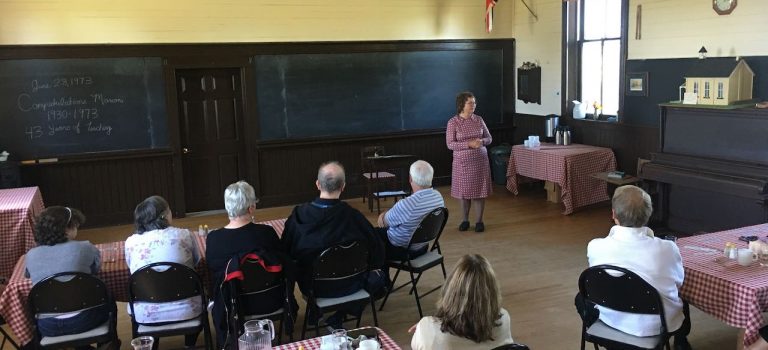
Giles took on the persona of Miss Dobie and presented three acts interspersed with a delicious ham and scalloped potatoes meal served up COVID-19 style with the help of one assistant.

When COVID-19 struck, Antje  Giles, community spark plug and entrepreneur, moved her back burner projects to the front burner and dove into the history of long-term local school teacher, Marion Dobie. Miss Dobie taught at Tait’s Corners school house 43 years.  

Miss Dobie was “married” to her beloved school and worshipped by her students.  

Back Row L – R: ______, Mary Eardley, Mary Margaret McEachren, Marion Dobie, Mildred Ayres, Eileen Poole. Front row: Lucy McRae, Stanley Jackson, Gordie Urquhart, ____, Dorothy Jean McCallum. As remembered by Dorothy Jean, who was in the audience. Photo taken in th early 1950s.

Giles took on the persona of Miss Dobie and presented three acts interspersed with a delicious ham and scalloped potatoes meal served up COVID-19 style with the help of one assistant.

Two performances on Saturday, September 19. Twenty people attended each sold out performance.  

L-R: David Nelms, Ina Nelms, and Alicia Nelms
Antje Giles brings history to life on September 20 at the Tait’s Corner’s School House
The original bell.

Photos by Mary Simpson. Many thanks to Hayter Publications Inc. and Marie Gagnon-Williams for publishing the story.

Underground Railroad Code: fact or fiction?

Underground Railroad Code: fact or fiction?

Presented by quilter, Micki Angyal. 

On Feb 19, 2020, forty five people attended Micki Angyal’s presentation about the quilt code possibly used by slaves to communicate along the Underground Railroad. Stories have been handed down the generations about the code but there is no hard historical evidence. Of course, it was a SECRET code, so the lack of evidence is no surprise.

After the U.S. Congress passed the Compromise of 1850, the law forced free northern states to return escaped slaves.  Conductors like Harriet Tubman and Frederick Douglass led many escapees to Canada. The journey north was not easy. Secrecy was necessary for escape and information could only be passed by word of mouth, using codes, signs and signals created by slaves. One such code was using quilts.  Various blocks in the quilts gave the slaves clues as to where they had to go.

Stan Grizzle, our 2019 Black History Monthpresenter attended and he recalls his grandmother telling stories about the quilts being used to communicate.  

Mary Simpson told the group about the Damascas Ontario 4-H Life Skills Club up in Wellingtown County.  In 2015, the 4-H members painted a series of 4X4 barn quilts depicting the coded designs Micki told us about. 

English Teacher Lonnie Grover from Glencoe & District Historical Society shared the creative project  she teaches with a fellow Mathematics teacher using barn quilts as an inspiring theme for learning.