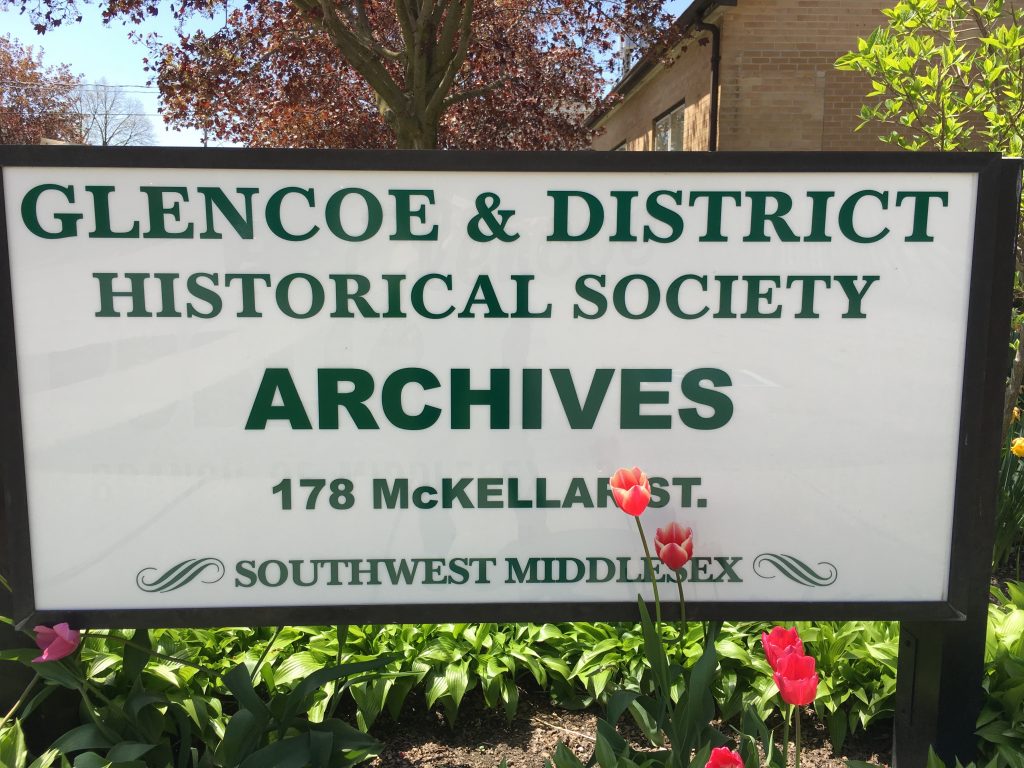
The Archives in Glencoe, Ontario, Canada

Many thanks to the Municipality of SWM

K.W. Beecroft, President, G & DHS. Dated April 20, 2022

The ARCHIVE – G&DHS and Municipality of Southwest Middlesex have an agreement for the use of the facility at 178 McKellar Street. This has proved to be a very positive arrangement for both parties involved. There is room for G & DHS meetings, restoration workshop, a sales area, an office, stacks for books, documents and artifacts along with special collections, microfilm library, and archival space for artifacts. Key also for the move is that the precious property records again make their home in the original Registry Office, which we now call “The Vault”. 

Our new facility allows us to host educational Program activities onsite, as we now have everything available –access, washrooms, seating capacity and parking. We are also pleased to say that we share our facilities with other community organizations, on a revenue neutral basis. Organizations such as local cemetery boards, such as Oakland and Eddie, and Southwest Middlesex’ “Celebrate Community Committee” conduct their routine members’ meetings at 178 McKellar Street.

Information Technology Report

for G&DHS general meeting 2020 – 2022

Aim: To plan for and manage the digital information and on-line applications owned by G&DHS. 

Domain:  Social media apps; Google Workspace; digital archives; on-line privacy and security.

Circle of volunteers includes: Tyler Thomson, Colin Varga, Mary Simpson, Ayako Macdonald, Ken Beecroft, Harold Carruthers, Angela Foreman–Bobier, Ryan Tuer, Marie Williams-Gagnon, Richard Hathaway, and more.  Thank you everyone for all you do.  

The goal for 2023 is to get better organised, establish policy and procedures, and include more people in the work of heritage preservation and the objects of the historical society.  This report prepared by Mary Simpson, for Annual General Meeting, Apr 20, 2022, Glencoe & District Historical Society. 

In-House Administration

Glencoe & District Historical Association has set up its own private and secure Google Workspace which allows our volunteers to have access to many Google tools.  

We are sharing these tools and workspaces with Your Wardsville to see how G&DHS can support collaboration and communication among local community groups. 

Everyone now has their own email address:   The President, Ken Beecroft, is the recipient of the front office email via: contactus@glencoehistoricalsociety.ca  

Social Media: meeting up with the World

Cardinal rule of social media: read, listen, and then engage.  Social media is a polite conversation.  

Glencoe & District Historical society website;  http://glencoehistoricalsociety.ca/   

Our FaceBook Page:  https://www.facebook.com/glencoehistoricalsocietyca/  A great place to promote the work of our fellow groups.  Marie Williams has started posting content.  Harold Carruthers and Ken Beecroft, President, are doing a great job monitoring the questions and comments coming to the Facebook Page.  

Our Eventbrite Page to promote events

Our FaceBook Events page to promote events.

Our Google Map Page: where to find us. 

Our YouTube Channel:  where we upload and curate our video content.

Preserving digital records online

We are pleased to be collaborating with Middlesex Centre Archives.  

Find a Grave: https://www.findagrave.com/my-cemetery/search?page=1#sr-2562231  Ken Beecroft is a super Find a Grave contributor.  It’s a great hobby for many people.  

Our Cemetery List and Interactive google Map.  

Ancestry.ca.   We have a public account that anyone can use and so does the Glencoe Library.  

History Pin: https://www.historypin.org/en/  A cool app for curating collections of pictures from our archives.  Also, we can upload walking and driving tours.  

On this Spot: https://onthisspot.ca/cities/middlesexcounty  Middlesex County.  We are promoting this project by local historian Michael Baker and the Elgin County Museum.

https://archive.org/  Internet Archive, a non-profit library of millions of free books, movies, software, music, websites.  This is the place where we think we can store important reports and document.  

Gathering Our Stories

Our goal is to build a story gathering pipeline.  Working with a team of people from our community and the  Tyrconnell Heritage Society, we are digitally recording personal stories that relate to our local Canadian history. In particular, aim to collect local stories that help explain the past 100 years of Canadian history – which happens to be a required course for Grade 10 students in Ontario.  If you are interested in participating please fill out the form at this link: I have a story to tell.  

Phase One: We recorded three stories from Al McGregor, and short stories from Ina Nelms and Don Webster.  These were submitted to the Oral History project run this winter by the Tyrconnell Heritage Society. 

Phase Two:  Work out a process for story collection, describing, organizing, and uploading online. Collaborate with Tyrconnell Heritage Society.

Report prepared by Mary Simpson, for Annual General Meeting, Apr 20, 2022, Glencoe & District Historical Society.  

Future Generations WILL Care about their history!

Once it’s gone, it’s gone forever!

Ken Beecroft, Ina Nelms, and Harold Carruthers, members of the Glencoe & District Historical Society speak about the need for a County of Middlesex archives to ensure our critical paper and digital records are preserved for the use of future generations.

Unlike other Counties in Ontario that have established archives (Lambton, Kent, Elgin, Oxford, Norfolk, Perth, Huron), Middlesex County has no such thing. In February 2020, representatives of historical societies and interested citizens met to gauge the interest in establishing a Middlesex County Archives. These aging keepers of history were frightened about the potential loss of local history. The group worried about what would happen to their precious historical documents due to aging volunteers and lack of funds.

What will the County of Middlesex decide? Stay tuned.

This video message published 29 July 2021

Edited by Colin Varga

Directed by Mary Simpson Social Media team, Glencoe & District Historical Society

How our historians preserve our history

Wardsville, ON: Recently a civil servant working for the Municipality of Southwest Middlesex approached Ken Willis, member of the Glencoe & District Historical Society, with questions about the history of Little Kin Park in Wardsville.  Ken spent a few hours consulting local records and submitted an intriguing historical report to the Municipality of Southwest Middlesex.  

Where were these records and how was it they even existed?  Ken Willis was appointed the Official Historian of Wardsville in the late 1970s by Wardsville Village Council.  With the formation of Southwest Middlesex in 2001, the new amalgamated council reconfirmed Ken as Wardsville Historian. Years later, he is still acting in that capacity.  Ken has filled a museum with artifacts, curates the Wardsville Archives, and is the authority on village history.

With little effort Ken was able to access the Vestry Minute Book of St. James Anglican Church 1933-1946.  The Wardsville Archives had this document because years ago, a stranger approached Ken at the Wardsville Post Office, and said “Here, take this, I understand you are the local historian.  You should have this.”  

But there was more.  Ken quickly accessed the relevant deeds from the wall of filing cabinets filled with land deeds at The Archives in Glencoe.  Their existence is another tale of local people making sure the land registry records for this part of the County were never thrown out after they were digitized.  

The Glencoe & District Historical Society is urging businesses, non profit organizations, and residents to think about their legacies.  What records are being preserved to ensure that future generations never forget those who went before?   

Ken Beecroft, President, Glencoe & District Historical Society explains that “many businesses and community organizations have faded away from memory, but their history won’t be forgotten because people took the time to store their records safely. Recently, concerned members of Glencoe Skating Club, Mayhew’s Clothing Store, Tender Tootsies ‘slipper factory’, Trinity United Church (Glencoe) , and Glencoe Masonic Lodge donated their records to The Archives which is managed by members of the Glencoe & District Historical Society. 

“The organizations have folded but their stories live on.  But what about our municipal records?  What about the County of Middlesex records?  What if the loyal volunteers at our local Archives start to falter?” Ken asks.

Historical records are an important community asset.  As we plan for new infrastructure to serve generations to come, planners and elected officials need a thorough understanding of local history.  

Indigenous Peoples’ history is critical. Marilyn McCallum, a volunteer with the Appin Museum and The Archives, has been noting references to Indigenous Peoples’ history when researching local history but sources are sparse.  Facts about land use pre-colonization need to be checked out with Indigenous People historians who have access to the oral histories passed down through the generations.   

Cemeteries of Southwest Middlesex can be viewed at https://tinyurl.com/md5yb8hb  

The Need for a County Archives

County of Middlesex: Unlike other Counties in Ontario that have established archives (Lambton, Kent, Elgin, Oxford, Norfolk, Perth, Huron), Middlesex County has no such thing.  In February 2020, representatives of historical societies and interested citizens met to gauge the interest in establishing a Middlesex County Archives. These aging keepers of history were frightened about the potential loss of local history.  The group worried about what would happen to their precious historical documents due to aging volunteers and lack of funds.

The Committee to Establish a Middlesex County Archives (CEMCA) was born. After two meetings, COVID-19 prevented formal meetings but planning continued.  In February 2021 virtual meetings commenced via Zoom. 

The first concern was municipal records. County and Municipal governments are legally mandated to store public records for historical, governance, and legal use.  The Ontario Municipal Act (2001, S.O. 2001. C. 25 Section 254) states that municipal offices must preserve certain documents. They must be publicly accessible and available in a timely manner. 

From a survey of Middlesex County Mayors and Administrators, it was learned that municipal records are stored in a variety of locations.  Some are stored on-site, others are stored off-site which makes accessibility and environmental control more difficult.   To be environmentally safe, records need to be kept in conditions with controlled temperature, humidity and ultraviolet light protection. 

Next concern: the records of local historical societies, private collections, the papers of famous people, family treasures, the records of non-profit organizations and countless other precious documents.  Even small local archives such as the wonderful collections of the Glencoe & District Historical Society are at risk.  They have a modern building and active volunteers preserving the growing collection but the Society could fail — just as so many other local organizations have shut down, before and during the pandemic. 

In June 2021, CEMCA developed a series of “Facts Sheets” that were sent weekly to County and Municipal Councillors and Administrative Staff. Information included: Municipal Act and Responsibilities; What is an Archives?; How Will the Municipality and Clerks Benefit; Where Are the Records Now?; Who Would Use the Middlesex County Archives; Resources Required; Challenges and Opportunities. See http://middlesexcentrearchive.ca/proposed-middlesex-county-archive/  or email proposedmiddlesexcountyarchive@gmail.com.

Committee representatives from each municipality are contacting their councillors and making presentations to their local councils. On September 28, 2021, CEMCA will formally ask the County Council to establish a Middlesex County Archives.

Who benefits from a County Archives? future generations!!  Not to mention students, scholars, educators, genealogists, family historians, tourists, municipal clerks, town planners, developers, lawyers, architects, and heritage advocates.

Video featuring Ken Beecroft, Ina Nelms, and Harold Carruthers, members of the Glencoe & District Historical Society,  speak about the need for a County of Middlesex archive to ensure our critical paper and digital records are preserved for the use of future generations.  https://youtu.be/-rxJE8p2oqk

Southwest Middlesex has a duty to save records  https://glencoehistoricalsociety.ca/2021/07/14/southwest-middlesex-has-a-duty-to-save-records/  

Once they’re gone, they’re gone.  https://glencoehistoricalsociety.ca/2021/07/28/1006/  

Let us lose nothing of the past, it is only with the past that one builds the future. Anatole France

Southwest Middlesex has a duty to save records

Municipal Act and Responsibility

Legal Mandate

  • Federal and Provincial Governments in Canada have mandated that public records be officially archived for legal, governance, and historical purposes.  
  • The division of records kept usually coincides with jurisdictional boundaries: Federal, Provincial, County, and Municipalities.  (Library and Archives of Canada Act, S.C.2004).
  • Ontario has further mandated that preserved public records be available to the public.  (Archives Act, RSO 1990; Archives and Recordkeeping Act, 2006; Archives and Recordkeeping Amendment Act, 2019.
  • The Ontario Municipal Act 2001, S.O. 2001. C. 25 Section 254 further states that municipal offices must preserve certain documents and they are to be publicly accessible. Those records need to be adequately stored.  It further indicates that municipal offices could deposit their records in an archives.

Many neighbouring Ontario counties have created their own archives to fulfill their legal obligations and to preserve important heritage materials. These include Elgin, Oxford, Huron, Perth, Grey, Bruce, Lambton, Haldimand, Wellington and more recently in 2020, Norfolk.  Middlesex County has not done so yet.

Often records are not easily accessible due to the location of the records in the municipality.  They are either stored off-site in another municipal structure or are not available for access to the public.  Whether in digital or hard copy, records need to be accessible in a timely manner, especially when there are MFIPPA requests.  

Environmentally controlled (EC) storage facilities are necessary for preserving records.  The temperature must be 18-21 degrees Celsius, which is colder than an office environment. Relative humidity (RH) should be between 45-50%.  If both elements are not met, mold can occur if humidity is too high, and paper can deteriorate if the temperature and RH are too low.  Based on the surveys returned from the municipalities in Middlesex County, none of the records are in EC areas. A few municipalities indicated the records are stored in their community centres. While these facilities may have air-conditioning, the RH control is still an issue.  

Even if municipal records are covered in Records Retention Schedules as per the Municipal Act 2001, S.O. 2001. C. 25 Section 253, some records have historical value that can be retained for researcher and/or historical value.   When records no longer serve administrative value, they could still have cultural value for information.  Less than 3% of municipal records are archival. While it might not be a lot, municipal records like tax assessment rolls, building plans, environmental assessments and other documents should be considered for placement in the Middlesex County Archives. 

Written by the Committee to Establish a Middlesex County Archives, July 2021

We Need a County Archives

Middlesex County does not have a county archives to protect our history for future generations.

Report from the Committee To Establish A Middlesex County Archives (CEMCA):

Unlike other counties that have established a County Archives (Lambton, Kent, Elgin, Oxford, Norfolk, Perth, Huron etc.) to house municipal as well as important historical materials, Middlesex County has not. In February 2020, representatives of historical societies and interested citizens from across Middlesex County gathered to ascertain the interest in establishing a Middlesex County Archives. The group had concerns about what would happen to their precious historical documents due to aging volunteers and lack of resources.  The group gave resounding approval to the initiative and the Committee to Establish a Middlesex County Archives was born. After two meetings, Covid-19 halted those for the year but work remained ongoing.  In February 2021 virtual meetings commenced via Zoom. 

How best to achieve the goal? The primary focus had to be municipal records. Through legislation, County and Municipal governments are mandated to officially store public records for legal, governance, and historical purposes.  The Ontario Municipal Act 2001, S.O. 2001. C. 25 Section 254 further states that municipal offices must preserve certain documents, and that they are to be publicly accessible.  Those records need to be properly stored and available in a timely manner.  It further indicates that municipal offices could deposit their records in an archive, to be secured. In addition, many historical societies hold historically significant documents and still more remain in private hands. Without a County Archives, there is concern about the location and condition under which many valuable historical documents are being stored.

CEMCA, through a survey to Mayors and Clerks, and another survey to Historical Societies within Middlesex County, ascertained much data – most materials were not stored in secure, environmentally-safe areas and most were not easily accessible.  That is a problem for municipal as well as local historical documents.

In June, CEMCA developed a series of “Facts Sheets” and other pertinent information to be sent weekly to County and Municipal Councillors and Administrative Staff. Information included: Municipal Act and Responsibilities, What is an Archives? How Will the Municipality and Clerks Benefit? Where Are the Records Now? Who Would Use the Middlesex County Archives, Resources Required and Challenges and Opportunities. To see any of this information, please check Middlesex Centre Archives webpage: www.middlesexcentrearchive.ca or email proposedmiddlesexcountyarchive@gmail.com.

Committee representatives from each municipality are contacting their councillors and/or making presentations to their councils. On September 28, 2021, CEMCA will be making a presentation to County Council to formally ask that a Middlesex County Archives be established.

Who benefits from a County Archives? Municipal clerks, town planners and developers, lawyers and architects, heritage advocates, scholars and educators, genealogists and family historians, tourists. The biggest benefactors will be our future generations!!!!!!!

How can you help? Contact your county councillors by writing, email or telephone to express your support for the Archives. For more information, please email proposedmiddlesexcountyarchive@gmail.com.

Let us lose nothing of the past, it is only with the past that one builds the future. Anatole France

Melbourne Legion 70 years

Melbourne Legion 70 years

Written by JoAnn Galbraith

On November 18th, 1949, twenty-four area veterans met in the Community Hall in Melbourne with the idea of possibly forming a Legion in the village.  With backing from Glencoe Legion Branch # 219, Melbourne received its Charter February 1st 1950. In 2017, a history committee was formed  to make plans for the anniversary celebration.

Several displays of the Legion’s history have been shown to the public since the committee was formed.   Richard Hathaway scanned all the photos and memorabilia while JoAnn Galbraith has reviewed the records and minute books with a possibility of publishing a book with the Legion’s history  in 2020.   

Fifty Legion members and special guest attended a  complimentary dinner at the Legion on Saturday night November 30th. Folks viewed a slide presentation of photos from the 1950s to present day.  Also on display were original photos and documents.  

At each table setting was a place card with the front cover consisting of a photo of the first Legion building 1949 and the present one in 2019.

Zone A 5 Commander Gerry Cross gave a brief history of Branch #510. Bob Davenport, on behalf of Reg Lovell Glencoe Branch # 219, gave a brief history of the affiliation between Melbourne Legion and Glencoe Legion since Branch #510’s formation.  

Regrets were received from Peg Luce, Zone A 5 Deputy Commander, and former Federal Minister Bev Shipley.  

JoAnn Galbraith, a member of the executive and the history committee, was introduced by President Tom Jeffery.  

Pin History

JoAnn told the history of her collection of Legion pins from 1783 to 2019.  The United Empire Loyalist pin represents those who were treated as traitors because of their allegiance to the British throne following the American Revolution were evacuated to Canada in 1783. 

The 1812 to 1815 pin represents the war 1812-15. A large percentage of those that took up arms in the 1812 War were Loyalists who fought against the American forces who were trying to take over their new homeland.  The 1812 pin also represents the Battle of Longwoods.   A memorial service is held annually at the site where the Battle occurred March 4,1814, usually the Sunday prior to March 4th. 

The American flag pin represents the Civil War. The Vimy Pin marks the birth of Canada as a nation as of the April 8th battle 1917,  a WWI pin dated 1918.  A Poppy pin and the origin of its existence since 1918.  A World War II pin, a Melbourne Legion Branch pin. 

JoAnn gave a brief history of the Melbourne Legion and the Ladies Auxiliary. A First Nation’s pin representing the Native Veterans. A Canadian flag pin represented Vietnam, Korean and Afghan Veterans.  A “D” Day  Looney 2019 pin and a Poppy Wreath pin inscribed with “We Will Remember Them”.  

Even though JoAnn is only an affiliate member of Melbourne Legion Branch #510,  her family members have been very involved during war time.  JoAnn’s great-great grandfather, Thomas Lucas was a Lieutenant in the 1812-15 war,  a son of a loyalist, who is buried in Cade Cemetery in Strathroy Caradoc. Her cousin Alonzo Lucas gave the Supreme Sacrifice in World War I. His parents are buried in Cook Cemetery. Her second cousin, Private Warden Lucas, a WWI Veteran, was a member of Melbourne Legion Branch #510. Her Uncle Bud Lucas, Royal Canadian Navy World War II, was a member of Caradoc-Mount Brydges Legion #251.  

In the new Mount Brydges subdivision in Municipality of Strathroy-Caradoc called Edgewoods, a number of the streets are named after Veterans of Caradoc Township and the Municipality of Strathroy-Caradoc. Lucas Avenue is a tribute to the four Lucas Veterans  who at one time or another were residents of Caradoc Township.  Two of the four are buried in the Municipality of Strathroy-Caradoc.

On the back of the place card was a list of  Melbourne veterans who gave the Supreme Sacrifice in World War I & II.   
Glencoe has changed over the decades.

Rural challenges

by Marie Williams-Gagnon, Hayter Publications Inc., Sept 2019

Spending a few hours involved in a municipal economic development strategy session this past week proved both enlightening and frightening, as would be the case in any rural community across Canada.

It’s no secret that rural communities face their own advantages, along with their own unique challenges. The reasons rural communities both suffer and thrive  have changed over the years, as have their demographics. 

In 1851, nearly nine in 10 Canadians lived in rural areas. The early census’ of this nation contained questions about the number of acres of land attached to a dwelling, the number and type of animals owned as well as the horsepower of equipment used on the property. During that time period, the Canadian economy was based on the primary sector more than today, led by agriculture and natural resources like wood or coal.

The proportion of those living in rural areas has steadily declined, eventually falling below 50 per cent between 1921 and 1931, due mainly to shifts within the Canadian economy.

Between 2006 and 2011, Canada’s rural population did increase by 1.1 per cent, compared to the nation’s overall growth rate of 5.9 per cent. However, in the same period, the rural proportion of the population declined. Ontario is one of four provinces that have the proportion of their population living in rural regions near to or lower than the national average. In fact, Ontario sits second lowest at 14.1 per cent. In a nutshell, today fewer than one in five live in a rural area.

The 2019 demographics indicate that rural communities overall are still facing a declining population, although many from cities are heading out of the urban centres for more reasonable housing prices. While the shift in search of housing is welcome news, it also comes with its own challenges as urbanites learn to cope without round-the-clock store openings, the anonymity of city living, internet options and, at times, even the scents of rural life.

Some opt to simply use their rural homes as residences, putting any involvement within their new communities on the back burner. They have continued to shop, dine and seek entertainment in the cities, places  that they commute to everyday for work, instead of seeing what their local communities have to offer. 

As many who live in rural areas are aware, there is a lot to offer and many opportunities beyond the farm life although agriculture may have the main economic impact, often followed by motor vehicle parts manufacturing and construction. 

While rural Ontario is not attracting the major immigrant population that cities are, it is changing in other ways. No longer are children automatically expected to take over the family farms. As a result, some have opted to sell to neighbours who have often severed the rural homes off and amalgamated the land to create larger farm parcels. 

Businesses, which no longer need a storefront thanks to the internet, are growing in rural areas but empty storefronts create unease among potential residents. The challenges small rural businesses face are multiple, ranging from attracting customers who are apt to drive to the city for perceived deals to simply getting the financing to even open their doors. Community businesses, which can be ignored by both newcomers and long-time residents, inevitably remain a target for fundraisers of all types which ultimately cuts into profits.

Rural municipal governments face their own challenges with the need to attract and retain both residents and businesses, to find funding for downloaded services while handling both application bottlenecks and increased regulations for everything from wastewater treatment to building permits. These communities face hurdles attracting and retaining health care professionals and keeping the doors of schools, arenas and churches open. 

On the horizon are even more challenges as baby boomers become retired seniors, needing support and housing. Without suitable housing to accommodate an aging population, rural communities may lose even more residents. That is something that census figures are already demonstrating with the number of seniors living in rural Canada being lower (15 per cent) than those living in small and medium centres. Rural Canada is also unique with a small proportion of young adults aged 15 to 29. In 2011, 17 per cent of people living in rural areas were aged 15 to 29, a proportion lower than the national average of 20. Many leave their rural homes in search of higher education and employment, never to return.

There are no magic answers. What must happen closest to home is getting involved in rural communities, buying local and supporting the businesses that in turn support local events and teams. The success or failure of the local economy hinges on the support of the community.

“A successful economic development strategy must focus on improving the skills of the area’s workforce, reducing the cost of doing business and making available the resources business needs to compete and thrive in today’s global economy.” –Rod Blagojevich

-30-

Marie Williams-Gagnon, Hayter Publications

Who We Are 2019

Mission:  to promote, encourage and foster the study of local history and genealogy including original research.

The Historical Society primarily focuses on local history within the bounds of the current Municipality of Southwest Middlesex, located in the south-west tip of Middlesex County.

The area includes:

  • Village of Glencoe
  • Ekfrid Township [Former]
  • Mosa Township [Former]
  • Appin
  • Newbury
  • Melbourne
  • Middlemiss
  • Wardsville

Local Expertise:  Many of our members are experts in regional history:

  • land registry records for West Middlesex 1790-1973
  • regional settlement in the 1800’s
  • life and culture throughout the past 200 years
  • involvement in WW1 and WW2
  • history of local families
  • significant buildings and structures
  • local agriculture
  • building design and methods, and
  • textiles, sewing, quilting.

Objectives:  The Glencoe & District Historical Society is an incorporated non-profit volunteer organization. It is a member of the Ontario Historical Society and the Ontario Genealogical Society. Our objectives are:

  • To promote, encourage and foster the study of local history and genealogy including original research.
  • To collect and preserve information, including books, manuscripts, typescripts, charts, maps, photographs, photostats, microfilms, tapes and related material for such historical study.
  • To reproduce some of the talks presented to the Society, as well as other research and materials, particularly relating to the region and to sell such reproductions.
  • To encourage, support and solicit research information on heritage buildings in our District as well as lend our support to other community groups who are active and interested in the preservation and restoration of heritage buildings.

The founding president Reverend George Hamilton held a strong passion regarding the preservation of local history and believed in the importance of sharing knowledge and engaging people with an organization that would provide an environment focused on encouraging these interests.  The Society was formed in April 1978.

Glencoe historians pay homage to Gough Cemetery

by Marie Williams-Gagnon, Hayter Publications Inc.  

Seated in the shade of an old pine tree, a group of over 40 gathered to honour those interred at the Gough Cemetery on Sunday afternoon, July 28, 2019. The community memorial service, an annual event held at a different cemetery each year, was hosted by the Glencoe & District Historical Society.

The Gough Cemetery is located at 5018 Scotchmere Dr. in Adelaide-Metcalfe.After Society president Ken Beecroft welcomed guests and area historian Ken Willis offered a dedication and prayer, historian Harold Carruthers provided some background on the Cemetery itself which is on the property settled by the John and Eliza  (Kellestine) MacGoughr (later Gough) family in 1845.

The couple had a large family of 13 but their son Nelson died in 1849. His was likely to be the first burial at the site, followed by those of his sisters Hannah in 1855 and Elizabeth in 1865. Since that time, the predominant family names of those interred on the tiny property are Ash, Boyd, Gough, Hetherington, Moore, Olde, Towers, Williams and Yager. Society member Marilyn (Gough) McCallum provided a detailed history of the “MacGoughr” family that voyaged to Canada from Ireland in 1831.

The family was among the earliest settlers of township in the early 1830s with Metcalfe itself not existing prior to 1846 when Ekfrid and Adelaide were divided. “They endured all the hardships of pioneer life having cut out of the wilderness homes for themselves on land given to them by the Crown.” McCallum detailed the life of settlers John and Eliza MacGoughr who received title on the property.

Sometime in the 1850s, the “Mac” and the “r” were dropped from their name. She shared details about family members, including those buried at that particular cemetery. She recalled visiting the cemetery as a child. “We would tread softly, touch the stones, speak the names…of those who came before.”

Lorne Munro added some information about the Kellestine family before the service closed. The property was sold to Charles Towers in 1909. The Cemetery is personally maintained by Heather and Charlie Towers who were recognized for their efforts and the new fence they constructed at the front of the property. They took over the responsibility from Reta and Alex Johnson and Vern and Shirley Towers who had maintained it over the years. 

Staying out of the heat while gathered in the shade, Glencoe historians and family members joined together at the Gough Cemetery in Adelaide-Metcalfe for a service of remembrance. The Glencoe and District Historical Society holds services at a different community cemetery each year. Photo by Marie Williams-Gagnon, Hayter Publications


Tartan Days 2019

Tartan Days 2019

Glencoe. Tartan Days in Glencoe celebrates Scottish heritage. On July 20th, our volunteers were at Glencoe’s Historic Train Station dressed in period attire, conducting free tours of this wonderful facility. We shared the history of the area and displayed interesting books, displays and artifacts. Volunteers from Backus-Page House near Wallacetown, in Elgin County, were with us with a superb visual display featuring Scottish settlement.

Our Archives were busy that day with a G & DHS yard sale fund-raising event. As it was a brutally hot day, folks visiting our sale were invited inside to cool off and look around. Thanks again to volunteers who helped that day.

Meanwhile, across the street from the Train Station, members of Upper Thames Military Re-enactment Society (UTMRS) were encamped. The re-enactors  gave visitors, particularly the children, an idea of what British military life in Upper Canada was like during the War of 1812. Many thanks to these volunteers who escorted our wonderful piper, along with a number of children up Main Street. (Did I mention that it was brutally hot…those guys wear wool clothing!)

The Classic Car Show, free Pancakes, BBQ’s, Thistle Contest, Children’s Fun Zone, merchant events, town wide yard sales and many other events pleased many visitors during this year’s Tartan Days.

Ken Beecroft, President, Glencoe & District Historical Society

Grand Opening of The Archives

Certainly the major event of our spring schedule was to host our official opening at 178 McKellar Street, the new “Archives”, on a bright and sunny May 15th. Much planning and preparation went into making this wonderful day a success. The extended hours of 10 a.m. to 9 p.m. planned for our event enabled visitors to come and go as their time allowed. The ribbon cutting at 11 o’clock was attended by SWM Municipal Council, our G & DHS Executive and about another fifty-five or so people. This gathering also was present for the re-dedication of the Rotary Memorial at the front of the Archive building, and for the awarding of lifetime memberships to long serving members Ina Nelms and Louise Campbell. Congratulations to them.

Throughout the day guests and visitors were encouraged to sign the guest book and enter the draw for prizes. Visitors also toured the building and displays, chatted with volunteers and members and enjoyed the refreshments provided. In the early evening, we were pleased to have historical author Guy St. Denis talk about his fascinating new book “The True Face of Sir Isaac Brock“. 

Much appreciation goes out to those who made this day possible and to the approximately 180 people who came through our doors. We were pleased to have the opportunity to share “who we are and what we’re about” with our community.

Harold’s Photos of Glencoe

Harold’s Photos of Glencoe

On Wednesday evening April 17, 2019, the Glencoe & District Historical Society hosted the Annual Meeting at the new ARCHIVE facilities. President Lorne Munro welcomed those attending and introduced the guest speaker, our own historian Harold Carruthers. Fifty people attended this event, the first program to be presented at 178 McKellar Street, Glencoe.

Although President Lorne introduced Harold, no introduction was needed. Harold mentioned that the presentation is a continuation of one that he did last April 2018 at Glencoe’s Historic Train Station.

Harold showed 300 images spanning the period between the 1880’s and the 1960’s, focussing on the street scenes of Glencoe Ontario. Harold also focused on the human perspective, highlighting parades and social events. Many people, long gone, were recognized by members of the audience.

Upon conclusion of the display at 8:15 p.m., President Lorne Munro thanked Harold for his interesting narrative. A time of fellowship followed the presentation and audience members enjoyed exploring the new facility. The Annual Meeting and Election of Executive Officers led by President Lorne Monroe followed.

The Archives Open!

Glencoe:   The Glencoe & District Historical Society has moved its archives from the old Carnegie Library building on Main Street Glencoe to the old Registry Office building, which until very recently was the home of the Glencoe Library.

Two years ago when the Historical Society started hearing rumours that a vision was taking shape for a new library, the members starting dreaming of moving their collection to the building that would be vacated, 178 McKellar Street.  

On February 16, 2018, the Society made a formal request to the Southwest Middlesex council and in early June, Council gave permission to the Society to move in.   The members were thrilled and grateful.  Not only was Southwest Middlesex gaining a modern new library but the community would gain an accessible archives just down the street.  

Glencoe & District Historical Society formed in 1978  and their growing collections could no longer be contained in the old building.  Worse, was the access problem.  Access into the building involved a difficult set of stairs; the bathroom was in the basement; precious books and collections were deteriorating without climate control; member meetings had to be held in another venue; and parking was poor.  The dear old Carnegie library just did not work anymore.Packing began in September and the move took place November 26.  On December 13, 2018, the Executive held their first meeting at the new facility.

This historical reference library houses archives from various community groups.  There is a book shop.  It has the original land registry documents and deeds.  Computers are available to the public for research.  There are special scanners, microfiche readers and photocopiers.  A meeting area that community organizations are welcome to use (donation welcome).  A reading room.  Family histories. Historical photographs.  Cemetery records.  Come visit and see for yourself.

70th Anniversary of the Melbourne Legion Branch #510

70th Anniversary of the Melbourne Legion Branch #510

Written by JoAnn Galbraith.

Melbourne, ON: On Wednesday evening October 17th, the Glencoe & District Historical Society celebrated the 70th Anniversary of the Melbourne Legion Branch #510 at their building in Melbourne. President Lorne Munro welcomed those attending and introduced the guest speaker, JoAnn Galbraith.

JoAnn announced that this year (2018), the Melbourne Legion Executive decided to update Legion records and compile photos and dialogues that Veterans and their family members have accumulated over the years. Tom Jeffrey, Wendy Robertson, Red Noble, Richard Hathaway and JoAnn Galbraith were chosen to carry out this important archival work.  For the evening.

JoAnn prepared a large display of Legion photographs and research material. She then explained the history of the first Legions which were established in 1925 after WWI.  These were special places where veterans could gather to reminisce and support one another.   Read more