There is never a doubt that a soldier marching obediently into a volley of musket fire is a hero. An army surgeon, his white apron stained with blood, working countless hours in the heat to save whomever he can, is also a hero. What of Generals, Lieutenants, and Captains who give orders, strategize, and feel the weight of entire armies on their shoulders as they command men to give everything to a cause? Surely, they are heroes as well. Historically, it seems easy to list the heroes of war, but it is rare that ordinary women and children are included on these lists. Today, I invite you to consider those left behind. They are not left behind by choice or lack of courage. Not because they didn’t feel the pull of the cause as deeply and passionately as their male counterparts. They were left behind, in the shadows, to do what women have always done: endure the hardships and try and prosper, all while maintaining their family’s wellbeing.
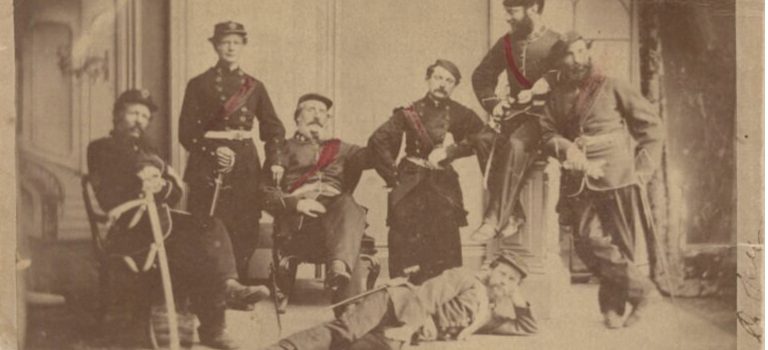
“Soldiers on a March.” The Army Children Archive (TACA), 14 Jan. 1884, www.archhistory.co.uk/taca/move.html. Accessed 14 Aug. 2025.
Contributions by Brian Huis and Gregory Childs. Edited by Mary Simpson.
On Sunday, July 27, 2025, the Simpson Cemetery in Southwest Middlesex came alive with memory, history, and community spirit. Over 50 descendants, neighbours, and friends gathered under the shade of the massive White Oak “heritage tree” for the annual cemetery memorial hosted by the Glencoe & District Historical Society (GDHS). This year a group of Simpson descendants, Micheline Champagne-Johnston, Wanda Simpson, Wendy Bestward, Jan Simpson, Dennis Simpson, Mary Simpson, and Brian Huis, joined in to give the event an interesting twist.
Cemeteries, particularly in rural Ontario, have long been places of both remembrance and reflection. Their park-like settings provide green space, cultural continuity, and a sense of belonging. This year’s memorial carried on the tradition of visiting and honouring one local cemetery each year.
Cemeteries are not only about the past; they are living classrooms and gathering spaces that remind us of who we are and the legacies we carry forward. – Brian Huis
Honouring Nicholas Bodine, War of 1812 Veteran
The central feature of the 2025 memorial was the recognition of Private Nicholas Bodine (1788–1885), a War of 1812 veteran buried in Simpson Cemetery. Bodine served in the 2nd Company, 1st Regiment of the Norfolk Militia and fought at the Battle of Lundy’s Lane on July 25, 1814—one of the war’s bloodiest encounters.
Nicholas’ service with the Norfolk Militia is perpetuated by the current Reserve Army Regiment, The 56th Field Artillery Regiment of the Royal Canadian Regiment of Artillery (56 FD), headquartered in Brantford. The Government of Canada awarded several War 1812-15 battle honours: ‘Detroit’, ‘Niagara’, ‘Queenston Heights’, ‘Defence of Canada 1812-15’, some of which, if not all were likely fought by Nicholas. The Norfolk Militia was also involved with the skirmish at the McCrae House near Chatham.
Born in Pennsylvania, Bodine came to Upper Canada in 1811, married Charlotte Sovereign, and farmed 50 acres in Mosa Township. His long life of 97 years was remembered in the Glencoe Transcript obituary of 1885, which praised his loyalty, faith, and wide respect in the community.
Glenn Stott and son, Brad Stott, stand attention to honour Nicholas Bodine, September 27, 2025Read more →
The UTMRS— the Royal Scots —are more than skilled re-enactors; they are devoted stewards of local memory and dedicated community builders. Under the leadership of committed champions like Glenn Stott, they have brought the history of the Battle of the Longwoods to life for countless residents and visitors alike.
The Longwoods Memorial Service, held each March, is a vivid example of their impact. For decades, the story of the March 4th, 1814 skirmish was largely forgotten. In the 1980s, when my mother, Betty Simpson, noticed a solitary wreath placed at the federal monument near our family home, she discovered it was the Royal Scots who had revived this commemoration. Their dedication inspired local neighbours and organizations—including our Historical Society—to get involved and ensure the memory of those who fought and fell is never lost again.
The Royal Scots’ efforts extend beyond a single memorial service. They have taken on the ambitious Longwoods Heritage Weekend, an undertaking that draws families, students, and history enthusiasts from far and wide. Through authentic re-enactments, educational demonstrations, and engaging storytelling, they make our shared past accessible and meaningful for new generations.
Moreover, the UTMRS’s leadership and volunteer spirit have rippled outward. Champions like Glenn Stott were early supporters of the Canada Barn Quilt Trails project—encouraging community heritage work far beyond the battlefield. Their members give countless hours in costume and behind the scenes, sharing history with honesty, passion, and respect for the land and peoples connected to these stories.
Their work has even inspired film. The 2017 documentary by Barbara Urbach and Crocodile Productions is a testament to how the UTMRS bring history alive in both intimate, human ways and grand, dramatic moments on our historic landscapes.
In every sense, the Upper Thames Military Re-enactment Society are true keepers of our community memory. Their dedication ensures that stories like Lieutenant Patrick Graeme’s sacrifice—and the broader heritage of the War of 1812 in our region—continue to inspire reflection and understanding.
For these reasons, the Glencoe & District Historical Society wholeheartedly endorses the Upper Thames Military Re-enactment Society for the Governor General’s History Award. They richly deserve this recognition for their outstanding contribution to community history and heritage education.
There is so much more we could add. Please do not hesitate to reach out to us to learn more about their wonderful community work. It’s so much fun to work with them – they never say ‘no’ when we ask for a re-enactor to attend an event – no matter how small or modest the event is.
Part 1: Peter McArthur, the hardest question and the “horrible, horrible” war
By Stephanie McDonald, December 2024
It’s a question from a child no parent is equipped to answer: Should I go to war? It was what Daniel, eldest son of Mabel and Peter McArthur, asked of his father in the early years of the First World War.
Even as prolific a writer as Peter McArthur was, one can imagine how the man dubbed the “Sage of Ekfrid” struggled to find the right words to share with his son. His response reveals both his wish for his child to come to his own decision as well as the urge to protect and keep him safe.
Peter penned his answer to Dan’s question in a letter on January 25, 1916, a year and a half into the war:
Near the house there is a sturdy oak tree that I always think of as one of the oldest of my friends. I grew up with it. Of course that is not exactly true, for I stopped growing many years ago, while it kept on growing, and it may keep on growing for centuries to come. But when I was a growing boy it was just the right kind of a tree for me to chum with. It was not too big to climb, and yet it was big enough to take me on its back and carry me into all the dreamlands of childhood.
Reverend Enos Montour (1898-1985) was a United Church minister and writer from Six Nations of the Grand River Territory.
Over the course of his retirement, Rev. Montour wrote a collection of stories about Mount Elgin Industrial School at the time he attended (ca.1910-1915). Mount Elgin is one the earliest United Church-run Indian Residential Schools and was located on the Chippewas of the Thames First Nation. With the help of Dr. Elizabeth Graham, Montour finished and titled his book Brown Tom’s Schooldays.
With no publisher in sight, photocopies were made and distributed to family members in the early 1980s. This important book is difficult to find today, so Professor McCallum, worked with the University of Manitoba Press, Dr. Graham, and Montour’s two granddaughters Mary I. Anderson and Margaret Mackenzie, to issue a new edition.
Ellwyne Ballantyne’s twenty-two years of brief, bright life are summed up on a simple plaque attached to a majestic buttonwood tree in Carruthers Corners. When local author CJ Frederick first saw the memorial tree in the rural area just outside of Glencoe, ON, she experienced a keen reverence. “It’s just a dot on a map. I was not prepared for how beautiful the tree was. It looked like it was wearing a cloak; as my mother says, ‘wrapped in a queen’s robe’. Knowing that this tree was dedicated to the life of someone who had given that life in a faraway, long-ago conflict really made me stop and think about remembrance and the enduring nature of love.” Ballantyne’s story had to be told; Frederick was eager to record it.
Great evening with James Carruthers, the story keeper; CJ Frederick, the story teller and author; and Patrick, the story champion. We packed the Archives and hosted a few people via zoom as well.
Stories ripple all around us, if only we’re willing to hear them. In 2012, CJ first learned of Ellwyne Ballantyne and the astonishing relationship he forged with two strangers after reading a short newspaper article about the dedication of an unusual tree to a long-dead soldier from World War One. With obligations to work and family filling her time, she wasn’t yet ready to hear his story. It took a global pandemic, with the prospect of lockdowns and unexpected forced time at home, to open her ears, mind, and heart and be ready to explore the roots of Ellwyne’s story that took place more than a century before.
Yoshio Shimuzu: “You have to remember that we had been driven from our homes by racial prejudice in British Columbia, reviled and despised by the bulk of the population, and here in the farmlands of southwestern Ontario, we were welcomed as equals and saviours by the farming population.” Read more →
By Mary Simpson and Denise Corneil. Featured in the Middlesex Banner.
The Barn Quilt Trail Movement, which started in Ohio, USA, has blossomed into a colorful journey across North America, thanks to the vision and dedication of individuals like Donna Sue Groves, now deceased. Inspired by her love for quilts and barns, Groves initiated the movement in 2001 when she painted the first quilt square on her family’s barn in Adams County, Ohio.
In Canada, the movement found roots in Temiskaming, Ontario, in 2007. Bev Maille, Marg Villneff, and Eleanor Katana spearheaded a project to paint 200 quilt squares, adorning barns and historic landmarks across the region in time for the International Plowing Match 2009. This initiative not only added vibrant colors to the landscape but also attracted tourists and boosted economic development.
Wardsville, Middlesex County, Ontario, joined the trail in 2009 when Denise Corneil’s mother, Eileen, returned from the U.S. with a barn quilt brochure. Denise, along with a team of volunteers, stitched a story quilt commemorating Wardsville’s founders, Mr. and Mrs. George Ward, for the village’s 2010 Bicentennial celebration. This project revitalized the community and became a testament to the power of preserving local heritage.
The movement continued to flourish in Ontario. With support from the Sand Plains Community Development Fund, over 100 quilts were created, each telling stories of settlement, community building, and rural life. Barn quilt trails spread up and down the roads of Middlesex, Elgin, Oxford, Norfolk, and Brant Counties in 2011.
Here in Middlesex, women living along Longwoods Road and the community of Chippewa of the Thames, worked side by side to plan two trails explaining how the War of 1812-1814 affected the lives of women, children, and families. The winter of 1813 was particularly bad.
Trail of Tears- Family. Located in the community of Chippewa of the Thames
The result was the Trail of Tears Barn Quilt Trail, a collection showcased on Chippewa of the Thames locations, and a trail stretching along Longwoods Road from Delaware to Thameville – plus two beautiful quilts and many new and enduring friendships. These trails and many more trails across Canada are curated at barnquilttrails.ca.
In 2013, all major barn quilt trails in Ontario were curated on one website, barnquilttrails.ca, supported by the Ontario Trillium Foundation. This initiative aimed to provide guidance and encouragement to communities starting their own barn quilt projects, ensuring the movement’s sustainability and growth. This website continues to be curated by volunteers and now showcases barn quilts across Canada.
As barn quilt trails spread across Canada, the United States, and around the world, they became more than just colorful displays; they became a way for communities to share their stories and preserve their heritage.
Today, as new projects like those in South Bruce and Osgoode Township emerge, the legacy of the Barn Quilt Trail Movement lives on. Denise Corneil, Wardsville, along with a dedicated team, remains committed to supporting and promoting these initiatives, ensuring that the colorful journey across North America continues to thrive for generations to come.
Some community barn quilt projects start the planning process with a theme and a story quilt. In 2009, Wardsville started up with the War of 1812 theme. Eleanor Blain and Sue Ellis, seasoned quilt makers, devised a plan to engage people of all skill levels in the quilt-making process.
With the assistance of local historian Ken Willis, who provided valuable insights into the Wards’ history, the quilt committee traced the Wards’ journey from establishing a settlement along Longwoods Road to enduring the trials of the Battle of the Longwoods and the ensuing accusations of treason. Thirty quilt blocks were meticulously selected to depict key moments in the Wards’ lives, ensuring that Mrs. Margaret Ward’s contributions were honored too.
The quilt-making process was a labor of love, with countless hours spent selecting fabrics, cutting shapes, and stitching together each block. Ellis and Blain invited community members, both experienced quilters and novices, to lend their hands to the project. The quilt frame at Beattie Haven Retirement Home became a hub of activity as individuals gathered to contribute stitches to the communal creation.
The quilt telling the story of George and Margaret Ward being stitched at Beattie Manor retirement home.
When the George Ward Commemorative Quilt was unveiled at Wardsville United Church in May 2010, it elicited gasps of awe from the crowd. The quilt’s was entered into the Group category at the 2010 International Plowing Match Quilting Competition in Shedden,where it claimed second prize.
Barn quilts are eight-foot square (and larger) painted replicas of actual fabric quilt blocks installed on barns. Barn quilts draw attention to Canada’s disappearing rural landscapes, timber frame barns, and the family farm. Each barn quilt tells a story and draws attention to unmarked historical places.
They can be scattered through the county mounted on beautiful barns (like Huron County), or they can create a themed route, leading visitors from one site to the next.
Tourists are Interested in our local history
With the aging baby boomer cohort, there is a lot of interest in nostalgia and history. There is a growing recognition that tourists are interested in our local history too.
The Canadian federal government is investing in rural and remote tourism. The tourism industry is realizing what barn quilt enthusiasts always knew. Statistics Canada shows that tourism provides billions of dollars in revenue and accounts for 10% of local jobs in rural (non-metro) areas. A federal spokesperson said that “Tourism can diversify and strengthen the economic base and viability as well as safeguard local culture, language and heritage. Businesses benefit from increased income from direct sales of homegrown and locally made products. Visitors want to participate in authentic Indigenous experiences, and 62% of Indigenous tourism businesses are in rural and remote areas.”
Louise Long applies masking tape prior to painting. Three coats. (Photo by Dave Chidley)
And so the barn quilt movement continues to spread. Go to barnquilttrails.ca to find the trails in Middlesex County and southwestern Ontario. Embark on a journey through time and space. This isn’t just tourism; it’s a love letter to the land, a celebration of heritage, and a testament to the power of community.
Marie Williams: An impressive crowd gathered for the “Haunts of Peter McArthur” road trip Sunday afternoon, June 16, starting out at what was the McArthur homestead on McArthur Rd. before moving onto the Eddie Cemetery on Glendon Dr. and finally back to the Archives in Glencoe. Two plaques were unveiled along the way as McArthur trivia and memories were shared. Both young and more established fans of the works of the “Sage of Ekfrid,” family members and historians enjoyed the afternoon which was organized by the Glencoe and District Historical Society. The Society is marking the 100th anniversary of the death of Peter McArthur in 2024. See photos on Facebook Post.
Marie Williams, Glencoe: The huge crowd that packed into the Glencoe and District Historical Society Archives on February 22 proved that the “Sage of Ekfrid” is as popular today as he was over 100 years ago. In addition to 30 viewing online, over 50 turned up in person.
The Board of Directors of the Archives Association of Ontario (AAO) is heartbroken at the violence in Israel and Gaza. We are deeply saddened by the loss of life in the region over recent months and express our immense grief for any of our members who are affected or have lost family members or friends.
After Confederation 1867, the Province of Ontario (Canada West) was under British governance. Due to fears of what would happen after the American Civil War (1861-1865), the British authorities formed volunteer militia companies in hundreds of communities across Ontario, including our own.
The British authorities were concerned about a secret society of Irish patriots who had emigrated from Ireland to the United States with the intent of ending British rule by taking Canada by force and exchanging it with Britain for Irish independence. This secret revolutionary organization was founded on St. Patrick’s Day in 1857, by James Stephens in Dublin, Ireland. It was called the Fenian Brotherhood.
It is fascinating to imagine local kitchen table discussions about the Irish “terrorists” . Only our ancestors didn’t just talk about local politics at the coffee shop. They obeyed orders, formed militias and showed up.
On 3 Jan 1863, Wardsville volunteers formed independent militia company No. 6 within the 26th Middlesex Battalion headquartered in London. It was commanded by James T. Ward.
In early 1866, with tensions very high and Fenian attacks were anticipated along the St. Clair River. The Wardsville company was dispatched on March 8th to the Sarnia area and the local men “went under canvass” in full readiness to meet the enemy — in March .
But the Fenians didn’t show up. Instead, the Fenians attempted to invade Canada at Campobello Island at the Maine, US / New Brunswick border. It was a complete disaster.
The British authorities relaxed, but the clever Fenians took heart and re-organized an invasion across the Niagara River. They captured the undefended town of Fort Erie and its railway and telegraph terminals. The revolutionaries arrested the Town Council, Customs and border officials before cutting outgoing telegraph lines so help could not be summoned.
Rev. Tom Wilson joined us live from the French Riviera to tell us about the role of Allied military chaplains and the stories of those who died in the Battle of Normandy from June 6, 1944 to August 25, 1944.
Tom told us about a the Allied Chaplains in the Battle of Normandy, including what is known about their lives before they joined the service and what is known about their deaths. Often there are conflicting stories of their heroism, and where their final resting places are.
The Revd Dr Tom Wilson has had an interest in World War Two military history since he was 12 years old. Rev. Tom Wilson is a local son, who for 12 years owned and managed the Why Not Shop in Glencoe and lived on a farm near Melbourne. He was ordained in the Anglican Church in Canada and served as Rector of a parish in southwestern Ontario.
In 2007, he had the chance to spend a year in France, on university exchange program with his wife, Dr Dawn Cornelio. While there he led some of Canadian students on a visit to Normandy where they held a graveside memorial service for Canadian Chaplain Walter Brown. Padre Brown’s murder led Revd Wilson to explore all the Allied Chaplains killed in the Battle of Normandy. After serving in the Scottish Episcopal (Anglican) Church for 5 years, Revd Wilson now is the Anglican Chaplain of St Raphael in southern France where he ministers to a multi-national English-speaking congregation.
Thanks for telling us these fascinating stories, Tom! Let’s do it again!
Tom: “I look back with fondness on my time in Glencoe and SW Ontario. I confess though, I do like the winter here on the French Riviera, as it is normally sunny and warm during the days, but the nights are cool.”
Order his book, No Guns, Just God’s Glory at: OREPeditions
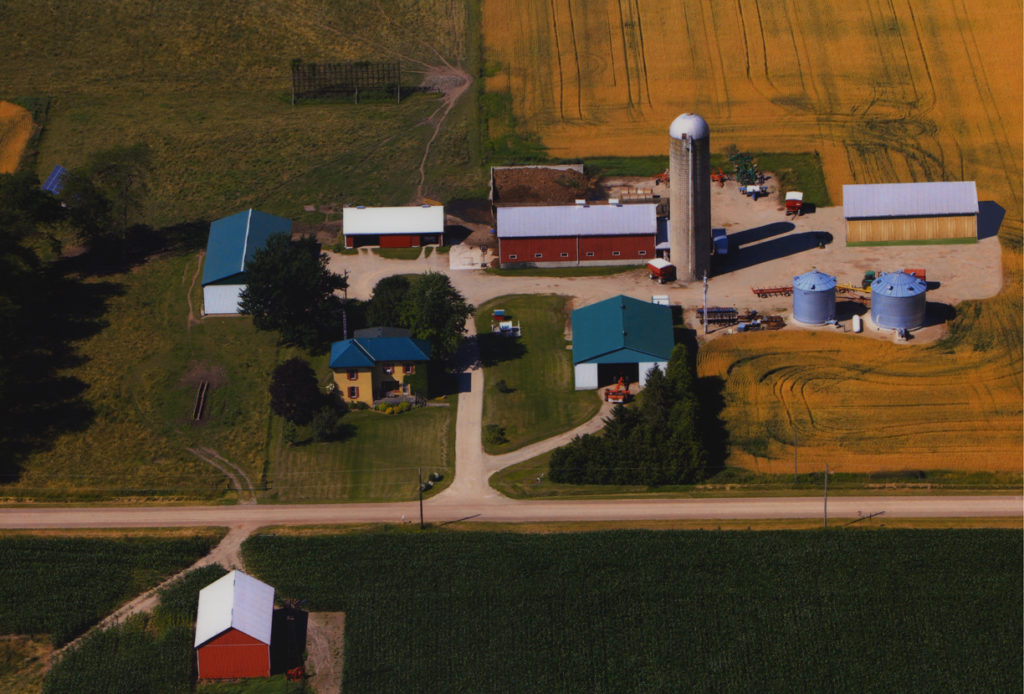
My name is Andrew McGill, I’m a young farmer and a photographer. I grew up on a farm 6 kilometres north of Glencoe, Ontario. In mid 1940 my great grandfather Fred McGill purchased a farm building which was to be moved from the site of the No. 4 Bombing and Gunnery School at Fingal Ontario. The building was dismantled and moved 45 kilometres north of Fingal to its final resting place on the McGill farm at Taits rd. Glencoe where it has sat to this day. My father and I think the building was then reassembled with a new roof sometime in 1941. The site of No. 4 B&G school sat on a swath of 724 acres of land that was returned to the crown for the purpose of building the training facility. One can imagine the numerous agricultural buildings on the land that would have had to be dismantled and moved in short order to make way for the multiple airplane hangers and triangle runway of the Fingal school.
Aerial photo of the McGill farm circa 1977. The building in question can be seen directly to the left of the barn. (Photo care of McGill family Archive, 1977.)
McGill farm building moved from Fingal Bombing And Gunnery School site in 1940. (Photo: Andrew McGill. September, 2022.)
Aerial photo of the site of the Fingal Bombing and Gunnery School. (Photo: Commonwealth Air Training Plan Museum.)
Route from Fingal B&G school site to the McGill farm. (Photo: Google Maps)
Interior detail of the McGill farm building which continues to house tools and horse equipment which would have been used by the late Fred McGill circa 1940’s. (Photo: Andrew McGill, 2016.)
A restored 1942 Minneapolis Moline “Waterloo” tractor stored in the building on the McGill farms site. (Photo: Andrew McGill, 2022.)
Winifred (Eddie), Fred, and Blake McGill using their 1942 Minneapolis Moline Tractor to plant sugar beets for seed to aid the allied forces war effort. (Photo care of McGill family Archive, 1942.)
Alternate angle of Winifred (Eddie), Fred, and Blake McGill using their 1942 Minneapolis Moline Tractor to plant sugar beets for seed to aid the allied forces war effort. (Photo care of McGill family Archive, 1942.)
Clare McGill and Dorothy Brown in front of the McGill homestead with the 1942 Minneapolis Moline “Waterloo” tractor. (Photo care of McGill family Archive, 1942.)
Clare, Winifred (Eddie), and Blake McGill in front of the McGill homestead to mark the moment King George VI announced enlistment of eligible men into the military in Canada. (Photo care of McGill family Archive, 1941.)
Blake McGill standing with his newly restored 1942 Minneapolis Moline tractor on the McGill farm in 1993. (Photo care of McGill family Archive, 1993.)
Aerial photo of the McGill farm taken the year of its 100th anniversary in 2016. The relocated building can be seen clearly to the left of the barn. (Photo care of McGill family Archive, 2016.)
Dorothy (Knapp), Doug, and Ron McRae in Ilderton Ontario, 1955. During WWII, as a 13 year old, my grandmother Dorothy along with her schoolmates were tasked with finding a plant called Alder Buckthorn, which because of its consistent burn time was used to create fuses for depth charges used to sink German navy vessels. It is told that Dorothy found enough of the valuable plant for her father to pay off the mortgage of their farm. (Photo care of the McRae family Archive, 1955.)
Al McGregor has launched his new book: Salvaged from the Ruins – A Novel of 1945. As One War Ends Another Begins. Al’s novels serve up history with drama, great characters, and several intersecting storylines to keep things exciting. It’s hot off the press. Let’s help our local writer sell lots of copies. http://almcgregor.com/
Salvaged from the Ruins is a story about the end of WWII when millions of refugees flood Europe – a time when compassion is another casualty of war. The story is set against the events of 1945 in Europe, Canada and the United States.
Local author Al McGregor specializes in historical fiction. His books are based on the Canadian experience with an emphasis on Southwestern Ontario.
G&DHS was happy that their first ‘hybrid event’ went off without a hitch Wednesday, September 28th at the Archives in Glencoe. Al also signed books at Glencoe Fair a few days prior.
Here is a link to Al sharing his personal story as part of the Senior’s Life in the Talbot SettlementSeries: Al McGregor.
Conflict doesn’t end with surrender. The evidence is in the Ruins.
Al McGregor tells his audience about the historical backstory to his new novel.
Al McGregor's Oral History 15 minute tale told to the Seniors Oral History Project, telling about growing up in West Elgin, how he got into broadcasting, and his love for writing historical fiction!
This fall’s program is about the resistance movements in Europe and the Canadian Home Front. These are inspiring stories for the generations who have never had to rise up together to fight a war. (Our COVID experiences gave us an inkling.) Only years later do we learn about what went on behind the scenes, thanks to historians. Our speakers are going to address this civilian engagement angle as well as their research and stories.
Oct 12, 2022. Two historians will regale us with stories from our local #4 Bombing and Gunnery School during WWII. The Archives, 178 McKellar St, Glencoe from 7 p.m. to 9 p.m. https://glencoehistoricalsociety.ca/events/
Nov 8, 2022. The role of Allied military chaplains and the stories of those who died in the Battle of Normandy from June 6, 1944 to August 25, 1944. Featuring Rev. Tom Wilson from the French Riviera. 2:00 p.m. at The Archives, 178 McKellar St, Glencoe https://glencoehistoricalsociety.ca/events/ Nov 23, 2022. Red Noble will tell us about the daring WWII Operation Jericho to bust out Resistance members and political prisoners. Hybrid in-person and broadcast event starts at 7:00 p.m. at The Archives, 178 McKellar St, https://glencoehistoricalsociety.ca/events/
Nov 23, 2022. Red Noble will tell us about the daring WWII Operation Jericho to bust out Resistance members and political prisoners. Hybrid in-person and broadcast event starts at 7:00 p.m. at The Archives, 178 McKellar St,
On December 21, 2020, Arnold Nethercott passed away at Country Terrace Nursing Home, Komoka, Ontario. Arnold was the beloved husband of 32 years of Barbara (Balch) Nethercott nee: Dadswell. He was a dear stepfather of Ruth Truesdale (Brian), Kathy Bedford (Larry), Greg Balch (Kim), Mark Balch (Linda), Bruce Balch (Kim) and Chris Balch (Yvonne). Loving grandfather of 14 and great-grandfather of 15.
Arnold is also survived by his brothers Marv Nethercott (Mary) and Bill Nethercott (Roxann) and by his sisters Lois McLean and Phyllis Munro (Lorne). He was the loving uncle of 13 nieces and nephews and many great-nieces and great-nephews. Predeceased by his parents James Percy Nethercott and Mary Louise (Warren) Nethercott, his sister Eleanor Wells and his brothers-in-law Vin Wells and Jack McLean.
Arnold achieved the rank of Captain as a Forward Air Controller in fixed-wing aircraft and as a helicopter pilot while in the Canadian Armed Forces. He served in peacekeeping duties in various locations around the world including Cyprus. He was also a respected Past President of the Ontario Genealogical Society (www.ogs.on.ca) and the United Empire Loyalists Society of Canada. (www.uelac.org)
Here is a delightful booklet published circa 1925 that tells the story of Eaton’s. If you are interested, more information about this iconic Canadian company can be found online at the T. Eaton Company fonds.
The T. Eaton Company started up in 1869 . This 27 page booklet was donated this month to The Archives by Ina Nelms.