Middlesex County Approves Feasibility Study for County Archives
In a landmark and unanimous decision, Middlesex County Council has voted to move ahead with a Middlesex County Archives Feasibility Study, marking the most significant progress to date toward establishing a permanent county-wide archives.
In November 2025, the motion—brought forward by Mayor McMillan and seconded by Mayor DeViet—sparked thoughtful questions around the council table, with councillors expressing both strong support and prudent concern for the project’s long-term sustainability. Following discussion, the vote passed unanimously, prompting applause from the gallery filled with advocates, historians, and community supporters.
For the Committee to Establish a Middlesex County Archives (CEMCA), this moment represents a breakthrough many years in the making. The idea of a county archives has circulated for decades. CEMCA has spent the past several years building awareness, engaging municipalities, and championing the need for proper stewardship of Middlesex County’s more than 225 years of documentary heritage.
While the vote does not commit the County to building an archives at this stage, it does confirm the County’s intention to undertake a comprehensive, professionally guided study. This study will assess needs, gaps, costs, and opportunities—ensuring that decisions about preserving local history are grounded in strong evidence and reflect today’s economic realities.
CEMCA emphasizes that all heritage, cultural, and community organizations throughout Middlesex County will be encouraged to participate in the study process if invited. Broad input will be essential to reflect the diversity of local collections, stories, and archival needs.
This important step could not have happened without the many residents, volunteers, historians, journalists, and local groups who wrote letters, attended meetings, raised awareness, and kept the conversation alive.
CEMCA extends heartfelt thanks to all supporters and media partners. The work continues—but the door is now open.
Mary Simpson, President, 2024-2026, Glencoe & District Historical Society
By Mary Simpson and Caroline Gough, November 8, 2025.
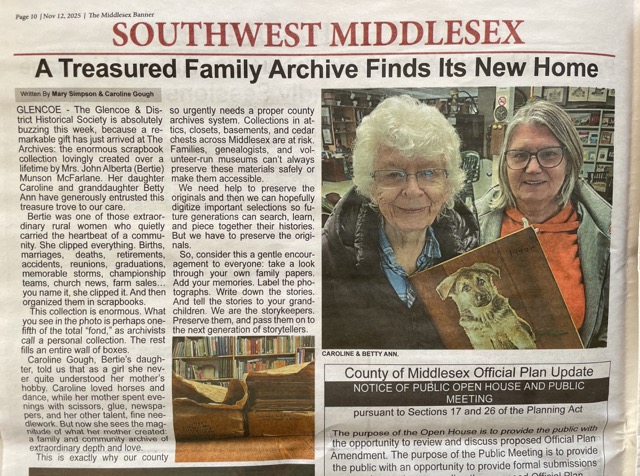
The Glencoe & District Historical Society is absolutely buzzing this week. A remarkable gift has just arrived at The Archives: the enormous scrapbook collection lovingly created over a lifetime by Mrs. John Alberta (Bertie) MUNSON McFarlane. Her daughter Caroline and granddaughter Betty Ann have generously entrusted this treasure trove to our care.
Bertie was one of those extraordinary rural women who quietly carried the heartbeat of a community. She clipped everything. Births, marriages, deaths, retirements, accidents, reunions, graduations, memorable storms, championship teams, church news, farm sales… you name it, she saved it.
A portion of her scrapbook fonds: Mrs. John “Alberta” McFarlane of R.R. #4, Appin, ON
This collection is enormous. What you see in the photo is perhaps one-fifth of the total “fonds” . The rest fills an entire wall of boxes. In archival science, a fonds is a group of documents that share the same origin and have occurred naturally as an outgrowth of the daily workings of an individual, or organization
Caroline Gough, Bertie’s daughter, told us that as a girl she never quite understood her mother’s hobby. Caroline loved horses and dance, while her mother spent evenings with scissors, glue, newspapers, and her other talent, fine needlework. But now she sees the magnitude of what her mother created: a family and community archive of extraordinary depth and love.
This is exactly why our Middlesex County so urgently needs a proper county archives system.
Collections in attics, closets, basements, and cedar chests across Middlesex are at risk. Families, genealogists, and volunteer-run museums can’t always preserve these materials safely or make them accessible. We need help to preserve the originals and then we can hopefully digitize important selections so future generations can search, learn, and piece together their histories. But we have to preserve the originals.
So consider this a gentle encouragement to everyone: take a look through your own family papers. Add your memories. Label the photographs. Write down the stories. And tell the stories to your grandchildren. We are the storykeepers. Preserve them, and pass them on to the next generation of storytellers.
She was born Dec. 7, 1903. She lived her entire life on the farm where she was born. Sometimes she was called Bertie. Her parents were Edgar & Ida Munson. They sold their farm to John McFarlane, the boy from over the line from next farm and they moved to Glencoe. John & Alberta were married on June 23, 1926 when they went to Hamilton to her uncle Rev. Hewitt who married them.
Alberta had a sister Ruby Munson who was a school teacher. Ruby married Herb Neeb of Zurich. John had 3 sisters & 3 brothers. Alberta & John were members of the Appin Presbyterian Church and she was president several years of the Appin Presbyterian Busy Bees. John was an elder of the church.
Being a busy farm wife she saved papers and magazines that she could use later for her favorite hobby of “scrapbooking.” They had a daughter Caroline and a son Wilfred and 4 grandchildren and several great grandchildren.
She died Sept. 9, 1989 at age 85 and was buried in Kilmartin Cemetery. Now we are sharing some of the many scrapbooks to the Glencoe & District Historical Society.
But why the name Bertie – Alberta?
Caroline always wondered why her mother was named Alberta. A quick search revealed the answer—she was likely named for Princess Louise Caroline Alberta, (18 March 1848 – 3 December 1939) daughter of Queen Victoria. The province of Alberta, in fact, was named after the Princess just 18 months after Bertie was born—a fitting historical echo for a woman whose life’s work was preserving the stories of others. And that’s maybe why her daughter was named Caroline. Caroline’s not sure… she forgot to ask her Mom. That makes me think of all the questions I didn’t ask my Mom.
This generous donation reminds us how essential it is to care for our family archives. These homegrown collections deserve professional preservation, cataloguing, and digitization so that families, genealogists, and historians alike can continue to piece together the stories that define who we are.
Shared with gratitude by the Glencoe & District Historical Society, November 2025.
So, we invite everyone: go through your family papers, label your photos, add your stories, and pass them on when the next generation is ready to be the storytellers and caretakers.
The Archives
Come to the Archives and spend an afternoon
As I flipped through just one small volume, up popped a handwritten transcription of my Aunt Dorothy SIMPSON Parker’s wedding to Rev. Harvey Parker, Sept. 20, 1947.” This handwritten announcement – (why was it hand written? Did she borrow the local paper and have to give it back to someone?) fits perfectly with the video I have of Uncle Harvey, telling the story of meeting Dorothy at a young people’s gathering in London. Harvey was serving graduated as an Anglican minister at the end of the war. We filmed him telling stories not long before his Dorothy died. Here is a clip:
Film industry pros sweat the possibility that many digital files will eventually become unusable — an archival tragedy reminiscent of the celluloid era.
Martin Scorsese: “The preservation of every art form is fundamental.”
For the movie business, these are valuable studio assets — to use one example, the MGM Library (roughly 4,000 film titles including the James Bond franchise and 17,000 series episodes) is worth an estimated $3.4 billion to Amazon — but there’s a misconception that digital files are safe forever. In fact, files end up corrupted, data is improperly transferred, hard drives fail, formats change, work simply vanishes. “It’s a silent fire,” says Linda Tadic, CEO of Digital Bedrock, an archiving servicer that works with studios and indie producers. “We find issues with every single show or film that we try to preserve.” So, what exactly has gone missing? “I could tell you stories — but I can’t, because of confidentiality.”
Specialists across the space don’t publicly speak about specific lost works, citing confidentiality issues. So, only disquieting rumors circulate — along with rare, heart-stopping lore that breaches public consciousness. One infamous example: In 1998, a Pixar employee accidentally typed a fatal command function, instructing the computer system to delete Toy Story 2, which was then almost complete. Luckily, a supervising technical director who’d been working from home (she’d just had a baby) had a 2-week-old backup file.
Experts note that indie filmmakers, operating under constrained financial circumstances, are most at risk of seeing their art disappear. “You have an entire era of cinema that’s in severe danger of being lost,” contends screenwriter Larry Karaszewski, a board member of the National Film Preservation Foundation. His cohort on the board, historian Leonard Maltin, notes that this era could suffer the same fate as has befallen so many silent pictures and midcentury B movies. “Those films were not attended to at the time — not archived properly because they weren’t the products of major studios,” he says.
Can you imagine digitising the Mona Lisa painting and destroying the original? The Magna Carta? The British North America Act? 1798 Act of Parliament to create London District? The answer to maintaining records is not paper or digital – it is both!
Committee To Establish a Middlesex County Archives
The Board of Directors of the Archives Association of Ontario (AAO) is heartbroken at the violence in Israel and Gaza. We are deeply saddened by the loss of life in the region over recent months and express our immense grief for any of our members who are affected or have lost family members or friends.
Join the Glencoe & District Historical Society and come to the meeting of the members to review the accomplishments of 2022 and make plans for the coming year. Individual Memberships are $20 and family memberships are $25. Tax Receipts will be issued by Membership Secretary Harold Carruthers.
Show and Tell! Bring a family heirloom, artifact, or mysterious thing from the past to share with the group. We’ll have some fun with this.
Existing members: this is your official notice to attend the annual general meeting to be held at the Archives, 178 McKellar Street, Glencoe, Ontario.
Or attend via Zoom meeting.
Topic: Glencoe & District Historical Society Annual General Meeting 45 years!
Time: Apr 19, 2023 07:00 PM Eastern Time (US and Canada)
Federal and Provincial Governments in Canada have mandated that public records be officially archived for legal, governance, and historical purposes.
The division of records kept usually coincides with jurisdictional boundaries: Federal, Provincial, County, and Municipalities. (Library and Archives of Canada Act, S.C.2004).
Ontario has further mandated that preserved public records be available to the public. (Archives Act, RSO 1990; Archives and Recordkeeping Act, 2006; Archives and Recordkeeping Amendment Act, 2019.
The Ontario Municipal Act 2001, S.O. 2001. C. 25 Section 254 further states that municipal offices must preserve certain documents and they are to be publicly accessible. Those records need to be adequately stored. It further indicates that municipal offices could deposit their records in an archives.
Many neighbouring Ontario counties have created their own archives to fulfill their legal obligations and to preserve important heritage materials. These include Elgin, Oxford, Huron, Perth, Grey, Bruce, Lambton, Haldimand, Wellington and more recently in 2020, Norfolk. Middlesex County has not done so yet.
Often records are not easily accessible due to the location of the records in the municipality. They are either stored off-site in another municipal structure or are not available for access to the public. Whether in digital or hard copy, records need to be accessible in a timely manner, especially when there are MFIPPA requests.
Environmentally controlled (EC) storage facilities are necessary for preserving records. The temperature must be 18-21 degrees Celsius, which is colder than an office environment. Relative humidity (RH) should be between 45-50%. If both elements are not met, mold can occur if humidity is too high, and paper can deteriorate if the temperature and RH are too low. Based on the surveys returned from the municipalities in Middlesex County, none of the records are in EC areas. A few municipalities indicated the records are stored in their community centres. While these facilities may have air-conditioning, the RH control is still an issue.
Even if municipal records are covered in Records Retention Schedules as per the Municipal Act 2001, S.O. 2001. C. 25 Section 253, some records have historical value that can be retained for researcher and/or historical value. When records no longer serve administrative value, they could still have cultural value for information. Less than 3% of municipal records are archival. While it might not be a lot, municipal records like tax assessment rolls, building plans, environmental assessments and other documents should be considered for placement in the Middlesex County Archives.
Written by the Committee to Establish a Middlesex County Archives, July 2021
Middlesex County does not have a county archives to protect our history for future generations.
Report from the Committee To Establish A Middlesex County Archives (CEMCA):
Unlike other counties that have established a County Archives (Lambton, Kent, Elgin, Oxford, Norfolk, Perth, Huron etc.) to house municipal as well as important historical materials, Middlesex County has not. In February 2020, representatives of historical societies and interested citizens from across Middlesex County gathered to ascertain the interest in establishing a Middlesex County Archives. The group had concerns about what would happen to their precious historical documents due to aging volunteers and lack of resources. The group gave resounding approval to the initiative and the Committee to Establish a Middlesex County Archives was born. After two meetings, Covid-19 halted those for the year but work remained ongoing. In February 2021 virtual meetings commenced via Zoom.
How best to achieve the goal? The primary focus had to be municipal records. Through legislation, County and Municipal governments are mandated to officially store public records for legal, governance, and historical purposes. The Ontario Municipal Act 2001, S.O. 2001. C. 25 Section 254 further states that municipal offices must preserve certain documents, and that they are to be publicly accessible. Those records need to be properly stored and available in a timely manner. It further indicates that municipal offices could deposit their records in an archive, to be secured. In addition, many historical societies hold historically significant documents and still more remain in private hands. Without a County Archives, there is concern about the location and condition under which many valuable historical documents are being stored.
CEMCA, through a survey to Mayors and Clerks, and another survey to Historical Societies within Middlesex County, ascertained much data – most materials were not stored in secure, environmentally-safe areas and most were not easily accessible. That is a problem for municipal as well as local historical documents.
In June, CEMCA developed a series of “Facts Sheets” and other pertinent information to be sent weekly to County and Municipal Councillors and Administrative Staff. Information included: Municipal Act and Responsibilities, What is an Archives? How Will the Municipality and Clerks Benefit? Where Are the Records Now? Who Would Use the Middlesex County Archives, Resources Required and Challenges and Opportunities. To see any of this information, please check Middlesex Centre Archives webpage: www.middlesexcentrearchive.ca or email proposedmiddlesexcountyarchive@gmail.com.
Committee representatives from each municipality are contacting their councillors and/or making presentations to their councils. On September 28, 2021, CEMCA will be making a presentation to County Council to formally ask that a Middlesex County Archives be established.
Who benefits from a County Archives? Municipal clerks, town planners and developers, lawyers and architects, heritage advocates, scholars and educators, genealogists and family historians, tourists. The biggest benefactors will be our future generations!!!!!!!
How can you help? Contact your county councillors by writing, email or telephone to express your support for the Archives. For more information, please email proposedmiddlesexcountyarchive@gmail.com.
Let us lose nothing of the past, it is only with the past that one builds the future. Anatole France