By Ian Mason, published in the Middlesex Banner, May 2026. Plan to do the North Middlesex Day Trip June 12, 2026 – link here
Nestled in the cemetery in the hamlet of Carlisle, 6 kms east of Ailsa Craig, is the Presbyterian Church Heritage Centre (PCHC). It contains the national collection of artefacts from various congregations of The Presbyterian Church in Canada from coast to coast. We are the only historic mainline denomination in Canada that preserves a collection of its artefacts. There are a few church museums throughout Canada, but they pertain to a specific church, rather than its denomination.
A common question is, “so what does the Presbyterian Church Heritage Centre collect? Bibles and crosses?”
Bibles, “yes”; crosses “mostly no.” More about that later.
In 2018, the National Presbyterian Museum in St. John’s Presbyterian Church, Toronto closed. The Museum was obliged to leave what had been our host church since 2002 when the church was sold to a developer which will eventually convert the church into condominiums, providing a small area for the congregation to continue to meet.
Curator Ian Mason began a 5-year search for a church which would be willing to host the collection of artefacts relevant to the history of The Presbyterian Church in Canada (PCC). These items help to tell the stories of those who worshipped and served Jesus Christ within the context of the PCC. Prior to the formation of the United Church of Canada in 1925 – into which 2/3 of the Presbyterian Church amalgamated – the PCC was the largest Protestant denomination in Canada.
The Curator made a cold call to Carlisle United Church asking the congregation if they would be interested in hosting a collection of artefacts. And, he added, “if you are interested in hosting this collection, you would have to give up your sanctuary and move to the basement.”
He had his answer in 3 seconds, “yes, we would be willing to do that.”
It took another 3 years to work out the details between the head offices of the United Church of Canada and the PCC. By 2021, at the height of the COVID pandemic, the collection and display furniture was moved in 1 full transport truck load from Toronto to Carlisle. (The remaining part of the collection was later shipped from Toronto in a ¾ transport truck load.)
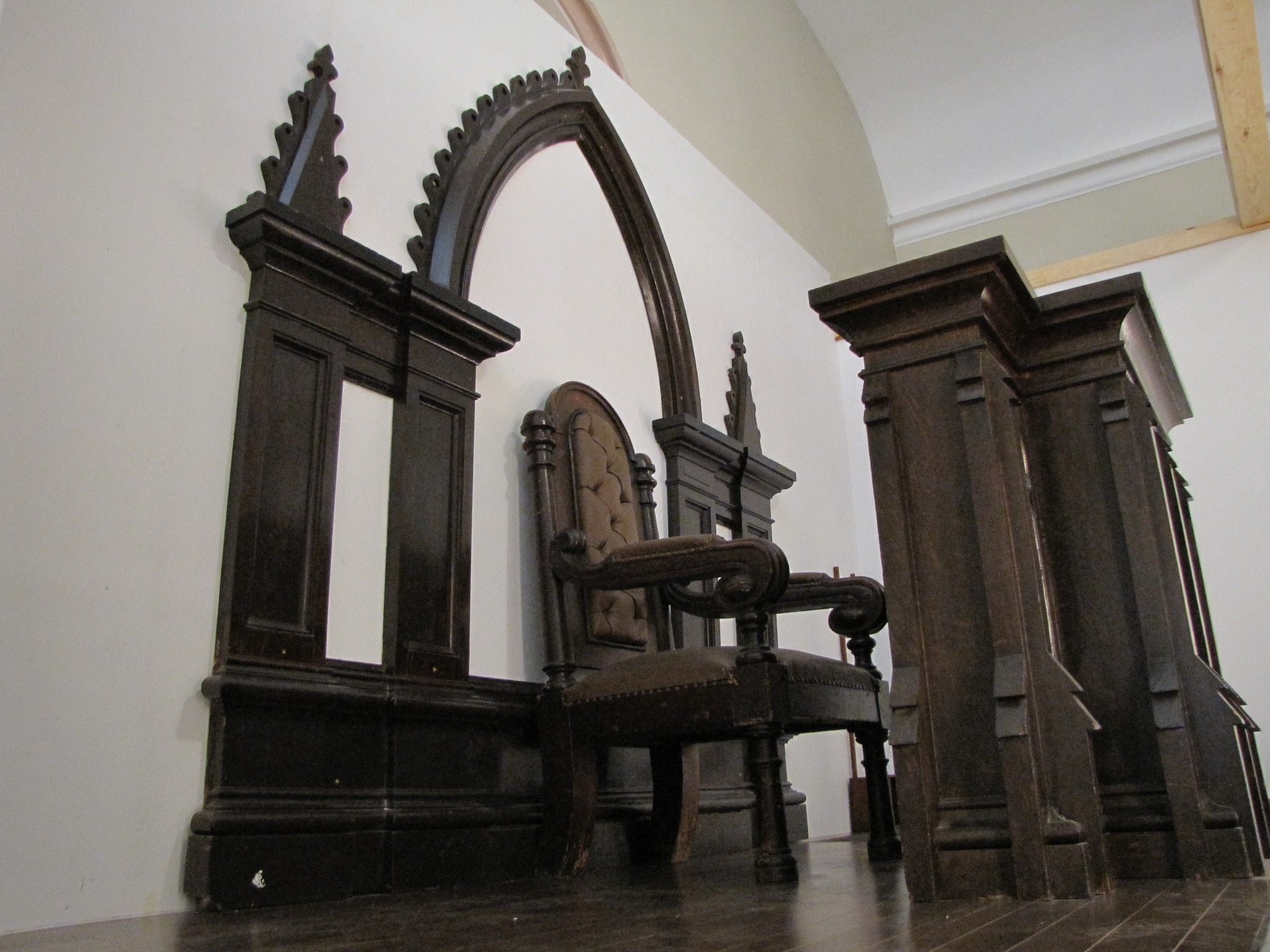
Renovations to transform the main floor from a worship sanctuary to an exhibit hall continued for the next four years.
Finally, after a 7-year hiatus, the Advisory Committee of the PCHC was ready to exhibit its collection of artefacts once again. On Saturday, September 20, 2025, the PCHC was dedicated with a worship service and officially opened. The Bible used in the dedication service was the one first used in the opening of the first Presbyterian Church in Carlisle in 1858.
The main feature of the Heritage Centre is a replica 1850s Canadian Presbyterian chapel furnished with artefacts from closed historic Presbyterian Churches, including: the precentor’s chair (ca. 1792-1810) from St. Gabriel Street Presbyterian Church, the first Presbyterian Church in the city of Montreal; a precentor’s desk (1805) from Shelburne, NS; the pulpit and crocketed pulpit arch (1861) from Merrickville, ON; and examples of pews (1866, 1870s, 1879).
A precentor was the Psalm leader before instruments, hymns, choirs, anthems, etc. were permitted to be used in The Presbyterian Church in Canada in 1875.
The chapel’s replica 1850s Gothic windows and doors were crafted by a Mennonite shop near Millbank, ON.
The PCHC is often the last stop for historic items related to the PCC before they end up at a thrift store. Closing churches and individuals who possess Presbyterian heirlooms often contact the PCHC in the hope that we can provide a home for them.
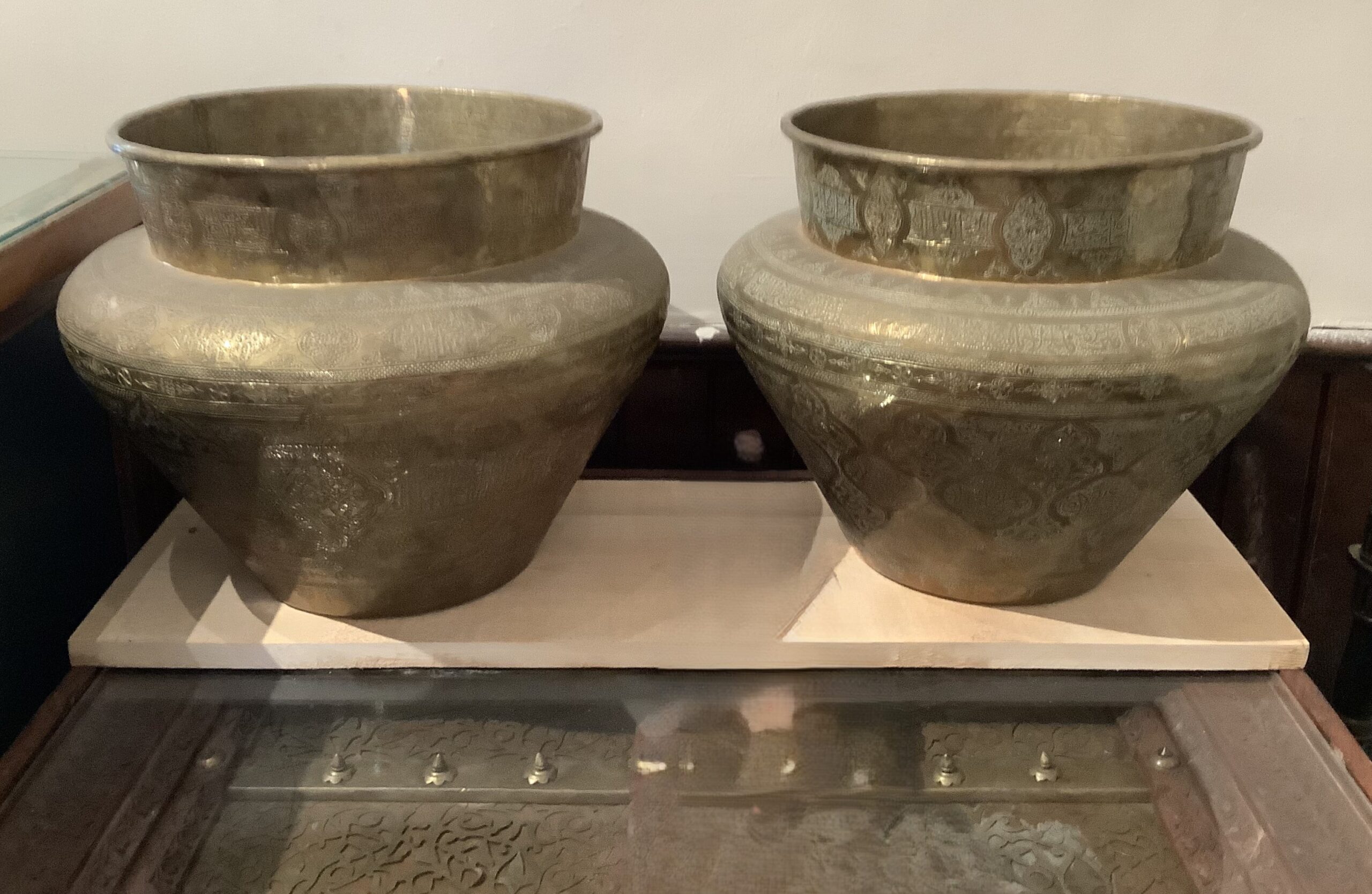
An ardent supporter of missionary work in Canada and around the world, the Rev. Dr. John McPherson Scott of St. John’s Presbyterian Church, Toronto travelled to each of the overseas mission stations of The Presbyterian Church in Canada in 1912 through 1913. Dr. Scott returned with this pair of hand-tooled brass urns from India in his luggage. They remained at St. John’s Church from 1913 until they were donated to the Heritage Centre in 2021.
What about any local connections to Middlesex County?
Absolutely.
Middlesex County had a high concentration of Presbyterians, thanks mainly to a heavy presence of Scottish Presbyterian immigrants throughout the county. Within 32 kms of Carlisle United Church, itself organized as a Presbyterian congregation in 1858, there were, at the very least, 12 Presbyterian Churches – only 4 of them remain active in 2026 (Carlisle United; Melville United in Ivan; St. Andrew’s Presbyterian, Beechwood; and Knox Presbyterian, Centre Road, south of Bornish).
The Communion Table (1862) in our replica chapel was donated by the former Bethel Presbyterian Church, Proof Line, London Township, at the corner of Highway 4 and Ilderton Road.
The 96-year old pipe organ is from Middlesex County as well. One of the Curator’s friends who is an organbuilder asked the question, “don’t you think that you should have an example of the type of instrument that used to be found in nearly every Presbyterian Church?”
The Curator agreed and commented that he knew of a pipe organ that was available. The historic Presbyterian Church of Dorchester, established in 1855, closed in January, 2024. St. Thomas Malankara Catholic Church, the parish that purchased the former Dorchester Presbyterian Church, has no need of an organ for its Mass. Subsequently, the small 1930 pipe organ was removed in January, 2025. Two organbuilders spent 10 months restoring it. In the second week of November, the organ was installed in the PCHC. By the second week of December, it was fully tuned and ready to be played – the only pipe organ in the Municipality of North Middlesex.
A dedicatory recital will be held in the Christmas season 2026.
What about the “mostly, no” response to crosses in the Presbyterian Church? Of the 10 distinct 19th century Canadian Presbyterian denominations that eventually amalgamated to form The Presbyterian Church in Canada in 1875, the dominant one was known as the Free Church. The Free Church was Biblically orthodox and evangelical. Anything that remotely hinted at Roman Catholicism was categorized as anathema to the Christian Church, as perceived by the Presbyterians, was frowned upon at best, and forbidden at worst. Crosses, instruments, most especially pipe organs, stained glass windows, choirs, hymns, anthems, clergy in robes — the list was long – were to be avoided. As a result, a cross would never under any circumstance be seen in a 19th century Presbyterian Church. Presbyterians were distinct as Christians who preached regularly about Jesus Christ’s cross as long as a physical cross was never seen in or on their churches.
Canada’s 19th century Free Church Presbyterians might be surprised to learn that the PCHC counts among its most generous supporters a few Canadian Roman Catholics who feel that the dominant place of Presbyterianism in Canadian Protestantism needs to be preserved as a significant aspect of Canada’s vanished Christian era which had inarguably ended by the early 1960s.
All are welcome to tour the Presbyterian Church Heritage Centre. It is open by appointment by contacting Ian Mason, Curator: pcheritagecentre@gmail.com
Website: pcheritagecentre.ca
Post by Ian Mason. Ian is also the photographer for all the images, with the exception of the photo of the pair of brass urns that were photographed by Doug Carmichael of Carlisle, a member of the Advisory Committee of the PCHC.
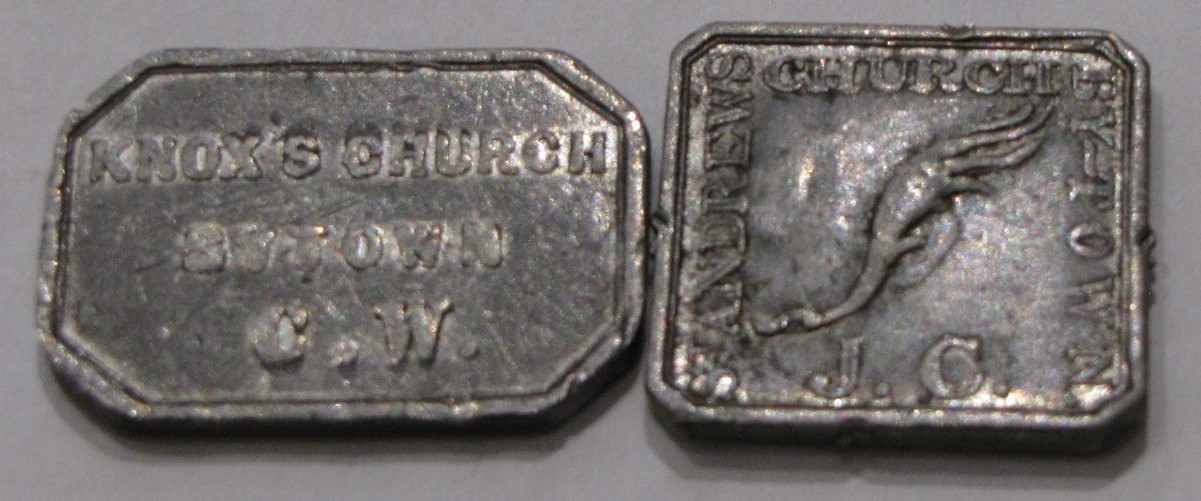
A Communion Token was, with very few exceptions, unique to the Presbyterian Church. Distributed by the minister or elder prior to Communion to church members who were in a right relationship with Jesus Christ and their fellow people. Church members were required to present the tokens at each Communion. If a church member was denied a token because they held an unrepentant spirit, they could not partake the bread and the wine (or grape juice) of Communion “lest they bring judgement on themselves.” (see 1 Corinthians 11 verses 27-29)