Dec 6, 2025. The Archives, Glencoe – Donation and provenance provided by Kathleen Scott, great grand daughter, St. Thomas, Ontario. Received by Mary Simpson and Norm McGill.
This collection of items belonged to the McAlpine and Smith families of 3528 Oil Field Road, near Glencoe, Ontario. At the center of the family story is the marriage of Rebecca Smith and Alexander McAlpine, who were married on April 12, 1899. Their illustrated marriage certificate, preserved inside Alexander’s family Bible, is one of the key artifacts in this collection.
Rebecca and Alexander lived on the family farm on Oil Field Road. After Alexander’s death, the property was eventually purchased by Jim Schieman, and the McAlpine family maintained a warm friendship with the Schieman family for many years afterward. Several items in the collection reflect this long community connection.
Also included are photographs and records connected with the Zavitz, Schieman, and Peters families, who were neighbours and later stewards of the original McAlpine farm. A wedding photo of Peter Schieman’s son is part of this grouping.
Rebecca and Alexander lived on the family farm on Oil Field Road. After Alexander’s death, the property was eventually purchased by Jim Schieman, and the McAlpine family maintained a warm friendship with the Schieman family for many years afterward. Several items in the collection reflect this long community connection.
These artifacts—Bibles, hymnals, books, and photographs—together illuminate more than a century of rural family life in Southwest Middlesex, documenting marriages, migration, faith, work, and community connections passed down through generations. Thank you Heather for entrusting these treasures to the Glencoe & District Historical Society.
Middlesex County Approves Feasibility Study for County Archives
In a landmark and unanimous decision, Middlesex County Council has voted to move ahead with a Middlesex County Archives Feasibility Study, marking the most significant progress to date toward establishing a permanent county-wide archives.
In November 2025, the motion—brought forward by Mayor McMillan and seconded by Mayor DeViet—sparked thoughtful questions around the council table, with councillors expressing both strong support and prudent concern for the project’s long-term sustainability. Following discussion, the vote passed unanimously, prompting applause from the gallery filled with advocates, historians, and community supporters.
For the Committee to Establish a Middlesex County Archives (CEMCA), this moment represents a breakthrough many years in the making. The idea of a county archives has circulated for decades. CEMCA has spent the past several years building awareness, engaging municipalities, and championing the need for proper stewardship of Middlesex County’s more than 225 years of documentary heritage.
While the vote does not commit the County to building an archives at this stage, it does confirm the County’s intention to undertake a comprehensive, professionally guided study. This study will assess needs, gaps, costs, and opportunities—ensuring that decisions about preserving local history are grounded in strong evidence and reflect today’s economic realities.
CEMCA emphasizes that all heritage, cultural, and community organizations throughout Middlesex County will be encouraged to participate in the study process if invited. Broad input will be essential to reflect the diversity of local collections, stories, and archival needs.
This important step could not have happened without the many residents, volunteers, historians, journalists, and local groups who wrote letters, attended meetings, raised awareness, and kept the conversation alive.
CEMCA extends heartfelt thanks to all supporters and media partners. The work continues—but the door is now open.
Mary Simpson, President, 2024-2026, Glencoe & District Historical Society
Tracing a Journey of Faith: Author Maria Moore shares the migration history of Old Colony Mennonites and her own family’s story during a presentation hosted by the Glencoe Historical Society.
The Old Colony Mennonite story stretches across continents and centuries—a journey shaped by faith, identity, and the ongoing search for a place where religious convictions can be lived without interference. This history, and its enduring impact, was the focus of a recent presentation by author Maria Moore at the Glencoe Presbyterian Church, hosted by the Glencoe & District Historical Society.
A Remarkable Revival of Scots Gaelic Heritage at Tait’s Corners
Written by Trevor Aitkens | Directed by Antje Giles Performed November 15–16, 2025
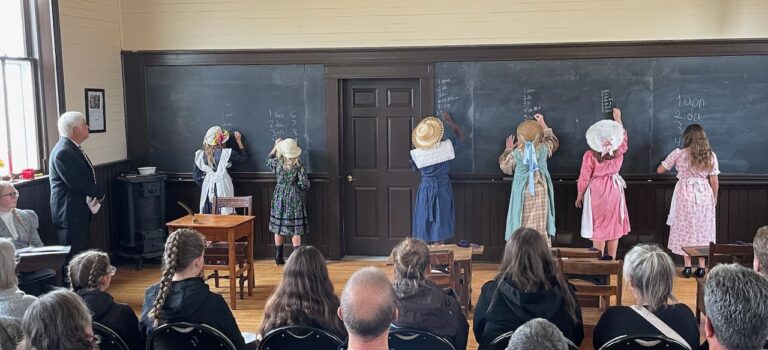
The Glencoe & District Historical Society was honoured to sponsor and support June Journey / Turas an Ògmhìos, a beautifully crafted Gaelic play written by Trevor Aitkens and hosted at the historic Tait’s Corners Schoolhouse. Over three sold-out performances on November 15–16, 2025, audiences filled the lovingly restored 1910 one-room school to experience a deeply moving, often humorous, always heartfelt return to the early school days of our region.
A Cast of 18 Bringing 1910 Back to Life
The production featured a remarkable cast of 18 local actors, intergenerational in age and representing families from across Southwest Middlesex and Strathroy-Caradoc. Their portrayals of teachers, students, elders, and neighbours transported audiences directly into a 1910 classroom at the very moment when Scots Gaelic—the language of their parents and grandparents—was slipping out of daily use.
The cast brought warmth, laughter, tenderness, and occasional heartbreak to the stage. Audience members noted that the play felt “like watching our great-grandparents speak again.”
The cast takes a bow. the students earned a certificate for their commitment to learning Gaelic and their lines.
The Glencoe area was settled predominately by Scottish immigrants many of whom spoke Gaelic.
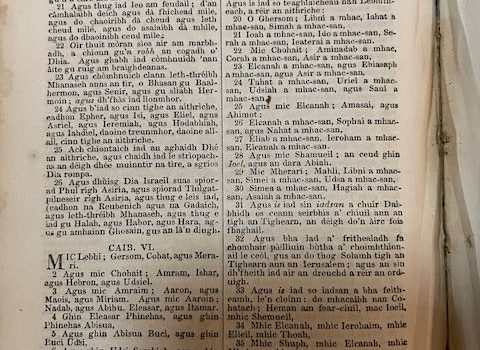
Duncan Mitchell (1838-unknown) from Metcalfe Township lived on the South 1/2 of Lot 18, Conc 13. He had this book of 41 Gaelic poems published localy in Rodney, Ontario in 1887. This book was generously donated to the Historical Society from the McAlpine family in 1986, and several poems were translated by Donald Campbell in 1999.
D. Campbell included notes with the translation explaining that most Gaelic speakers did not learn to read and write from formal education, and that to a modern reader his spelling is very poor. He surmises that Duncan was likely quite a fluent speaker who wrote in Gaelic using what he had learned from personal study and practice. Campbell also states that he clearly used a regional dialect of Gaelic and that he was writing according to his accent, which was common.
Druchd Na Beinne (Original Gaelic Text) Druchd na beinne, druchd na beinne, Druchd na beinne, o anail Chriosd, Druchd na beinnes’s Dia bhi lienne ‘N am na gainne’s gus a chtioch.
Druchd na beinne, gu ar comhdach, Air an lon anar bhios sin sgith; druchd na beinne bheiradh beos dhuinn Air an rod san tsaoghal shios.
Druchd na beinne ann’s an fhasach, Gu ar sasachadh gu sior: Leis an dochas chaoidh nach basaich; Ach gu brath a mhareas fior.
Druchd na beinne ‘n am an earraich, Gu ar tarruinn dhionnsuidh Chriosd Druchd na beinne tha toirt barrachd: Bheir nach fannaich sin gu sior.
Druchd na beinne tha cho beodhach, Air na rosaibh sruthadh sios; ‘S leam bu tatneach e bhi dortadh; Air gach neonnan buidhe blion.
Druchd na beinne ‘n am an t’samhraidh, ‘S e a b’ansuidh lainn gu fior; Gu ar cumail dlu r’ar n’annsachd: ‘S tiormachd samhraidh orn’ a crion.
Druchd na beinne ‘n am an fhaoghair, Gu ar cumail dlu ri Criosd; Gu ar neartacha ‘S g’ar cobhair: Ann’s gach obair gus a chrioch.
Druchd na beinne’n am a gheamhraidh, ‘N nar bhios teanndtachd air tir; Druchd na beinne chum na cranndachd: Chuir a dh’ anntaobh chaoidh gu sior.
Druchd na beinne ann’s an t’siorruitrheachd, ‘S mi nach iarradh uaith gu fior; Ach bhi’m shuidhe’n sgail na diadhachd: ‘N glachdadh Chriosd gu suthinn sior.
The Dew of the Mountain (English Translation) The dew of the mount, the dew of the mount, The dew of the mount from the breath of Christ, The dew of the mount God being with us In the time of famine, to the end.
The dew of the mount, to cover us, on the morass when we are tired; dew of the mount that would enliven us on the road in the earth below.
Dew of the mount in the wilderness, To give us satisfaction never ending: with the hope that will never die; But forever will last true.
Dew of the mount in the spring time, Drawing us toward Christ Dew of the mountain that surpasses: Enabling that we shall not faint ever.
Dew of the mount that is so enlivening, On the roses dripping down; With me would be desirable to be pouring; On each small wilted yellow flower.
Dew of the mount during summer time, It would be preferable to us; to keep us close to our attachment: while drought of summer withers us.
Dew of the mount in time of autumn, To keep us close to Christ; Strengthening us, relieving us: in every toil to the end.
Dew of the mount in time of winter, When the land is paralyzed; Dew of the mount to put anger: To one side always and forever.
Dew of the mount in eternity truly, I would not desire to be without; But that I’d be sitting in the shadow of God: in the everlasting embrace of Christ.
Known locally as the “Mush Hole,” the Mohawk Institute in Brantford, Ont. was Canada’s oldest and longest-running residential school. But on September 30, 2025, it officially became an interpretive historic site. On that solemn day, what was once a place of suffering, erasure and intergenerational trauma was reborn as a museum, teaching site—and a space for truth-telling, remembrance and hope.
The transformation was decades in the making, built on persistent activism, deep community engagement, archival research, restoration efforts and, above all, the resolve of survivors and Indigenous leadership that this history not be buried.
Behind the Bricks: A New Chapter
At the London Museum on September 25, Mary Simpson attended the launch of Behind the Bricks: The Life and Times of the Mohawk Institute. Edited by Richard W. “Rick” Hill Sr., Alison Norman, Thomas Peace and Jennifer Pettit, Behind the Bricks draws together Indigenous and settler historians, community voices, archival researchers, archaeologists and survivors to reconstruct the layered history behind the walls of the institute. Another launch event was held by the Ontario Historical Society a couple nights later.
The book begins by tracing the school’s founding and historical context, before delving into the its architecture and physical spaces, the curriculum and daily regimes imposed on children, religious and governmental oversight, student resistance, and the long process of commemoration and preservation. To close, Behind the Bricks allows survivor voices to speak directly, offering their unique perspectives of lived experience.
The editors have emphasized that the Mohawk Institute was not an isolated institution—it was in many ways a model or prototype for national residential school policy. The takeaway: What can this case teach us about the wider system of Indigenous schooling and control in Canada? How did notions of “civilization,” assimilation and authority operate in this place? How do we reckon with the spaces—the bricks, corridors and dormitories—that bore witness to so much pain? Behind the Bricks does not offer easy answers, but rather invites readers into the difficult task of listening, digging and reflecting.
There is never a doubt that a soldier marching obediently into a volley of musket fire is a hero. An army surgeon, his white apron stained with blood, working countless hours in the heat to save whomever he can, is also a hero. What of Generals, Lieutenants, and Captains who give orders, strategize, and feel the weight of entire armies on their shoulders as they command men to give everything to a cause? Surely, they are heroes as well. Historically, it seems easy to list the heroes of war, but it is rare that ordinary women and children are included on these lists. Today, I invite you to consider those left behind. They are not left behind by choice or lack of courage. Not because they didn’t feel the pull of the cause as deeply and passionately as their male counterparts. They were left behind, in the shadows, to do what women have always done: endure the hardships and try and prosper, all while maintaining their family’s wellbeing.
“Soldiers on a March.” The Army Children Archive (TACA), 14 Jan. 1884, www.archhistory.co.uk/taca/move.html. Accessed 14 Aug. 2025.
Contributions by Brian Huis and Gregory Childs. Edited by Mary Simpson.
On Sunday, July 27, 2025, the Simpson Cemetery in Southwest Middlesex came alive with memory, history, and community spirit. Over 50 descendants, neighbours, and friends gathered under the shade of the massive White Oak “heritage tree” for the annual cemetery memorial hosted by the Glencoe & District Historical Society (GDHS). This year a group of Simpson descendants, Micheline Champagne-Johnston, Wanda Simpson, Wendy Bestward, Jan Simpson, Dennis Simpson, Mary Simpson, and Brian Huis, joined in to give the event an interesting twist.
Cemeteries, particularly in rural Ontario, have long been places of both remembrance and reflection. Their park-like settings provide green space, cultural continuity, and a sense of belonging. This year’s memorial carried on the tradition of visiting and honouring one local cemetery each year.
Cemeteries are not only about the past; they are living classrooms and gathering spaces that remind us of who we are and the legacies we carry forward. – Brian Huis
Honouring Nicholas Bodine, War of 1812 Veteran
The central feature of the 2025 memorial was the recognition of Private Nicholas Bodine (1788–1885), a War of 1812 veteran buried in Simpson Cemetery. Bodine served in the 2nd Company, 1st Regiment of the Norfolk Militia and fought at the Battle of Lundy’s Lane on July 25, 1814—one of the war’s bloodiest encounters.
Nicholas’ service with the Norfolk Militia is perpetuated by the current Reserve Army Regiment, The 56th Field Artillery Regiment of the Royal Canadian Regiment of Artillery (56 FD), headquartered in Brantford. The Government of Canada awarded several War 1812-15 battle honours: ‘Detroit’, ‘Niagara’, ‘Queenston Heights’, ‘Defence of Canada 1812-15’, some of which, if not all were likely fought by Nicholas. The Norfolk Militia was also involved with the skirmish at the McCrae House near Chatham.
Born in Pennsylvania, Bodine came to Upper Canada in 1811, married Charlotte Sovereign, and farmed 50 acres in Mosa Township. His long life of 97 years was remembered in the Glencoe Transcript obituary of 1885, which praised his loyalty, faith, and wide respect in the community.
Glenn Stott and son, Brad Stott, stand attention to honour Nicholas Bodine, September 27, 2025Read more →
The UTMRS— the Royal Scots —are more than skilled re-enactors; they are devoted stewards of local memory and dedicated community builders. Under the leadership of committed champions like Glenn Stott, they have brought the history of the Battle of the Longwoods to life for countless residents and visitors alike.
The Longwoods Memorial Service, held each March, is a vivid example of their impact. For decades, the story of the March 4th, 1814 skirmish was largely forgotten. In the 1980s, when my mother, Betty Simpson, noticed a solitary wreath placed at the federal monument near our family home, she discovered it was the Royal Scots who had revived this commemoration. Their dedication inspired local neighbours and organizations—including our Historical Society—to get involved and ensure the memory of those who fought and fell is never lost again.
The Royal Scots’ efforts extend beyond a single memorial service. They have taken on the ambitious Longwoods Heritage Weekend, an undertaking that draws families, students, and history enthusiasts from far and wide. Through authentic re-enactments, educational demonstrations, and engaging storytelling, they make our shared past accessible and meaningful for new generations.
Moreover, the UTMRS’s leadership and volunteer spirit have rippled outward. Champions like Glenn Stott were early supporters of the Canada Barn Quilt Trails project—encouraging community heritage work far beyond the battlefield. Their members give countless hours in costume and behind the scenes, sharing history with honesty, passion, and respect for the land and peoples connected to these stories.
Their work has even inspired film. The 2017 documentary by Barbara Urbach and Crocodile Productions is a testament to how the UTMRS bring history alive in both intimate, human ways and grand, dramatic moments on our historic landscapes.
In every sense, the Upper Thames Military Re-enactment Society are true keepers of our community memory. Their dedication ensures that stories like Lieutenant Patrick Graeme’s sacrifice—and the broader heritage of the War of 1812 in our region—continue to inspire reflection and understanding.
For these reasons, the Glencoe & District Historical Society wholeheartedly endorses the Upper Thames Military Re-enactment Society for the Governor General’s History Award. They richly deserve this recognition for their outstanding contribution to community history and heritage education.
There is so much more we could add. Please do not hesitate to reach out to us to learn more about their wonderful community work. It’s so much fun to work with them – they never say ‘no’ when we ask for a re-enactor to attend an event – no matter how small or modest the event is.
Normally, if you want to see the pioneer buildings constructed by our ancestors, you have to visit a museum like Fanshawe Pioneer Village. That’s because most of our early buildings were torn down and replaced with larger, grander ones as soon as it was practical to do so. If not demolished, the earliest buildings were usually modernized to include electricity, plumbing, openable windows, and insulation. Nobody likes privations.
That’s why it’s fascinating to enter one of those rare pioneer structures that’s almost completely unchanged. I’m talking about St. Mary’s, Napier...
It was in the year 1839 that John Strachan became the first Bishop of Toronto. When he received this appointment, his diocese covered the land area now known as Southern Ontario.
The Rev John Gunne was licensed ‘To perform the office of Travelling Missionary’ by the Bishop, for the Townships of Zone, Euphemia, Brooke, Ekfrid and Mosa on June 30, 1845. On one Sunday of each month he would ride his horse from Zone Mills (Florence) which was his headquarters, to hold services in Wardsville, likely in private homes until a church building was erected.
The first official parish to be formed was Wardsville, Glencoe and Newbury, also in 1845. About the same time, land was given to the Church of England, for the purposes of a church building, by Dr. Abraham Francis. (This land, 102 acres, was on the south Part of Lot 20, Range one North of the Longwoods Road.) A parsonage was subsequently built on this property but the year is not known.
Lots 18 and 19, south of Church Street, were obtained by the Church Society of the Diocese of Toronto by a Bargain and Sale agreement with William Hatelie, et al, on August 22, 1849. This was a year or two after a wooden framed church building had already been constructed on the lot. This is known from a letter penned by Bishop Strachan on May 8, 1848, to Hatelie and the Churchwardens of the Church of Wardsville. He wrote, gentlemen: I have the honour to acknowledge your Memorial of the 2nd instant, in which you state that you have erected a church at Wardsville, Township of Mosa at considerable expense, but that since the erection of said building, you have only had divine service in it every third Sunday. This building served a congregation of approx. 150 members until the very early 1870s when it fell into disrepair.
Published in the April 2025 issue of the Middlesex Banner.
Orval Shaw, a name that once echoed through over 40 cities, towns and countryside of Ontario, was more than just a petty criminal. He was a symbol of defiance, a master of evasion, and a figure who captured the public’s imagination. I have drawn his story from historical accounts and newspaper reports, revealing the life of the man known as the “Skunk’s Misery Bandit.”
I first found out about Orval while researching other local history topics in the area of Hespeler, Ontario where I lived. During my research Orval’s name turned up several times as he was in Guelph, Hespeler, Idylwild and Puslinch during his escapades.
I was amazed that nobody had researched his life previously. One of the main challenges was finding out more about Orval’s private life and the lack of photos of him. I was lucky to find a distant relative of Orval’s’ who supported my work.
Eventually I decided to do comprehensive research of Orval, and I am very pleased with the book that came out of that research.
Prepared by the Executive members for the members of G&DHS. For the AGM April 16, 2025.
Preserving Our Family Histories for Future Generations
Our ancestors—whether Indigenous, settler descendants, newer generations, or recent Canadians—have all contributed to the rich history of our communities. Each of us carries important stories that deserve to be told. Historians seek the truth, striving to understand what really happened and how people have worked together over time. We share a common past, woven together through generations. Consider this: each of us has two grandmothers, four great-grandmothers, eight great-great-grandmothers, and so on—each with their own unique stories waiting to be remembered.
Every family needs both storytellers and story keepers. The Glencoe & District Historical Society encourages families to record their histories—write down stories, label the backs of photographs, and document the details that future generations will cherish.
Some families are fortunate to collaborate with authors like CJ Frederick, who transform family histories into engaging historical novels. Others use platforms like Remento or StoryWorth to compile family memories into beautifully bound books that can be passed down for generations. Online genealogy tools such as Ancestry.ca have also made it easier than ever to trace our roots.
Many families bring their archives and precious artifacts to the Historical Society for safekeeping. In today’s digital world, we recognize what a treasure trove these collections are. While digitization allows for easy sharing, it does not guarantee long-term preservation. Whether in digital or physical form, historical records are always at risk. By working together to protect and document our shared past, we ensure that future generations will have access to the rich stories that shape our community.
These are our aims for 2024/2026:
Connect with membership and build close, working relationships with all our local groups, our regional heritage groups, and the elected reps and staff people of Southwest Middlesex and County of Middlesex.
Ramp up our outreach and channels. Mobilize an IT circle to support improved communication and decision-making.
Digitize and record our stories, curate, preserve, upload, and share. Figure out better platforms for working together. Facebook groups don’t cut it.
Learn the tools offered by dynamic governance, and the flourishing business canvas
Bring our elders and youth together. Tell all the stories. 10,000 years of local history. Place making.
Build a cultural network to link history with tourism. Nurture and support the arts in heritage and cultural communities.
Lead the interactive Barn Quilt Trail project, which features an alliance of four organizations plus FedDev Government of Canada, the funder. Link our cultural assets to local tourism strategies and investments. Work with Middlesex county tourism.
Advocate for county archives. Interpret history along the Thames river Watershed arts corridor
Invite skilled local people and support their history passions. Build teams around peoples’ interest. Assign domains. Delegate authority.
Update and revise our bylaws. Build a closer working relationship with the Ontario Historical Society.
Build out our organizational structure. We have a great foundation in our bylaws featuring managers. Build a circular hierarchy to support workers, facilitators, leaders, and admin support.
Engage the branding dream team to do an agile branding process for G&DHS, the interactive Barn Quilt Trail, and our various groups and projects that need a brand
Figure out how to tell our amazing stories, make sure they are preserved and interpret the amazing history of Ontario Southwest, that we want to share with family, friends, community, travelers, guests, youth, new, Canadians, refugees, children, all of the people that make up our Rural society people.
On April 5, 2025, Carrie Jeffery conducted a workshop on capturing oral histories. We had members of our community, visiting members of other heritage groups, and members of our own historical society in attendance. The engaging and interactive talk was followed by an informative presentation that showcased the various aspects of modern record-keeping that are now accessible for ancestral storytelling. Left to right: Donna Lynam, David Campbell, Carrie Jeffery, Susan McWilliam. Mary Simpson, the president of our historical society, also presented.
L-R: Donna Lynam, David Campbell, Carrie Jeffery, Susan McWilliam.
Imagine for a moment the mystery of your history.
By Carrie Jeffery. Published in the March 2025 issue of Middlesex Banner’s ‘Archive Alley’
Personal storytelling can be both fun and provide new perspectives on how we came to be. These stories can challenge our understanding of the past and give a voice to people who are often left out of traditional historical records: the everyday people that played a role not just in our own lives but also in the communities we live in that they helped shape.
With the help of today’s technology, we can translate an afternoon visit with our elders into a published collection of stories that honour their lives and their place in history.
They get to relive their younger days while we either transcribe them ourselves or even utilize voice memo software to transcribe them for us automatically!
In doing this now while this aging generation is still here, we are able to ask questions like “What year would that have been?” and “Why did you do things that way?” before it’s too late. We can learn about the passions and values they may have held that were similar to our own and what shaped their career or other interests. We can witness and capture the changes that have occurred in just one or two generations.
Stories about the Kilmartin community who established Burns Presbyterian Church in the hills of North Mosa.
Jennifer Grainger reporting from Mosa Township: On Sunday, March 30 at 2:00 pm I attended a rare event, an historic church celebrating an anniversary. At a time when many rural churches are closing, it’s a pleasure to see one commemorating the 190th anniversary of the congregation.
The March 30th event wasn’t an actual church service, mind you, but a celebration of the surrounding community and the role Burns Presbyterian played in it. The occasion, more historical than religious, was entitled “A Stroll Through Time.” Actors portrayed fictional, but plausible, characters from the church’s past, including an early Scottish settler, a later Dutch arrival, the last Precentor, a member of the women’s auxiliary, etc. Sometimes amusing and often poignant, the stories of former congregants were well written and allowed the modern audience to imagine life in Middlesex County, Ontario in the Good Old Days.
The Canadian Government created the Public Archives of Canada in 1872. In Europe, archives retained government records only with personal papers going to libraries as manuscripts. The Dominion Archivist of Canada determined that all personal records of historical and cultural value should be collected as well as government records, with both being stored in the Public Archives. This Total Archives approach was a departure from other countries and is known as a Canadian contribution to archival theory and practice. Over time, multi-media records were added to collections in addition to traditional paper records. Many other national, regional archival programmes, as well as those in municipalities or universities, have adapted the total archives concept. The area municipal and university archives adopt this strategy as does the Provincial Archives of Ontario.
The benefit of this approach is that archives hold records for researchers about family history such as searching houses, land or any other item of interest. The government records also provide some of the information required in these searches. Having municipal records available – if they are open to the public – are advantageous to researchers and also to Municipal Clerks or staff, who sometimes are contacted by genealogists with family history requests. Municipal staff benefit by being able to transfer those questions to properly-trained staff who have access to, not only government records, but also personal papers and other resources. This removes the need for municipal staff to answer questions in an already busy day and provides researchers with a one-stop location. Genealogists account for over 40% of archives’ users who travel to areas specifically to visit Archives. While there, their tourist dollars support restaurants, hotels, local merchants and other local amenities.
An Archives is a program, not a project. Continued funding and municipal support are required to ensure the success of the Middlesex County Archives.
Written by the Committee to Establish a Middlesex County Archives, July 2021
Marie Williams: A large crowd packed into the Glencoe and District Historical Society Archives on Wednesday evening, March 12, 2025. Following announcements, a brief membership report and some unfortunate technical difficulties, Society president Mary Simpson introduced the evening’s guest speaker, Glencoe native and author Daniel Perry.
Perry spoke about his newest work, a non-fiction memoir focussed on his own research into the life of Thomas Gardiner and Gardiner’s connection to the hamlet of Cashmere in the former Township of Mosa.
Born in 1774 in Ireland, Singleton Gardiner sailed for New York State in 1804. He moved to the Talbot Settlement in 1816 and to Mosa Township in 1825. He built a mill in 1834 on the site of what became Cashmere.
His brother Thomas Gardiner, born in Ireland in 1767, sailed for New York in 1804 and arrived in Upper Canada in 1807. Perry outlined charges laid against Thomas Gardiner which were subsequently dismissed, the connections between Thomas Gardiner and John Parker Jr., tales from the War of 1812, his years serving as a teacher, disputes over land, family friction and his pleas for help as an aging man.
Singleton Gardiner was the first person buried at the Cashmere Cemetery in 1834 but there is no stone marking what could be the grave of Thomas Gardiner.
CBC Radio ‘Ideas’: Until the past few years, the story of the Chatham Coloured All-Stars was not widely known outside their hometown. But thanks to the Chatham-Kent Black Historical Society and the University of Windsor’s Centre for Digital Scholarship, with the help of the Harding family, the legacy of the Chatham Coloured All-Stars lives on. They reconstructed the 1934 season, and the team’s history through newspaper clippings, scrapbooks and interviews with the players and their descendants.
Everyone’s efforts led to the Chatham Coloured All-Stars being inducted into the Canadian Sports Hall of Fame in 2022 — 88 years after their 1934 season opener.
Listen to this hourlong podcast by CBC Ideas. Link here.
Everybody knew, in the neighborhood, all the men playing on the team…. And they played a really competitive, athletic, exciting kind of baseball.
Five months after their opener in October 1934, the Chatham Coloured All-Stars became the first all-Black team to win the Ontario Baseball Association championships, then known as the Ontario Baseball Amateur Association.
The story I am about to write happened in 1954 at the humble beginning of Hollandia Bakery, Wm. Bruinink & Sons, the start of what is now known as Hollandia Bakeries Ltd. The village of Mt. Brydges had a population of approximately 1200 souls, at least that is my recollection. Fire hydrants were a square hole of 24” x 24” approx. 6 feet deep. The water supply to homes was a piston pump pounding happily when it was encouraged to supply water.
The first Hollandia was located in what is now Sunshine Bakery. If one were to take down the brick wall, on the exposed wooden wall one would find the words Hollandia Bakery painted by John Kolstein. It was John who we kept busy painting our delivery vans which were later observed in the surrounding communities. The original Hollandia was known as Robinson Bakery until it was purchased by brother Henry in 1953.
Henry did the baking and I did the selling house to house in Mt. Brydges and Strathroy. Some of my customers were Northcotts, Lucas, Daucetts, Orrs and many more whose names have slipped my memory. In Strathroy one of my customers was Pastor Buursma of the CRC. It was he who put me in touch with Bill Jervis who owned the IGA store on Front Street. This store became the stepping stone to wholesale selling.
Hollandia Bakery & Sons was to be established in what was known as Gold Seal Dairy on the main street in Mt. Brydges, between Young and Regent streets. My parents Bill and Dorothy Bruinink, my brother Bill and I took up residence in the front of the dairy bar which, by the way, had gone bankrupt and we bought at a good price. In 1955 we added 75 feet to the back of the building which was to be the “enlarged” bakery. This expansion became an annual event until we reached Emerson Street. In 1961 an addition of approximately 300 feet was added to the north side of the building. In 1970 the bakery was destroyed by fire and rebuilt south of Mt. Brydges. It is difficult to imagine that 60 years have passed since Hollandia had it’s humble beginning. In 2014, Hollandia celebrated its 60th anniversary!
Going back to 1955, I was in charge of the sales organization while brother Henry and my father ran the bakery and its ever growing staff. In 1956, my brother-in-law, Joop de Voest, joined our now Hollandia Bakeries Ltd. and took on the job of Secretary-Treasurer and administrator.
I recently had a “flash back” regarding the thriftiness of being Dutch.
The Grandmothers Sugar Cookie by Hollandia Bakery & Sons, Strathroy, ON
Cookie with the Hole:
One of our most popular cookies was the sugar cookie. We were selling this item at .39 cents retail for a 13 oz. package and they “walked off the shelf”. This caught the attention of father William. He called us together and read the riot act pertaining to this cookie.
“Boys” he said, “We have to make a fundamental change to the weight of the sugar cookies. The package is simply too heavy for what we get in return. I propose that we reduce the count to 20 cookies in the roll from 24.”
My reaction was prompt – “But Dad, this would make this package a lot smaller and our sales would go down. Why not increase the selling price?” This was not a bad idea, but it would take this item out of the occasional 3/$1.00 special category. Suddenly Henry said “how about if we put a hole in each cookie? This will bring down the weight.”
Voilá – The Grandmothers Sugar Cookie was born and became our biggest seller. ‘The cookie with the hole’ was now a favourite with children and adults. Children enjoyed putting their finger in the hole. A contest was born – Who could keep the cookie from falling apart while eating it with their finger in the hole?!
It is amazing how the thriftiness of the Dutch could produce such an incredibly popular cookie.
As the remaining survivor of the founders of Hollandia Bakeries Ltd. and now retired and no longer involved, I am pleased to submit this brief history.
Over 60 history buffs gathered, in person and online, to listen to Doug Ferguson as he described his “Ancestral Odyssey” at the Glencoe and District Historical Society Archives on Wednesday evening, January 17, 2024. His Ferguson ancestors had left Craignish, Argyleshire for Aldborough Twp. in 1818 and then moved to northern Mosa Twp. in 1827. The McDonalds left Inverness for Quebec in 1830, before settling in Ekfrid Twp. in 1835.